

The energy you buy. The terms you sign. The price you actually pay.
Mobius advises commercial and industrial buyers on physical procurement of natural gas, diesel, and bunker fuel — analyzing supplier proposals, structuring contracts, and overseeing execution. Retainer-only, no transaction revenue, no discretion without buyer authorization.
The supplier proposal in front of you is not the price you pay.
Physical procurement decisions — index choice, basis, term length, volume flexibility, demand charges, take-or-pay provisions — drive realized cost more than the headline rate quoted on day one. Most buyers evaluate supplier proposals without an unconflicted second opinion. We provide one.
Pricing structure is the contract
A "fixed price" can mean six different things across six suppliers. Index choice, formula construction, and adjustment mechanics determine what you actually pay. We translate proposals into apples-to-apples economics before you sign.
Suppliers are not advisors
The counterparty quoting your supply contract is the same counterparty whose margin lives inside it. Their proposal is a sales document, not a recommendation. Treating it as the latter is the most common source of avoidable cost.
Volatility lives in the small print
Demand charges, swing provisions, force majeure language, and renewal terms produce most of the year-over-year cost variance. We surface these line items before execution, not after a surprise invoice.

What we do, by commodity.
The diagnostic framework is consistent across natural gas, diesel, and bunker. The market dynamics, contract conventions, and execution venues are not. Below is what an engagement covers in each.
Natural Gas
Pipeline gas, behind-the-meter supply, transport, and storage for industrial, utility, and data center loads.
Natural gas procurement spans index-based supply contracts, fixed-price arrangements, transport agreements with interstate pipelines, and increasingly, behind-the-meter supply for power-intensive facilities. The cost structure is rarely a single price line — it is a stack of commodity, basis, transport, storage, demand, and balancing charges.
We evaluate the full stack. Where load is large enough to justify it, we model how alternative supply structures — index choice, basis hub, term laddering — change realized cost under different forward curves. Where storage or transport capacity is contracted, we assess whether the value of optionality justifies the demand charge.
- Supply analysis
Index selection, basis evaluation, term structure, fixed vs. floating economics, supplier RFP design, and proposal comparison. - Transport & basis
Pipeline capacity assessment, basis differential analysis between supply hubs and delivery points, transport cost recovery review. - Behind-the-meter supply
Direct supply arrangements for data centers and industrial facilities co-located with generation, including reliability and curtailment terms. - Contract execution
Master agreement review, confirmation document oversight, and post-execution invoice audit against contracted terms.


Diesel
Rack pricing, bulk supply, and structured procurement for fleets, logistics operators, rail, and industrial users.
Diesel procurement covers ultra-low-sulfur diesel (ULSD) supplied via rack pickup, bulk delivery, or structured contracts indexed to OPIS, Platts, or NYMEX heating oil. Buyer exposures vary widely — a regional fleet sees a different cost structure than a national logistics operator or a Class I railroad — but the contract-level questions rhyme across them.
We assess whether the index reference reflects the buyer's actual delivery geography, whether the differential structure compensates the supplier appropriately without giving up margin, and whether volume commitments and credit terms align with operating reality. For larger buyers, we evaluate the trade-off between rack-indexed and structured supply, including fixed-price layers where the underlying market supports them.
- Index & differential
OPIS / Platts / NYMEX reference selection, geographic differential evaluation, freight and delivery cost allocation. - Volume & term structure
Take-or-pay analysis, volume flexibility provisions, term length vs. spot exposure trade-off, supplier concentration risk. - Fixed-price layering
Where supported by load and credit, structured fixed-price layers to reduce realized cost variance against budget. - Invoice audit
Ongoing reconciliation of supplier invoices against contracted index, differential, and adjustment mechanics.
Bunker Fuel
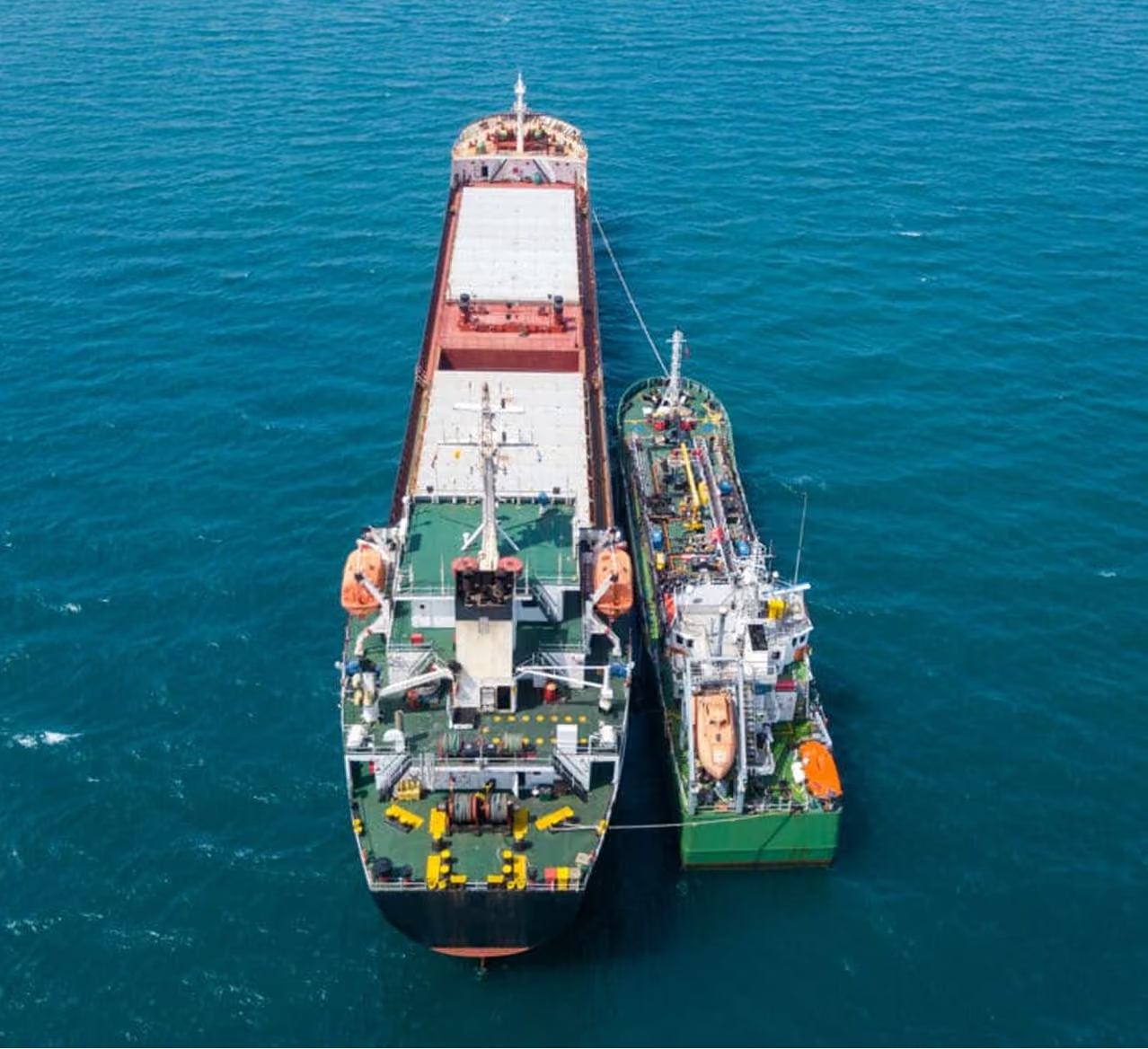
Marine fuel — VLSFO, MGO, and LNG bunker — for shipping operators, charterers, and port-call procurement.
Bunker procurement is one of the more opaque physical fuel markets a commercial buyer engages with. Pricing varies materially by port, supplier, fuel grade, and quantity. Quality disputes, sulfur compliance under IMO 2020, and quantity discrepancies on delivery are routine. The procurement function sits at the intersection of operations, commercial chartering, and risk.
We work with shipping operators and charterers on bunker procurement strategy, port-call execution, and supplier selection across VLSFO (very low sulfur fuel oil), MGO (marine gas oil), and emerging LNG bunker supply. The objective is consistent: a procurement decision driven by analysis, not by the supplier closest to the next port.
- Port & supplier selection
Port-level price benchmarking, supplier reliability and quality assessment, alternative-port economics under voyage flexibility. - Fuel grade & compliance
VLSFO, MGO, LNG bunker evaluation against route, vessel, and IMO sulfur compliance requirements. - Contract & spot mix
Trade-off analysis between term contracts and spot procurement, structured supply at high-volume ports. - Delivery oversight
Bunker delivery note review, quantity and quality dispute support, post-delivery cost reconciliation.
Intentionally independent
Mobius has operated as an independent commodity risk advisor since 2002.
Our compensation comes from the buyer we serve — never from a supplier, never from a counterparty, never from a transaction.
Unconflicted by design
Cross-commodity expertise
Analytical depth
Authority stays with the buyer
A diagnostic process, not a product pitch.
Exposure mapping
We build a current-state view of physical volume, cost structure, contract terms, and counterparty mix. The output is a single document that names every cost line and every key term.
Market & contract analysis
We benchmark current terms against market alternatives, identify provisions that drive cost variance, and quantify the economic difference between structures.
Strategy & execution
We design supplier RFPs, evaluate proposals on a like-for-like basis, and support contract execution. No discretion is exercised without buyer authorization.
Ongoing oversight
Post-execution, we reconcile invoices against contracted terms, surface anomalies, and provide quarterly reviews of cost performance against benchmark.