
August 28, 2026
Quick answer: The 45Z Clean Fuel Production Credit is a U.S. producer credit that, beginning in 2025, replaced prior blender-based incentives and ties credit value to a fuel's carbon intensity (CI) score. For RNG, lower-CI feedstocks earn more per unit—shifting value toward producers and making CI scoring, not just gas price, a core driver of project economics and hedging risk. [confirm current rules]
What changed with the 45Z credit?
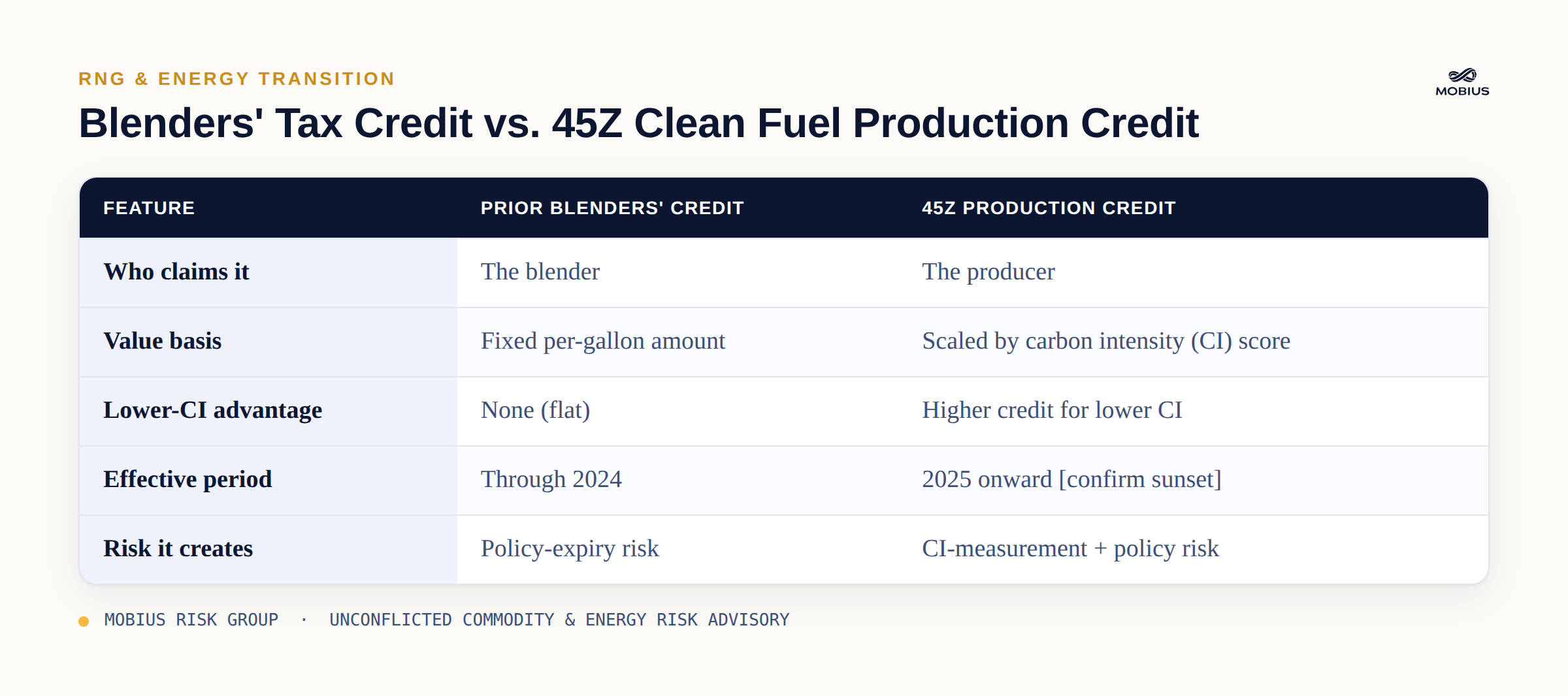
For years, clean-fuel incentives such as the blenders' tax credit delivered a flat, per-gallon value to the party blending the fuel. Starting in 2025, the 45Z Clean Fuel Production Credit restructured that support: it moves the benefit to the producer and scales the credit by the fuel's carbon intensity (CI) score. The cleaner the fuel on a lifecycle basis, the larger the credit per unit of energy. [confirm exact per-unit values and eligibility]
For renewable natural gas, this is a structural shift. RNG from very low- or negative-CI feedstocks—such as dairy or landfill methane capture—can qualify for materially higher credit value than higher-CI pathways.
Blenders' Tax Credit vs. 45Z Clean Fuel Production Credit
How does 45Z affect RNG project economics?
Under a CI-scaled credit, the carbon-intensity score becomes a revenue variable, sitting alongside the commodity gas price and environmental-attribute markets (such as RINs and LCFS credits). Two otherwise identical RNG volumes can now earn different credit values purely on feedstock and process CI.
That makes project underwriting more complex. A CFO evaluating an RNG offtake or investment must model not only gas and credit prices but also the durability of the project's CI score and the policy horizon of the credit itself.
What new risks does 45Z introduce for RNG?
Three risks stand out. First, CI-measurement risk: methodology changes or verification outcomes can move the credit a project actually captures. Second, policy risk: the credit's value and horizon depend on rules that can change. Third, stacking risk: RNG revenue often layers 45Z with RINs and LCFS, and the interaction between programs affects net economics.
These risks are harder to hedge with a single instrument than commodity price alone, which is why RNG hedging increasingly means managing a portfolio of exposures rather than one price.
How can producers and buyers manage 45Z-related exposure?
Because part of RNG value now rides on CI scoring and policy, the hedgeable and non-hedgeable pieces need to be separated. The commodity leg can be managed with conventional gas hedges; environmental-attribute value can be partially locked through offtake terms and credit sales. Mobius helps clients quantify which portion of an RNG revenue stack is market-hedgeable versus policy-dependent, so hedging and capital decisions rest on the exposure that can actually be transferred.
Related reading
Frequently asked questions
Does 45Z replace the blenders' tax credit?
Yes—beginning in 2025, the 45Z Clean Fuel Production Credit replaced prior blender-based incentives with a producer credit scaled by carbon intensity. [confirm exact transition details]
Why does carbon intensity matter under 45Z?
Because the credit value scales with the fuel's CI score: lower-CI fuels earn a larger credit per unit. For RNG, feedstock and process choices that lower CI directly increase potential credit revenue.
Can RNG still stack 45Z with RINs and LCFS?
RNG revenue commonly layers multiple programs, but the interaction affects net value and eligibility. Treat the stack as a portfolio and confirm current program rules before modeling. [confirm]
Is 45Z credit value hedgeable?
The commodity gas component is hedgeable with conventional instruments. The credit component depends on CI scoring and policy, which are managed more through contract structure and offtake terms than through market hedges.
Subscribe to receive the latest Mobius Research & updates