


September 2, 2026
Quick Answer
Spreadsheet-based commodity cash forecasting is reactive by construction: the workbook is rebuilt from settled numbers after the period closes, so treasury confirms what already happened rather than acting on what is coming. A CTRM platform holds one netted book valued against live curves, which is what makes an in-period, proactive forecast possible — and it removes the version errors and key-person risk that come with a hand-built model.
What is the difference between a CTRM platform and a spreadsheet?
A spreadsheet is a general-purpose calculator you shape into a risk model by hand. A CTRM (Commodity Trading and Risk Management) platform is purpose-built to capture trades, value positions, aggregate exposure, and report risk across commodities and counterparties in one system.
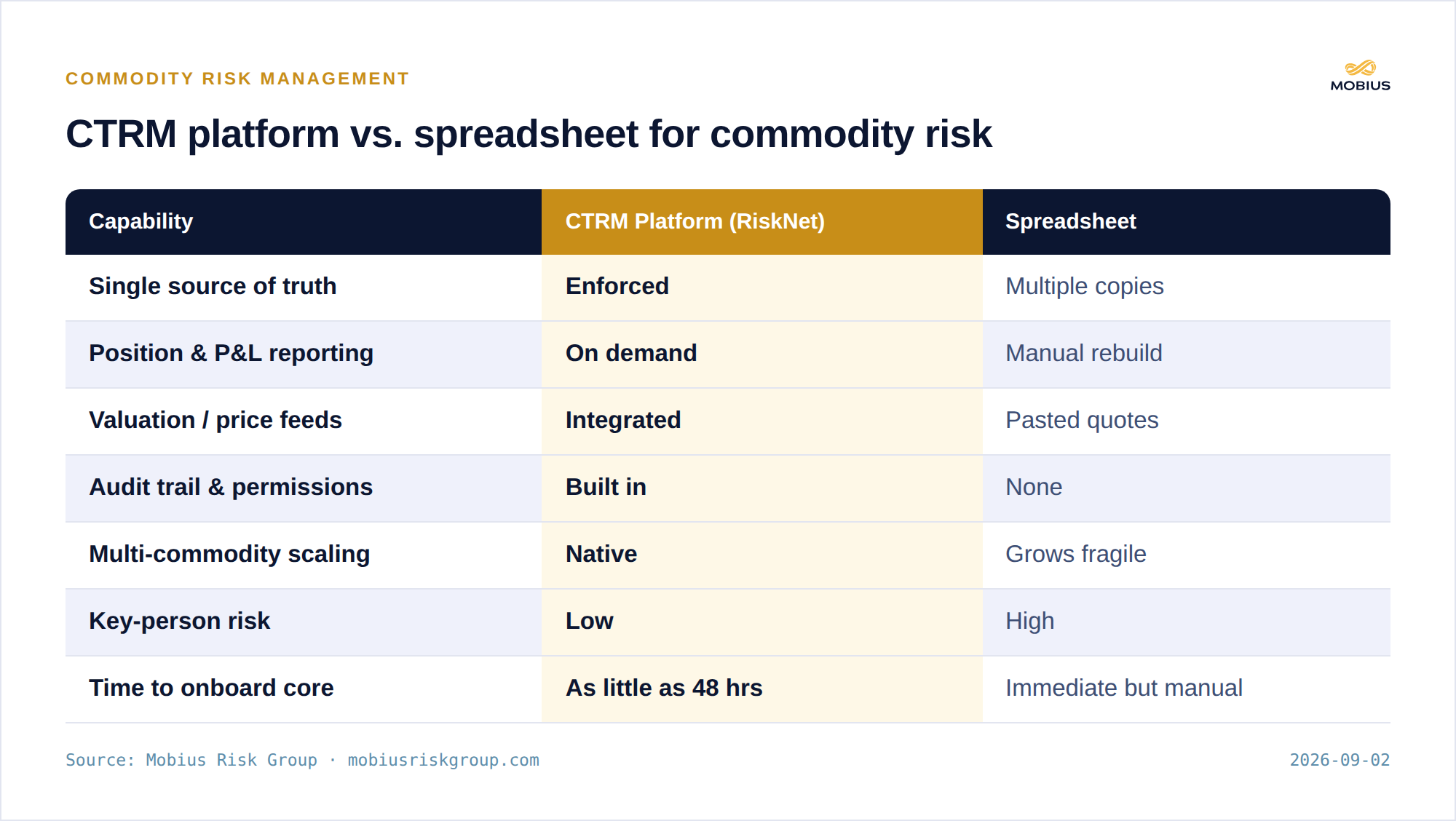
The functional gap is not formulas — it is control. A CTRM enforces one version of the book, keeps an audit trail of who changed what, values positions against managed price feeds, and produces position and risk reporting without someone rebuilding it each morning.
When do spreadsheets become a risk instead of a tool?
The warning signs are consistent: multiple copies of “the” risk file, formulas only one person understands, manual price updates, and reports that take hours to reconcile. Each of those is a place where an error can enter the book unnoticed.
The exposure compounds with scale. A single-commodity, lightly hedged book is manageable in Excel. Multi-commodity exposure, structured options, intercompany positions, and hedge-accounting requirements are where manual models start producing numbers no one can fully defend to an auditor or a board.
What makes cash forecasting proactive rather than reactive?
The difference is when the forecast is built, not how detailed it is. A reactive forecast is reconstructed from settled numbers after the period closes: invoices arrive, adjustments are applied, the treasury team works backwards to explain what happened, and the next forecast is an extrapolation of that history. A proactive forecast values open positions and expected settlements while the period is still running, so the cash view moves with the market and with operations rather than waiting on them.
The mechanism that holds commodity treasury teams in the reactive mode is prior period adjustment. Invoices diverge from expected revenue because several adjustments stack up — volume trueups, quality and index corrections, allocation and interest changes — and the difference is only resolved through forensic reconciliation weeks or months later. By the time the number is trusted, the decision, and sometimes the opportunity, has passed. That is not a discipline problem. It is a construction problem: a workbook is populated from figures that only exist after the fact, so the forecast can only ever be revised backwards.
Forecasting proactively needs four things in place, and a spreadsheet struggles with all four.
One netted book. Physical and financial positions, across commodities and entities, in a single view. If hedges live in one file and physical contracts in another, the net cash position is assembled by hand every time it is asked for — which means it is asked for less often than it should be.
Live curves. Expected settlement values have to reprice as the market moves. Pasted quotes are a snapshot; a managed price feed keeps the forecast current without a rebuild.
Expected settlement timing. Cash flow visibility is about dates as much as amounts. The forecast needs contract-level payment terms, pricing periods and settlement calendars so that working capital is projected into the right weeks rather than averaged across a month.
Margin and liquidity visibility. Initial and variation margin on exchange-traded hedges, letters of credit, and counterparty collateral all consume liquidity before any commodity moves. A forecast that ignores margin can be directionally right and still leave the treasury team short in the week that matters.
Mobius's rPnL is built for this problem specifically. It combines live market data with the portfolio to produce exposure, cash-flow forecasting and contract analysis in the period rather than after it, so reconciliation and reporting happen in real time instead of as a forensic exercise once the invoices land. In-period reconciliation is what converts a cash forecast from a record into a decision input.
What does a CTRM platform do that a spreadsheet cannot?
A CTRM centralizes trade capture so every position lives in one place, values the book against integrated price feeds rather than pasted quotes, and produces mark-to-market, P&L, and exposure reporting on demand. It maintains an audit trail, supports role-based permissions, and scales to new commodities without a rebuild.
Mobius's RiskNet platform is a CTRM built by the same team that advises on the underlying risk. Mobius is independent and unconflicted and does not take the other side of client trades. The core platform can be onboarded and ready to use in as little as 48 hours across multiple commodities; what extends a full rollout is the surrounding work — price-feed, ETRM/ERP and bank/exchange integrations, data migration, and customization — not the platform itself.
How do you know it is time to move off Excel?
A practical test: could you hand your risk workbook to a new analyst and have them produce the same numbers tomorrow without you in the room? If the answer is no, the book depends on a person rather than a system — and that is the point at which a CTRM pays for itself in reduced operational risk, not just efficiency.
The treasury version of the same test is simpler. Ask when you last knew your commodity cash position for the current period, rather than the last closed one. If the honest answer is that you find out when the invoices are reconciled, the forecast is reactive and no amount of spreadsheet discipline will change that.
Related reading
- rPnL: real-time commodity P&L and cash-flow forecasting
- CTRM software companies: a buyer's guide
- What Is a CTRM System? How the Software Works
- commodity risk management software
- How Long Does a CTRM or ETRM Implementation Take?
Frequently asked questions
What makes cash forecasting proactive rather than reactive?
Timing. A reactive forecast is rebuilt from settled numbers after the period closes, so it explains what already happened. A proactive forecast values open positions and expected settlements while the period is still running, using live curves and known settlement timing, so treasury can act on the number rather than confirm it. The practical test is whether your cash view changes when the market moves, or only when the invoices arrive.
Can you forecast commodity cash flow in a spreadsheet?
You can, but the forecast will be reactive by construction. A workbook is populated from figures that are only available after the fact, which means prior period adjustments land as surprises and the forecast is revised backwards rather than forwards. For a small, single-commodity book with simple hedges that can be acceptable. Once you carry multi-commodity exposure, margin obligations, or a lender or board that asks for a forward cash view, the manual rebuild cycle becomes the constraint.
Is a spreadsheet ever enough for commodity risk management?
For a small, single-commodity book with simple hedges, a well-built spreadsheet can be adequate. The risk grows with position count, commodity mix, and instrument complexity.
How long does it take to implement a CTRM platform?
The RiskNet core platform can be onboarded in as little as 48 hours across multiple commodities. Integrations, data migration, and customization are what extend a full rollout, not the platform itself.
What is the biggest hidden risk of running risk in Excel?
Key-person risk. When only one person understands the model and there is no audit trail, an undetected formula or version error can misstate the book without anyone catching it.
What does CTRM stand for?
Commodity Trading and Risk Management — software that captures trades, values positions, and reports exposure and P&L across commodities and counterparties in one system.
Subscribe to receive the latest Mobius Research & updates