
August 31, 2026
Quick answer
CFOs measure commodity price risk with three complementary tools: Value-at-Risk (VaR) sizes potential mark-to-market loss over a set horizon and confidence level; Cash-Flow-at-Risk (CFaR) translates price moves into budget and cash-flow impact; and stress testing shows exposure under specific scenarios. Together they answer how much is at risk, and to what.
Why do CFOs need more than one risk measure?
No single number captures commodity price risk. A trading-desk metric can look reassuring while the budget is quietly exposed, and a scenario that keeps the board up at night may never show up in a statistical average. CFOs who manage physical commodity exposure — fuel, feedstock, power, or output — generally rely on three measures that answer different questions.
What is Value-at-Risk (VaR) for commodities?
Value-at-Risk estimates the largest mark-to-market loss a position or portfolio is likely to suffer over a defined horizon at a chosen confidence level — for example, “we are 95% confident we will not lose more than X over the next 10 trading days.” It is compact and comparable across books, which is why treasuries and risk teams lean on it. Its weakness is that it says little about the rare, large move in the tail, and it is framed in market-value terms rather than cash.
What is Cash-Flow-at-Risk (CFaR)?
Cash-Flow-at-Risk reframes the same uncertainty in the currency a CFO actually manages: cash and budget. CFaR estimates how far realized cash flow could fall short of plan over a quarter or budget year given modeled price moves. For a producer or an industrial buyer, that maps directly onto covenant headroom, capital plans, and dividends — which is why it tends to be the board-facing number. Independent analytics such as M(β)risk are built to produce it consistently.
VaR vs. CFaR vs. stress testing: which should a CFO use?
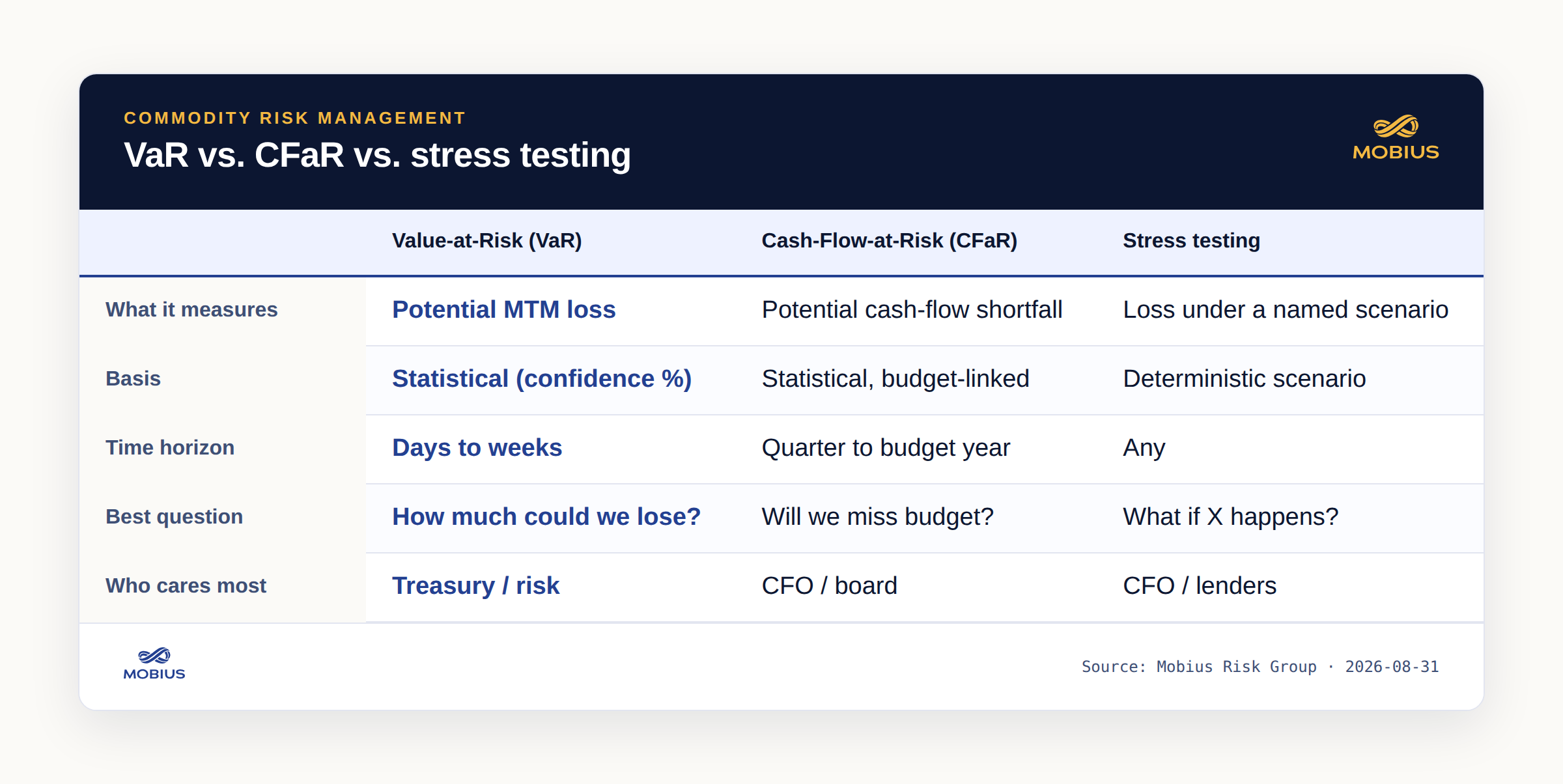
The honest answer is all three, because they answer different questions. VaR sizes short-horizon market loss; CFaR sizes budget and cash risk; stress tests pressure-test a named scenario — a hurricane-driven basis blowout, a demand shock, a counterparty failure. The table maps each to the decision it supports.
How often should you measure commodity price risk?
Market-facing measures such as VaR are typically refreshed daily or weekly; CFaR and the scenarios that feed the board are usually revisited monthly and around budgeting, financing, or major hedging decisions. The cadence matters less than consistency — the same method, run the same way, so trends are comparable over time. Firms often anchor this in a CTRM platform so the numbers are auditable rather than rebuilt each cycle.
Frequently asked questions
Is Cash-Flow-at-Risk better than Value-at-Risk?
Neither is better; they answer different questions. VaR sizes potential market-value loss over a short horizon, while CFaR sizes potential cash-flow shortfall against budget. CFOs generally want both.
Does a small company really need VaR and CFaR?
The techniques scale down. Even a single-commodity buyer benefits from translating price risk into a budget-shortfall number; the modeling can be simpler without losing the decision value.
What data do these measures require?
Accurate position and volume data, forward curves for the relevant products and locations, and volatility and correlation inputs. Data quality, not model choice, is usually the binding constraint.
How does hedging change these numbers?
Effective hedges reduce both VaR and CFaR by offsetting exposure; measuring them before and after a hedge is how a CFO shows the board what the program actually bought.
Talk to an unconflicted advisor. Mobius Risk Group has advised on physical and financial commodity risk since 2002. Request a conversation →
Subscribe to receive the latest Mobius Research & updates