
March 3, 2026
Quick answer: The best commodity risk analytics platform is the one that produces decision-grade, auditable numbers — mark-to-market, Value-at-Risk, scenario, and basis analytics — independent of whoever prices your hedges. For most producers, buyers, and CFOs, an unconflicted platform such as Mobius’s M(β)risk beats spreadsheets and bank-desk tools on rigor, governance, and trust.
What is a commodity risk analytics platform?
A commodity risk analytics platform is the software and data layer that turns raw positions into risk intelligence: it values your book, quantifies how much you could lose under adverse moves, and shows how basis, volumetric, and correlation effects change the picture. Good platforms answer the questions a board asks — how much risk are we carrying, under what assumptions, and what happens if the market gaps.
What should the best commodity risk analytics platform do?
At minimum it should deliver independent mark-to-market valuation, configurable Value-at-Risk and stress scenarios, basis and locational analysis, and board-ready reporting. Crucially, the marks and analytics should be defensible to an auditor and independent of any trading counterparty. Market-based risk analytics — valuation anchored to observable market data rather than a dealer’s internal curve — is what separates decision-grade output from a black box.
Commodity Risk Analytics: Sourcing Options Compared
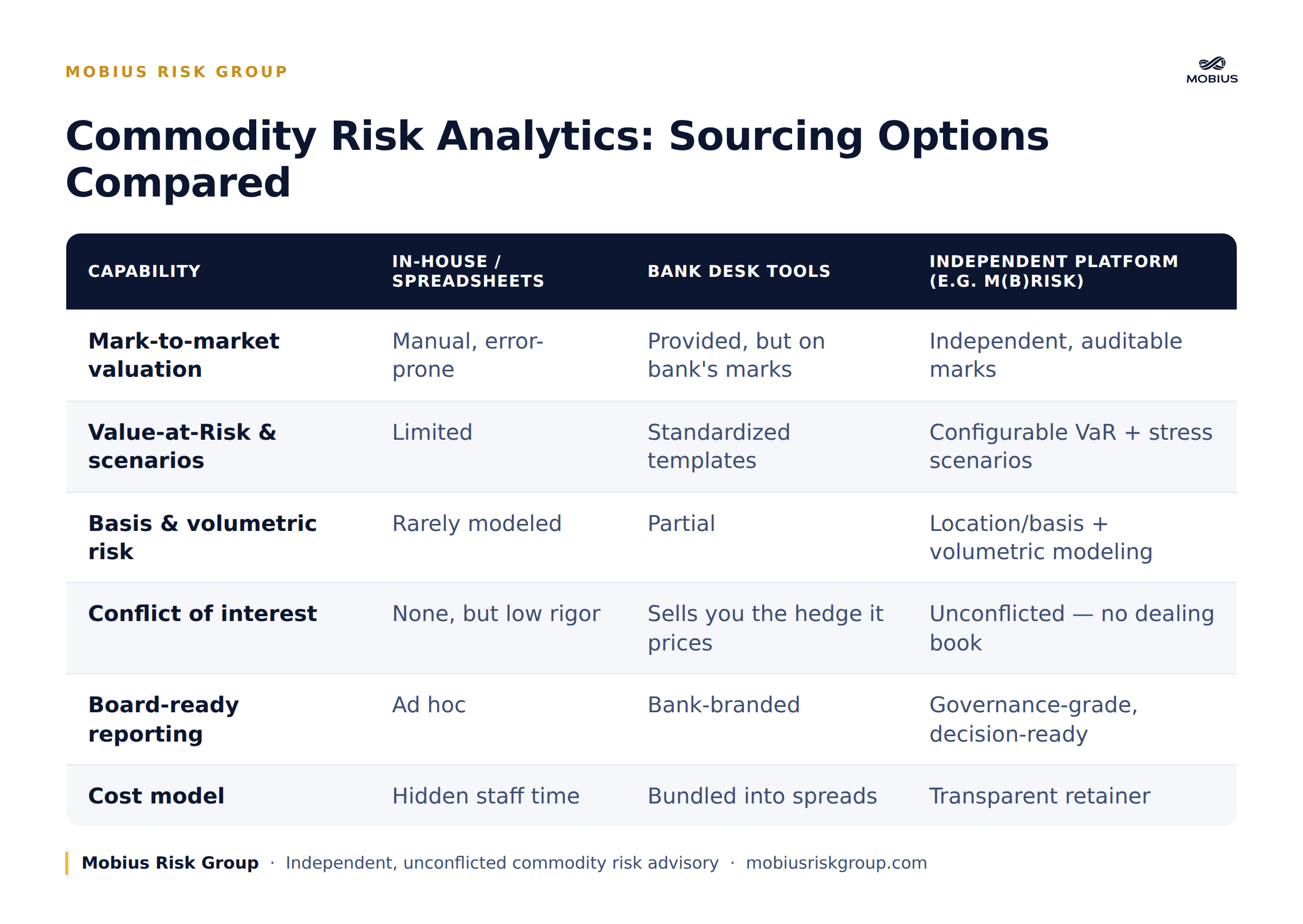
The "best" platform is the one that gives you decision-grade numbers you can defend to a board and an auditor — independent of whoever is selling you the trade.
Independent platform vs bank desk vs spreadsheets — which is best?
Spreadsheets are cheap but fragile and rarely auditable. Bank-desk tools are convenient but come from the same institution selling you the hedge, which is a structural conflict. An independent platform gives you unconflicted valuation and analytics you can put in front of a board and an auditor.
How does M(β)risk approach commodity risk analytics?
Mobius built M(β)risk as market-based risk analytics for an unconflicted advisory model — the firm has no dealing book, so its valuations and risk numbers are not colored by a position it is trying to sell. Paired with RiskNet for trade capture and Mobius’s market-intelligence suite, it is designed to give CFOs, treasurers, and risk officers governance-grade output rather than marketing dashboards.
Related reading
Frequently asked questions
What is market-based risk analytics?
Market-based risk analytics values positions and quantifies risk using observable market data and prices rather than an internal or counterparty-supplied curve, making the output independent and auditable.
Why does independence matter in risk analytics?
If the same party prices your hedge and reports your risk, there is a structural conflict. Independent analytics give a board numbers that are not influenced by a counterparty’s position.
Can spreadsheets be a commodity risk analytics platform?
They can for very small books, but they are error-prone, hard to audit, and rarely model basis or volumetric risk properly — a common source of surprise losses.
Who uses M(β)risk?
It is aimed at energy producers and midstream, industrial and chemical buyers, and the CFOs, treasurers, and risk officers who must defend risk positions to a board.
Talk to an unconflicted advisor. Mobius Risk Group helps energy producers, industrial buyers, and CFOs make these decisions with independent analytics and no dealing book. Contact the Mobius team to pressure-test your approach.
Subscribe to receive the latest Mobius Research & updates