
August 19, 2026
Quick answer: A swap locks in a fixed price and removes both downside and upside, with no upfront premium. An option sets a price ceiling or floor while preserving favorable moves, in exchange for an upfront premium. Swaps suit budget certainty; options suit protection with participation. Many hedging programs blend both across the exposure curve.
How does a commodity swap work?
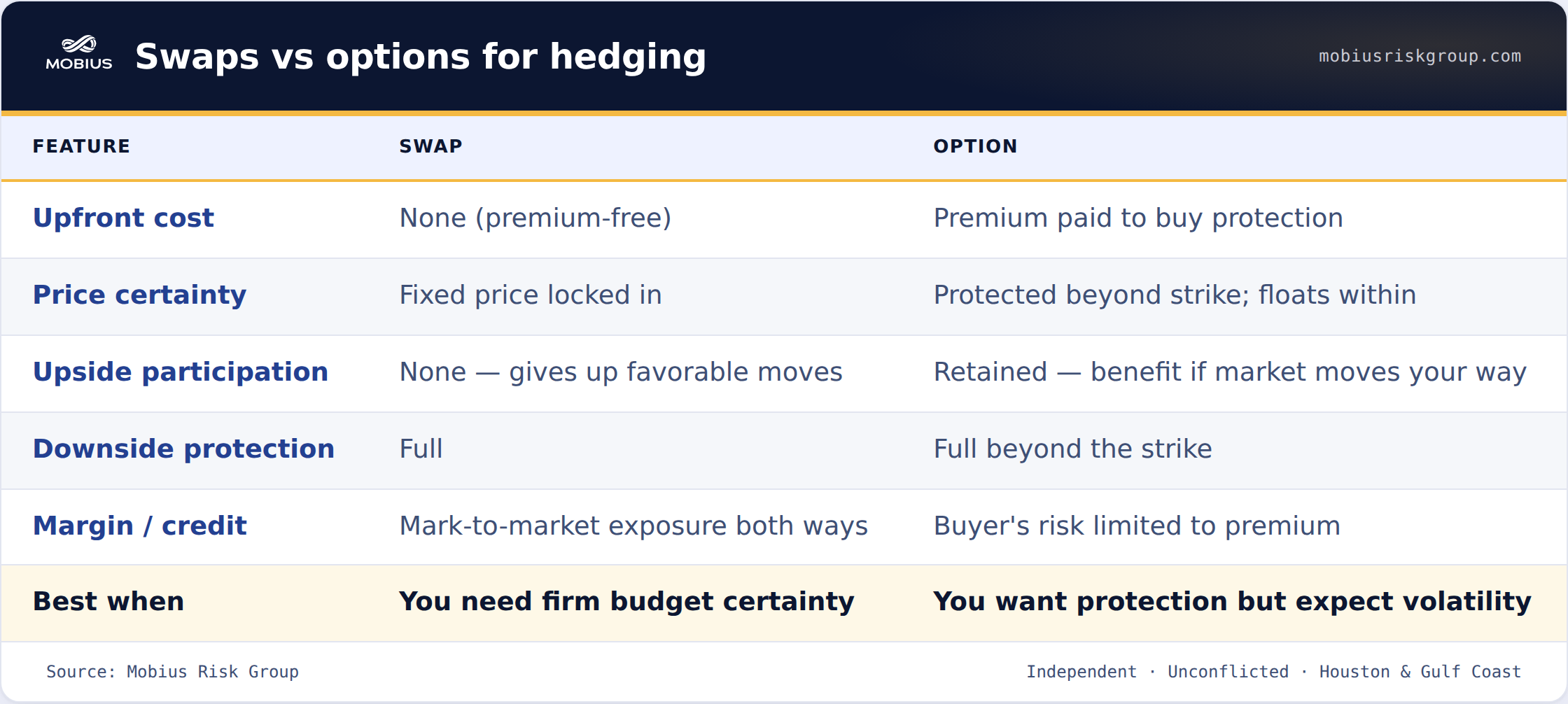
A commodity swap exchanges a floating market price for a fixed price over a set period. The hedger pays or receives the difference each settlement, locking in a known price with no upfront premium. The trade-off is symmetry: a swap removes downside risk but also gives up any favorable price move.
How does a commodity option work?
An option gives the right, not the obligation, to transact at a strike price. A cap (call) protects a buyer against rising prices; a floor (put) protects a producer against falling prices. You pay an upfront premium, and in return you keep the upside if the market moves in your favor.
Swaps vs options: which is better for hedging?
Neither is universally better — they solve different problems. Choose a swap when budget certainty is paramount and you can accept giving up upside. Choose an option when you want a hard floor or ceiling but expect volatility and want to participate in favorable moves. The right answer usually depends on your margin structure, covenant requirements, and market outlook.
When should you blend swaps and options?
Most disciplined programs use both. A collar (buy a floor, sell a cap) can deliver protection at low or zero net premium; layering swaps and options across tenors balances certainty near-term with flexibility further out. Mobius Risk Group builds these structures through its hedge strategy solutions, modeled with M(β)risk analytics before execution. For a primer on the underlying market, see our natural gas hedging guide.
Swaps vs options for hedging
Frequently asked questions
What is the difference between a swap and an option in hedging?
A swap fixes the price and eliminates upside and downside for no premium. An option provides one-directional protection (a cap or floor) for an upfront premium while keeping favorable price movement.
Are swaps cheaper than options?
Swaps have no upfront premium, so they can look cheaper, but they surrender upside. Options cost a premium but retain participation. Which is cheaper depends on which risk you are trying to keep.
Can you combine swaps and options?
Yes. Structures such as collars, participating swaps, and swaptions blend the two so a program can balance budget certainty against flexibility across the hedge curve.
How do I choose between swaps and options?
Start from your risk tolerance, budget rigidity, and market view, then size each instrument to the exposure. An unconflicted advisor like Mobius Risk Group models the payoffs before you trade.
Subscribe to receive the latest Mobius Research & updates