
August 31, 2026
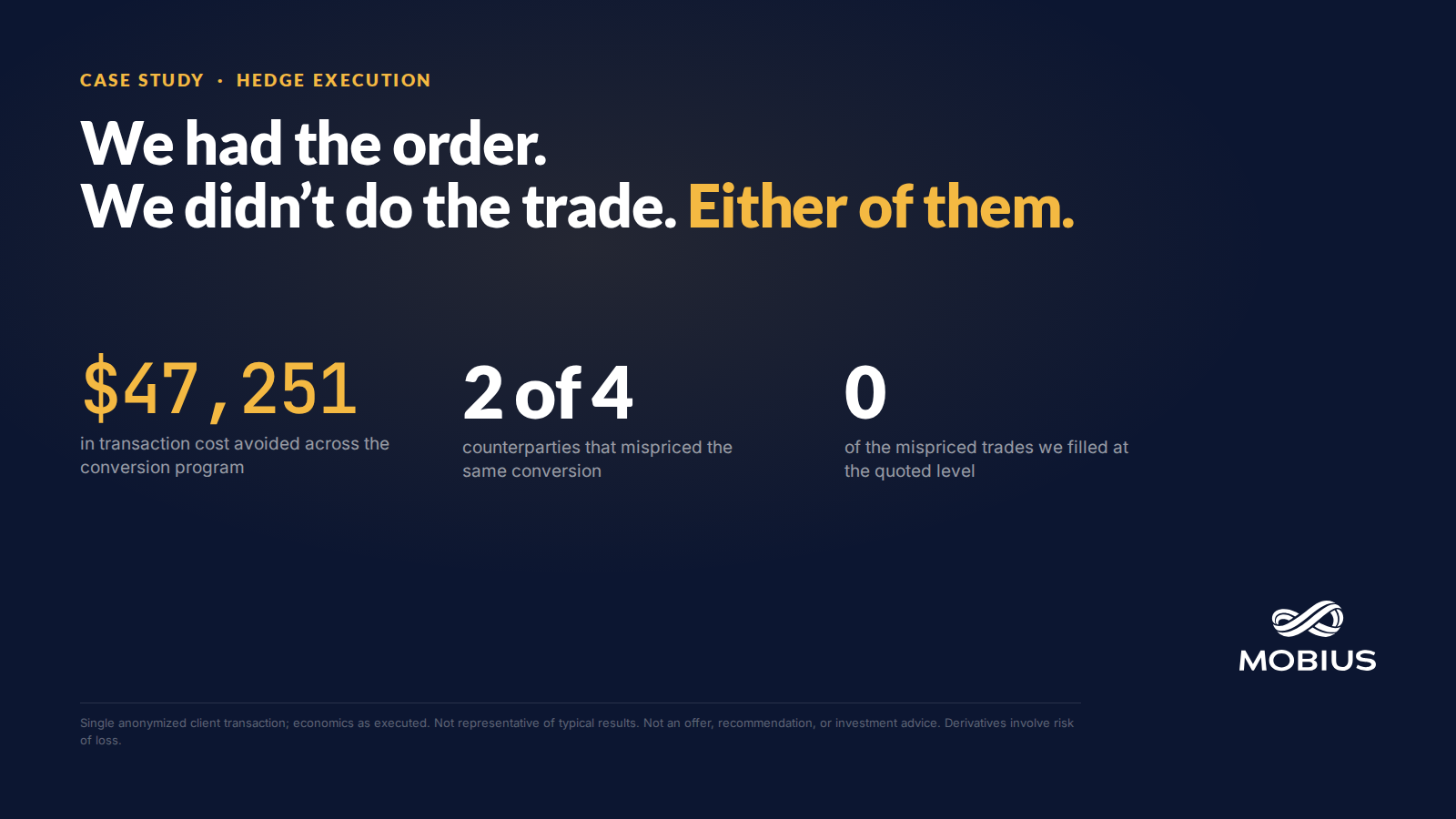
Two of a producer's four counterparties quoted the same collar-to-swap conversion inconsistently with put/call parity — on the same morning. Our desk had modeled the structure independently and caught both. Challenging them avoided $47,251 in transaction cost, on trades the client had already approved.
The situation
An upstream natural gas producer carried costless collars across four lender-counterparties under its credit-facility hedge requirement. It decided to convert them into fixed-price swaps — clearing the optionality and locking a known price across the book. The instruction was one line: execute all of them at the levels quoted.
Two quotes failed the same test
Counterparty A quoted the replacement swap two cents below the floor the client already owned. Counterparty B quoted it at exactly that floor — the entire call spread surrendered, and nothing received for it.
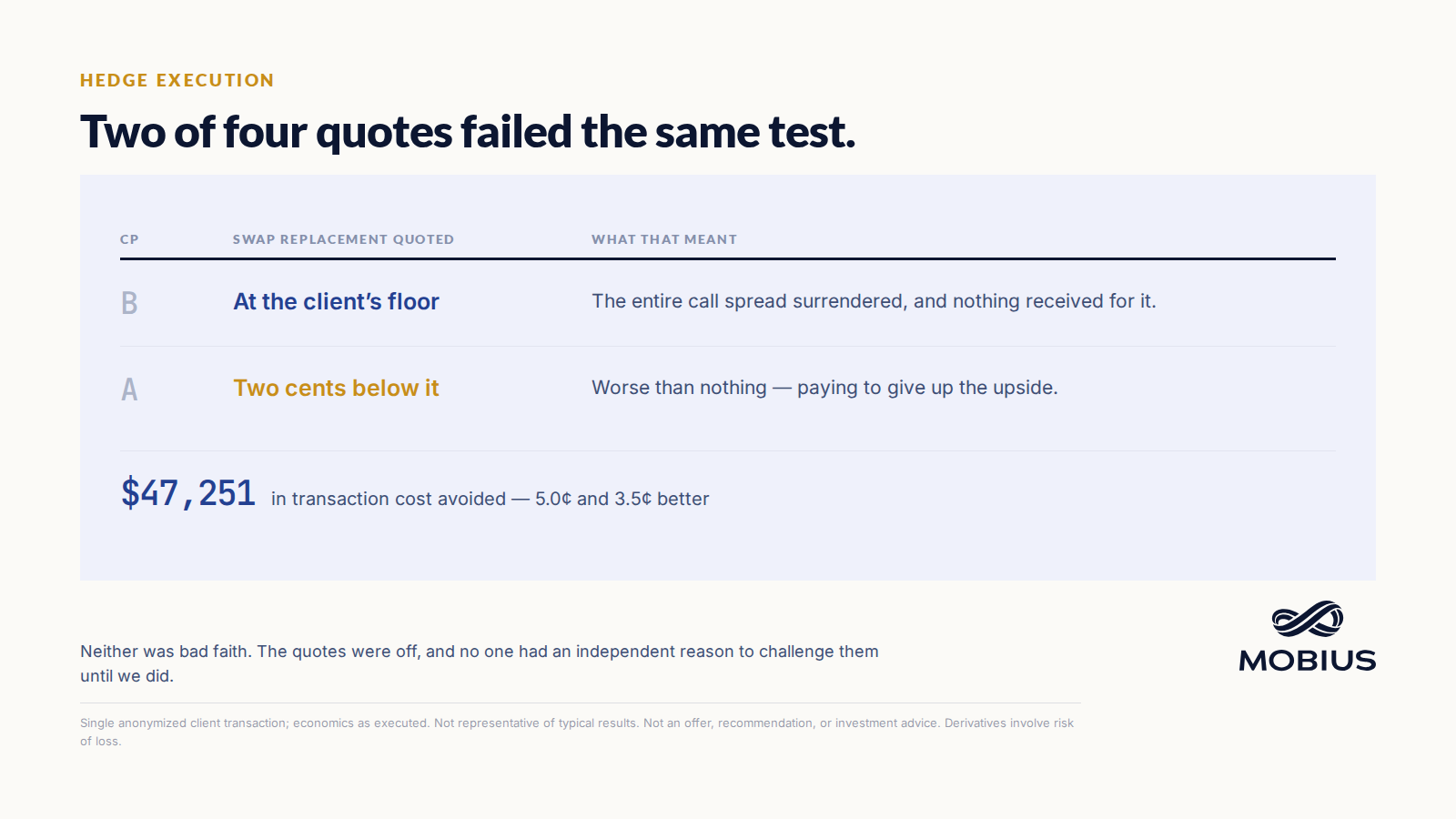
One offered nothing for the client's upside. The other offered less than nothing. Both quotes were inconsistent with put/call parity, and neither reconciled with the economics of the existing collars.
Converting a collar to a swap hands back a package that has value, so the replacement swap should print above your existing put strike — by the residual value of the call you are buying back. At the strike you surrender the call spread for zero; below it, you pay for the privilege.
What we did
We didn't trade. Neither of them.
We had a live, unambiguous, written order to execute, and a transaction-based compensation model creates an economic incentive to complete the trade. Instead we held both orders, went back to each bank with our own valuation of the structure and our cross-counterparty pricing, and asked them to justify the level. Both reviewed their pricing and raised their bids — five cents on one, three and a half on the other.
Why a restructure calls for a subject matter expert
A conversion is a restructure. Its value depends on both legs of the collar the client already holds, priced against a live volatility surface, and on the swap that would replace them — the two valued together as one position. That interaction is where the nuance sits.
It is also where a subject matter expert makes the difference. Two of four counterparties got this one wrong, and the only reason anyone knew was that a desk had modeled the whole structure independently, on a far more comprehensive model than an indicative screen carries.
The day-to-day of a hedge program is a different job, and it is well served by self-serve pricing. M-Direct gives producers real-time indicatives on swaps, collars and three-ways in seconds, so a quote arrives at a desk that already knows roughly what it ought to say.
Why it happened
Not malice. The quotes were off, and neither side had an independent reason to challenge them until we did. That is the point, and two out of four is the part worth sitting with: one quote out of line is bad luck; half a bank group on the same morning is a structural condition.
Your counterparty is the other side of your trade. They are not your adversary — but they are not your independent advocate either, and the counterparty providing the quote is not acting as your independent valuation advisor.

The takeaway for producers
Hedge strategy gets the attention. Hedge execution is one place where transaction economics can quietly deteriorate — and treating a relationship bank's quote as a fair quote without independent validation isn't conservative, it's untested.
The day-to-day book is well covered by real-time indicatives in M-Direct. Restructures, unwinds and conversions carry nuances of their own, and that is where a subject matter expert alongside you earns their place.
Get the full case study
The full write-up includes the price ladder, the outcome table for both counterparties, and the three things that made the catch possible. Enter your email below and we will send it over.
Single anonymized client transaction; economics as executed. Not representative of typical results. Not an offer, recommendation, or investment advice. Derivatives involve risk of loss.
Subscribe to receive the latest Mobius Research & updates