
July 27, 2026
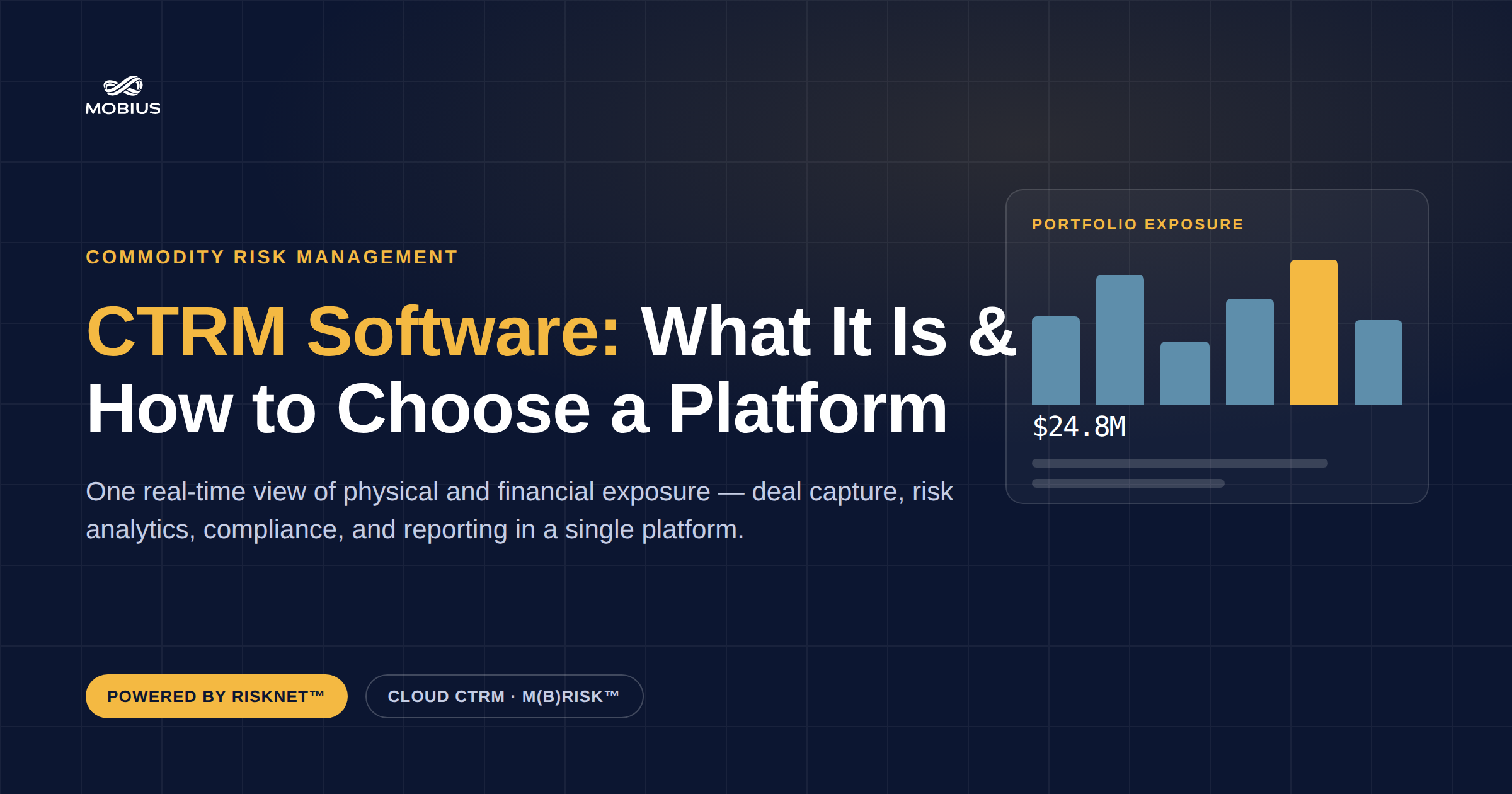
Quick answer: CTRM (Commodity Trading and Risk Management) software is a system that centralizes deal capture, position tracking, risk analytics, compliance, and reporting for physical and financial commodities in one place. The right platform gives a real-time, portfolio-wide view of exposure so risk and treasury teams can hedge and report with confidence - instead of stitching data together in spreadsheets.
What is CTRM software?
CTRM stands for Commodity Trading and Risk Management. CTRM software is the system of record for an organization's commodity activity: it captures trades and physical deals, tracks positions as prices move, calculates risk exposure, monitors regulatory compliance, and generates the reports that finance, risk, and leadership rely on. For energy producers, midstream operators, industrial buyers, and the CFOs and treasurers who oversee them, it replaces fragile spreadsheets with a single, auditable source of truth.
A modern CTRM platform such as Mobius Risk Group's RiskNet is cloud-based and unifies physical and financial exposures in one view, spanning deal capture, risk analytics, reporting, and market insight.
What does a CTRM platform actually do?
The strongest CTRM systems cover a consistent set of jobs. RiskNet, for example, provides:
- Deal capture and trade management for both physical and financial commodity transactions, including capture via API.
- Position tracking at the portfolio, commodity, and site levels.
- Portfolio visualization across commodities and locations, so exposure is seen whole rather than piecemeal.
- Scenario analysis and risk-exposure modeling to test hedges before they're placed.
- Compliance monitoring aligned to FERC, Dodd-Frank, EMIR, FAS, and SOX requirements.
- Customized reporting for risk, treasury, accounting, and executive audiences.
What are the must-have modules when choosing CTRM software?
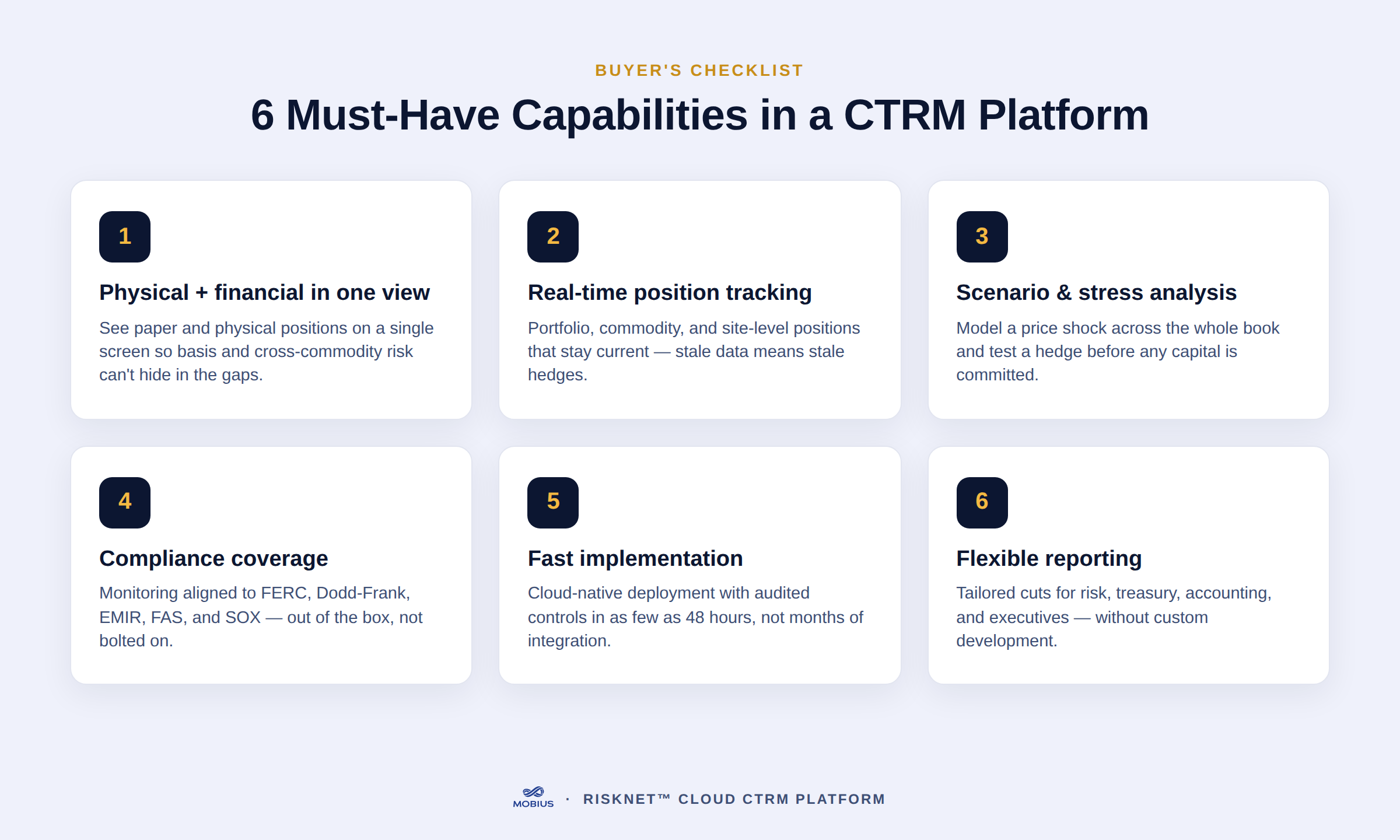
Cloud CTRM vs. legacy on-premise systems
Legacy CTRM installations were historically heavy, slow to deploy, and expensive to maintain. Cloud-native platforms have changed the calculus. RiskNet, for instance, is positioned for quick implementation - deployable in as few as 48 hours with audited controls - which is materially faster than traditional CTRM roll-outs measured in months. Faster deployment means the risk team sees value sooner and spends less on integration overhead.
How does CTRM software fit with advisory and analytics?
Software surfaces the exposure; judgment decides what to do about it. Mobius pairs RiskNet with the proprietary M-Beta-risk methodology, which offers an intuitive view of the most efficient path for managing risk, and with market-intelligence and indicative-pricing tools such as M-Direct. Because Mobius is an independent, unconflicted advisor, that analysis answers to the client rather than to a trading desk - the platform and the advice pull in the same direction.
Frequently asked questions
What does CTRM stand for?
CTRM stands for Commodity Trading and Risk Management. CTRM software manages the full lifecycle of commodity trades - capture, valuation, position tracking, risk analytics, compliance, and reporting - for physical and financial commodities.
Who uses CTRM software?
Energy producers and midstream operators, industrial and chemical commodity buyers, and the risk officers, treasurers, and CFOs responsible for hedging and reporting commodity exposure.
How is CTRM different from an ETRM?
ETRM (Energy Trading and Risk Management) is essentially CTRM applied specifically to energy commodities. CTRM is the broader term, covering energy alongside metals, agriculture, and other commodities. Many platforms serve both.
How long does it take to implement a CTRM platform?
It varies widely. Legacy systems can take months, while cloud-native platforms are far faster - RiskNet is positioned to deploy in as few as 48 hours with audited controls. Implementation speed is a fair proxy for how much integration overhead a platform carries.
Can CTRM software help with regulatory compliance?
Yes. A capable CTRM platform monitors positions and reporting against regimes such as FERC, Dodd-Frank, EMIR, FAS, and SOX, reducing the manual effort and audit risk of compliance.
Subscribe to receive the latest Mobius Research & updates