
August 14, 2026
Quick Answer
Gulf Coast hurricane season, running June through November, can disrupt roughly half of U.S. Gulf natural gas and refining capacity and move prices sharply within days. Energy buyers and producers hedge this weather risk in advance using options, storage, and basis positions sized to their physical exposure rather than reacting after a storm forms.
How does hurricane season affect Gulf Coast energy prices?
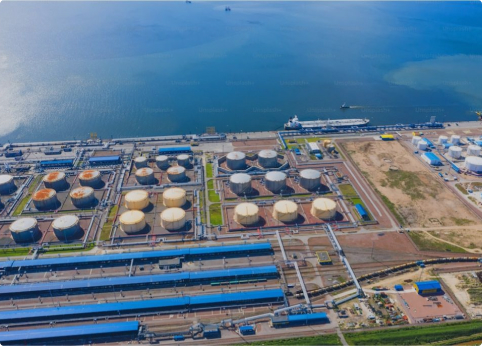
The U.S. Gulf Coast concentrates a large share of the nation's natural gas processing, LNG export, and refining capacity in a narrow strip of coastline. When a major storm enters the Gulf, operators pre-emptively shut in production and idle refineries, and the market re-prices supply risk almost immediately — often before a single rig is damaged. The result is a spike in near-month gas and regional power prices followed by a demand-loss pullback if refineries stay offline.
When should a hedging program be in place?
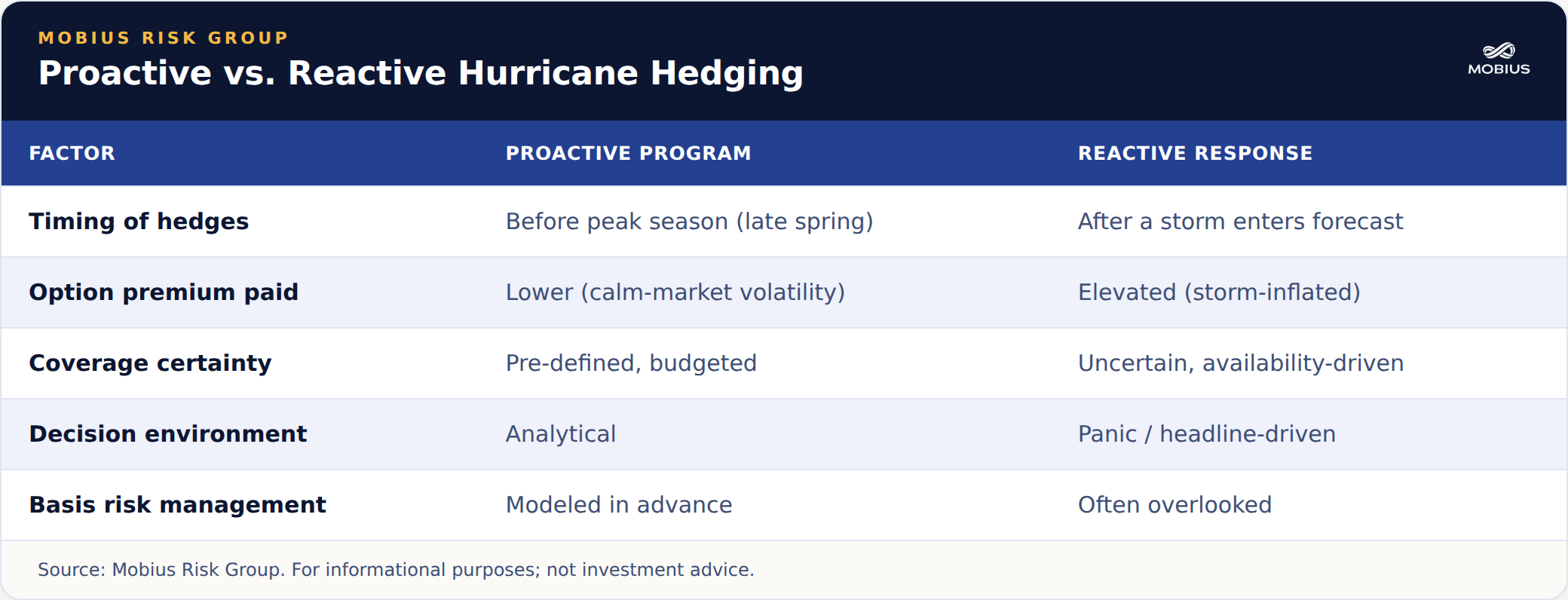
The costly mistake is treating hurricane risk as a headline to react to. By the time a named storm is in the forecast cone, option premiums have already widened. A disciplined program sets weather-contingent hedges before peak season — typically late spring — so protection is bought when volatility is cheap. The table below contrasts a proactive program with a reactive one.
Proactive vs. Reactive Hurricane Hedging
What tools do Gulf Coast buyers and producers use?
Physical buyers lean on call options and storage to cap upside without over-committing volume; producers use puts and basis hedges to protect realized prices when regional differentials blow out. Mobius supports both sides with M(β)risk scenario analytics that stress a portfolio against historical storm paths, and the RiskNet platform to track shifting physical positions in real time. Our market-intelligence suite — M-Power, CrudeHQ, and MidstreamHQ — tracks the fundamentals that drive storm-season pricing.
Related: what an unconflicted commodity risk advisor does.
Frequently asked questions
Which commodities are most exposed to Gulf hurricanes?
Natural gas, power, refined products, and crude differentials are most sensitive, because production, processing, and refining are physically concentrated on the Gulf Coast.
Can weather risk be fully hedged?
Not entirely — physical damage and demand destruction are hard to offset perfectly — but price exposure can be substantially managed with options, storage, and basis positions sized to the physical book.
When is Gulf Coast hurricane season?
Atlantic hurricane season runs June 1 through November 30, with peak activity typically from mid-August through October.
Talk to an unconflicted advisor. Mobius Risk Group has advised energy and industrial clients on commodity risk since 2002. Start a conversation →
Subscribe to receive the latest Mobius Research & updates