
August 28, 2026
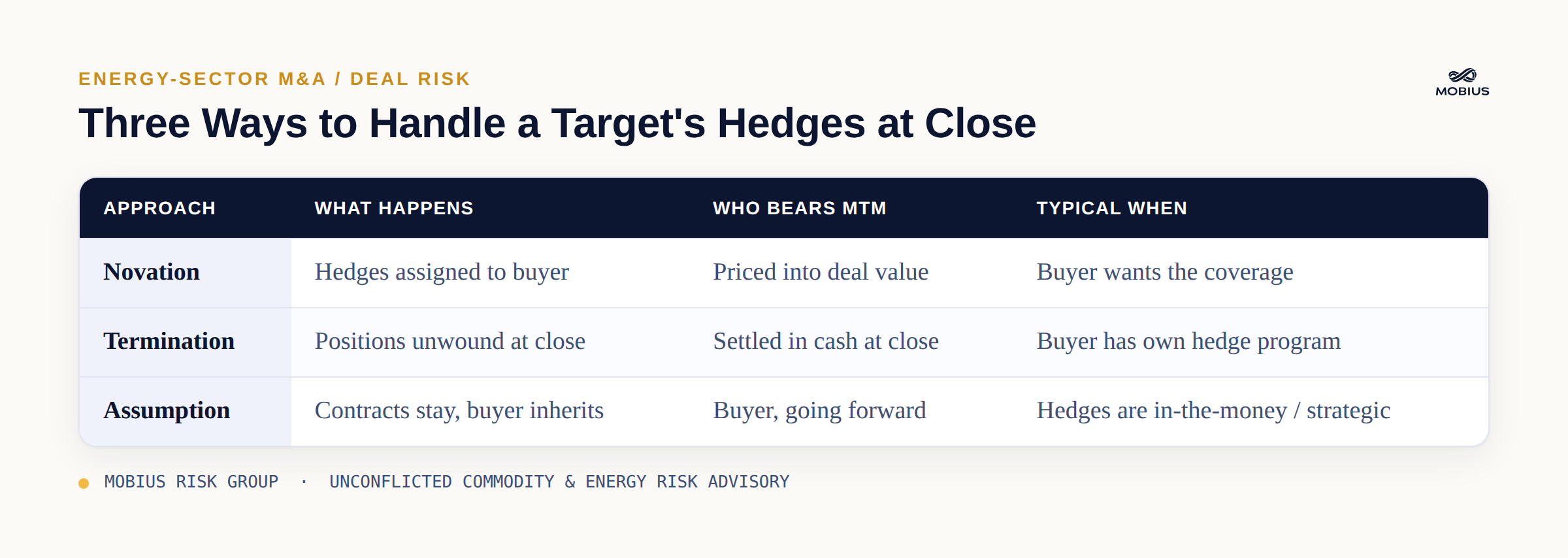
Quick answer: In an energy M&A deal, a target's existing hedges are handled in one of three ways: novated (assigned to the buyer), terminated and settled at close, or left in place and assumed. Each hedge's mark-to-market value is a real component of deal economics, so the hedge book is valued in diligence and reflected in the purchase price or a purchase-price adjustment.
What happens to a target company's hedges in an acquisition?
When a company with an active hedge book is acquired, those derivative positions do not simply vanish. The parties must decide whether to novate them to the buyer, terminate them at close, or leave them in place for the buyer to assume. The choice depends on the buyer's own hedging strategy, the mark-to-market value of the positions, lender requirements, and counterparty consent.
Because hedges carry a market value that moves daily, the decision is not only legal—it is an economic one that directly affects what the buyer is really paying for the business.
Three Ways to Handle a Target's Hedges at Close
How does a hedge book affect deal value?
A hedge book has a mark-to-market (MtM) value that can be a meaningful asset or liability. An in-the-money hedge book adds value the seller expects to be compensated for; an out-of-the-money book is a liability the buyer will inherit. This value is typically captured through the purchase price or a purchase-price adjustment at close, and it can swing with the commodity curve between signing and closing.
That timing gap is itself a risk: a large move in the forward curve can change hedge MtM materially before the deal closes, which is why sophisticated buyers track it through the deal period.
What should buyers check in hedge diligence?
Effective hedge diligence goes beyond a list of trades. Buyers should confirm the notional, tenor, and instrument type of each position; the counterparties and credit terms; any margin or collateral obligations; whether positions qualify for hedge accounting under ASC 815; and whether lender or ISDA consents are required to novate. Missing collateral terms or consent requirements can create surprises at or after close.
How does an unconflicted advisor help in hedge-related M&A?
Because Mobius does not take the other side of client trades, its role in a transaction is to independently value the hedge book, model its MtM sensitivity to the curve, and advise on novation versus termination without a stake in the outcome. For a PE buyer, that means an objective read on how much of the purchase price is really hedge value—and a hedging plan for the acquired production from day one.
Related reading
Frequently asked questions
Can hedges be transferred to the buyer in an acquisition?
Yes. Through novation, the target's derivative contracts are assigned to the buyer, usually with counterparty and sometimes lender consent. Alternatively, hedges can be terminated at close or assumed in place.
Do hedges change the purchase price?
They can. A hedge book's mark-to-market value—positive or negative—is typically reflected in the purchase price or a purchase-price adjustment, so the hedge value flows into what the buyer effectively pays.
What is novation in an energy M&A hedge context?
Novation is the legal assignment of an existing derivative contract from the target to the buyer, transferring the rights and obligations (and the mark-to-market) to the acquiring party.
Why value a hedge book during diligence?
Because its MtM is real deal economics and moves with the commodity curve. Valuing it—and stress-testing it against curve moves before close—prevents surprises and informs price and structure.
Subscribe to receive the latest Mobius Research & updates