
August 4, 2026
Chemical and industrial buyers hedge natural gas costs by locking or capping the price of future consumption using swaps, call options, costless collars, or physical fixed-price supply. The goal is budget certainty: converting a volatile fuel-and-feedstock line into a predictable cost so margins and capital plans survive price spikes.
Why do industrial buyers hedge natural gas?
For chemical producers, glassmakers, food processors, and other energy-intensive manufacturers, natural gas is both fuel and feedstock — often one of the largest and most volatile line items in the cost of goods sold. A cold-weather spike or a supply disruption can erase a quarter's margin before procurement can react.
Hedging does not aim to beat the market. It aims to remove ruinous outcomes from the budget so the business can price contracts, protect margins, and commit capital with confidence. An independent advisor helps size the program to actual exposure rather than to a bank's product shelf.
What are the main natural gas hedging instruments?
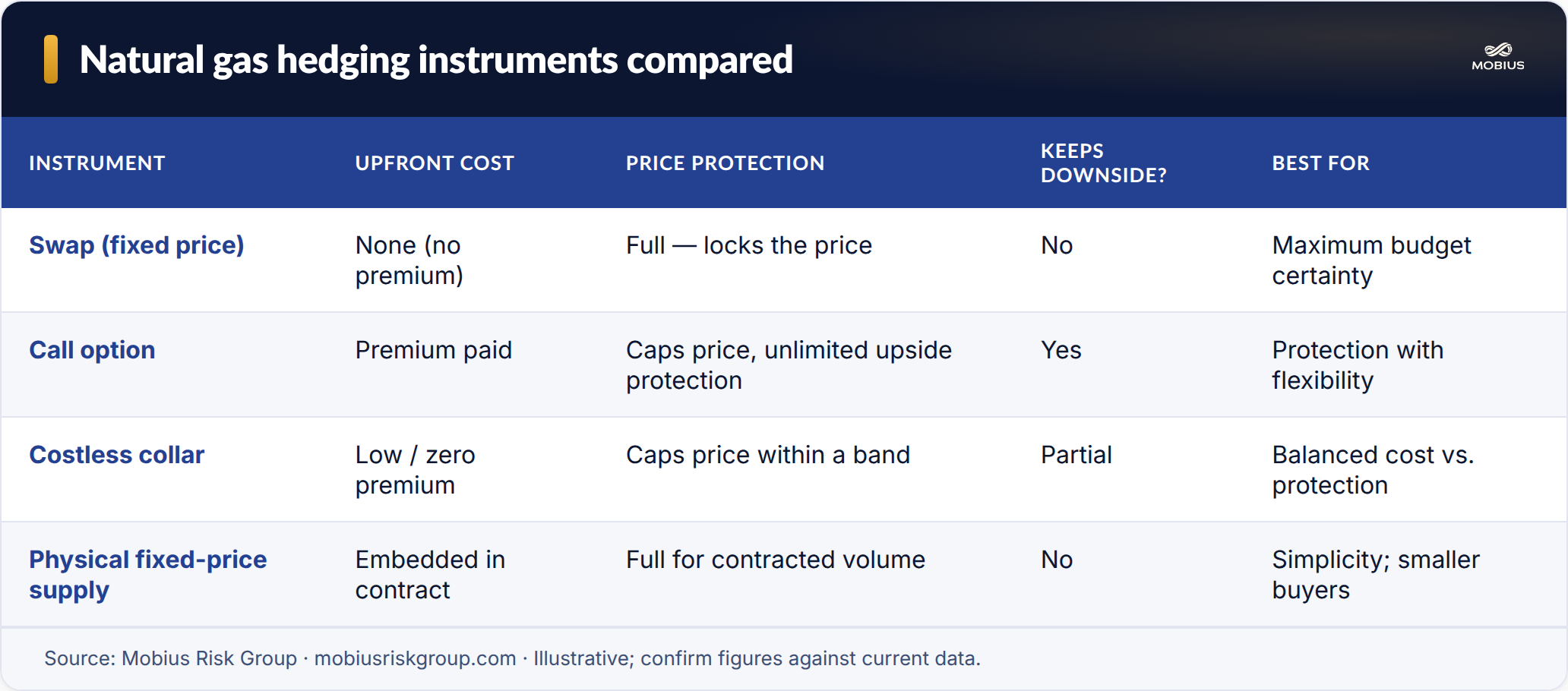
Four tools cover most industrial hedging needs, and most programs blend them. A swap fixes the price. A call option caps the price while keeping downside participation. A collar caps the price at low or zero premium by giving up some downside. Physical fixed-price supply bakes the hedge into the gas contract itself.
The comparison table below lays out cost, protection, and tradeoffs for each. The right mix depends on risk tolerance, budget sensitivity, and how much premium the business is willing to pay for flexibility.
How much natural gas should a buyer hedge?
A common framework is a layered, declining hedge ratio: hedge a high share of near-term, high-confidence volumes and a smaller share of volumes further out, adding layers over time. This avoids betting the whole program on a single price or date.
The right ratio is a governance decision, not a market call. It should be tied to budget thresholds — the price above which margins or covenants are threatened — and documented in a hedging policy the board or lender can review.
How do you build a natural gas hedge program?
Start with a clean exposure baseline: forecast consumption by month and location, and identify the basis points where you actually buy gas. Set budget objectives and risk tolerances, then choose instruments that meet them at acceptable cost. Finally, put governance around it — a written policy, approval limits, and mark-to-market reporting.
Because Mobius is an unconflicted advisor and not a counterparty, program design reflects the client's economics rather than an incentive to sell a particular structure.
Frequently asked questions
What is the simplest way to hedge natural gas costs?
The simplest approach is physical fixed-price supply — agreeing a fixed price with a gas supplier for a set volume and term — or a financial swap that fixes the price. Both deliver budget certainty without an upfront premium, though they give up the benefit of falling prices.
Do natural gas hedges require an upfront premium?
Not always. Swaps and costless collars typically require no upfront premium; call options do, because a premium buys the right to keep downside participation while capping the price. The trade-off is cost versus flexibility.
How much of my natural gas usage should I hedge?
Many industrial buyers use a layered, declining hedge ratio — hedging a larger share of near-term volumes and less further out. The exact ratio should be tied to budget thresholds and set in a written hedging policy rather than to a market view.
Can Mobius Risk Group execute hedges for us?
Mobius is an independent, unconflicted advisor that designs and supports hedge programs and provides the analytics and system of record (RiskNet) to manage them, without trading against clients.
About Mobius Risk Group
Mobius Risk Group is an independent, unconflicted commodity risk advisor founded in 2002 and headquartered in Houston. Mobius combines expert advisory with proprietary technology — including the RiskNet CTRM platform and M(β)risk analytics — to help producers, industrial buyers, CFOs, and investors manage commodity risk with confidence. Contact Mobius to discuss your exposure.
Subscribe to receive the latest Mobius Research & updates