
July 24, 2026
Quick answer: RNG hedging is the management of the multiple, correlated revenue streams an RNG project earns — the commodity gas plus environmental credits like RINs and LCFS. Because credit values are volatile and policy-driven, hedging RNG means combining gas-price tools, credit-sale strategies, and well-structured offtake contracts rather than a single natural-gas hedge.
What is RNG hedging?
Renewable natural gas (RNG) is pipeline-quality biomethane produced from landfills, dairies, wastewater, and other organic sources. RNG hedging protects a project’s economics against price swings across every revenue stream it earns — not just the gas molecule, but the environmental attributes that often make up the majority of its value. Because those attributes are shaped by federal and state policy, RNG carries a risk profile a conventional natural-gas hedge does not fully address.
For developers, hedging stabilizes the cash flows lenders and investors underwrite. For buyers and utilities, it locks in supply and cost for decarbonization commitments.
Why is RNG price risk different from conventional natural gas?
- Commodity (brown) gas: the underlying molecule, priced off benchmarks like Henry Hub, hedged with familiar tools.
- Federal RIN credits: RNG as transportation fuel can generate RINs under the Renewable Fuel Standard — often D3 (cellulosic) values, historically volatile.
- State LCFS credits: Low Carbon Fuel Standard programs (California and others) generate credits whose value depends on carbon-intensity score and program credit price.
- Voluntary attributes: environmental attributes sold into voluntary decarbonization markets, priced by corporate demand.
Environmental credits frequently dwarf the value of the gas itself and are the most policy-sensitive part of the stack, so hedging only the commodity leaves the largest exposure uncovered.
Which RNG revenue streams need hedging?
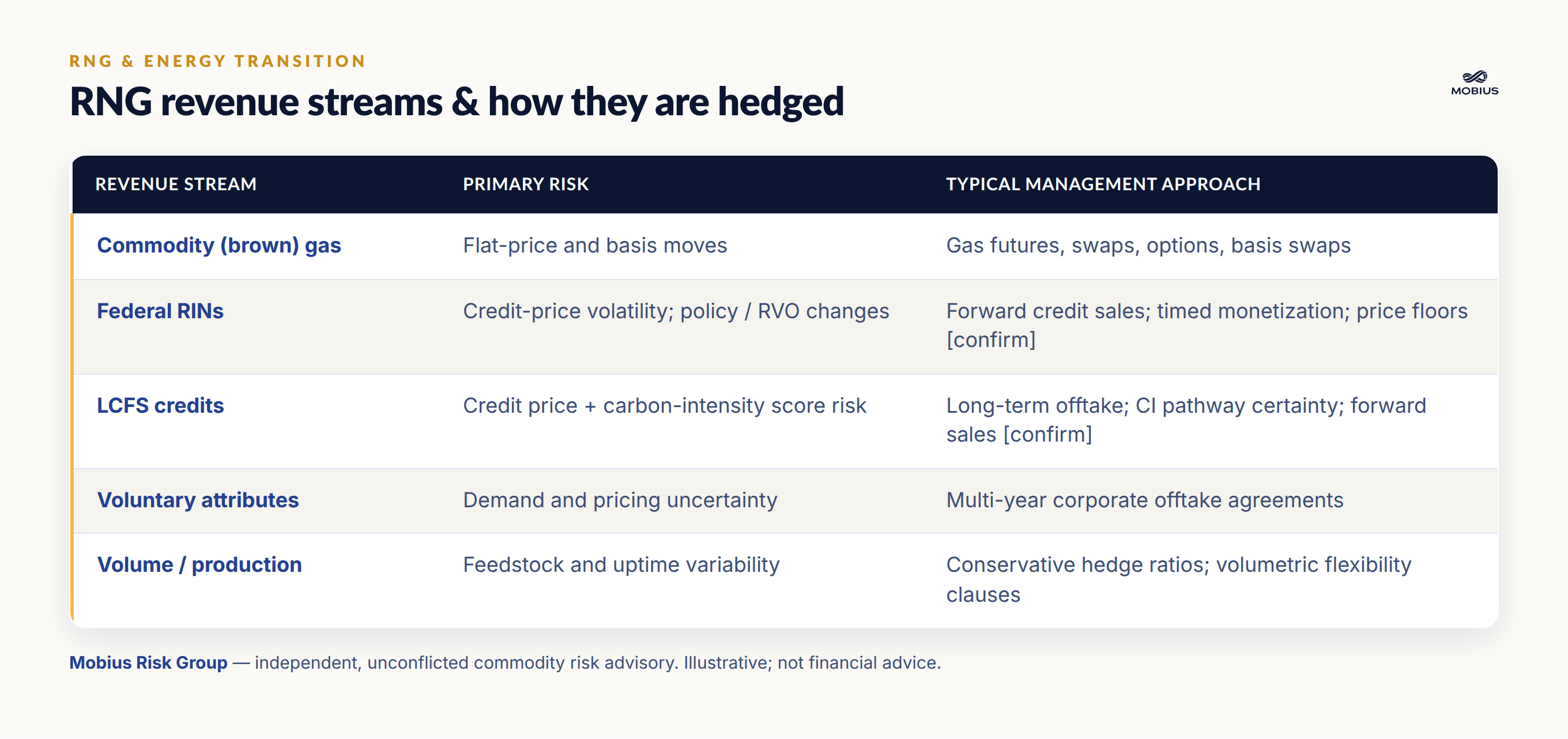
Revenue streamPrimary riskTypical management approachCommodity (brown) gasFlat-price and basis movesGas futures, swaps, options, basis swapsFederal RINsCredit-price volatility; policy / RVO changesForward credit sales; timed monetization; floorsLCFS creditsCredit price + carbon-intensity scoreLong-term offtake; CI pathway certaintyVoluntary attributesDemand and pricing uncertaintyMulti-year corporate offtake agreementsVolume / productionFeedstock and uptime variabilityConservative hedge ratios; flexibility clauses
What instruments and structures hedge RNG risk?
- Gas derivatives (swaps, options, basis swaps) to fix or cap the commodity portion.
- Forward and long-term credit sales to convert volatile RIN/LCFS spot values into contracted cash flows.
- Offtake agreements with floors, collars, or fixed-price components that transfer part of the credit-price risk to the buyer.
- Conservative hedge ratios that account for feedstock and uptime variability.
How do developers and buyers structure offtake?
The offtake contract is where much of RNG risk is allocated. Developers favor longer-term agreements with price certainty on at least part of the stack; buyers want supply security and cost predictability. A floor or collar protects the developer’s downside while preserving some upside, and clear treatment of the environmental attributes — who owns them, how they are priced, what happens if policy changes — prevents disputes when credit values move. Because these structures interact with the commodity-leg hedges, they should be modeled together.
How Mobius helps
Mobius Risk Group brings independent, unconflicted advice to a market where many counterparties have a stake in the other side of the trade. M(β)risk™ analytics quantify how the gas, RIN, LCFS, and voluntary layers move together so a project can be hedged as a portfolio; RiskNet™ CTRM tracks positions, exposure, and valuation across all streams; and Strategy Direct advisory helps structure offtake and hedging programs lenders and boards can stand behind.
Frequently asked questions
Can you hedge RNG the same way as natural gas?
Only partly. The commodity gas portion uses standard gas derivatives, but the environmental credits — which often carry most of the value — need credit-sale strategies and offtake structures.
What makes RNG revenue volatile?
The environmental-credit layer. RIN and LCFS values are policy-driven and can move sharply even when gas prices are stable.
Why do offtake agreements matter for RNG hedging?
The offtake contract allocates price and volume risk between developer and buyer; floors, collars, and clear attribute ownership are often the most effective way to stabilize cash flows.
Who needs an RNG hedging strategy?
Developers financing facilities, investors underwriting the cash flows, and corporate or utility buyers using RNG for decarbonization goals. Mobius is not a financial advisor.
Subscribe to receive the latest Mobius Research & updates