
August 15, 2026
Quick Answer
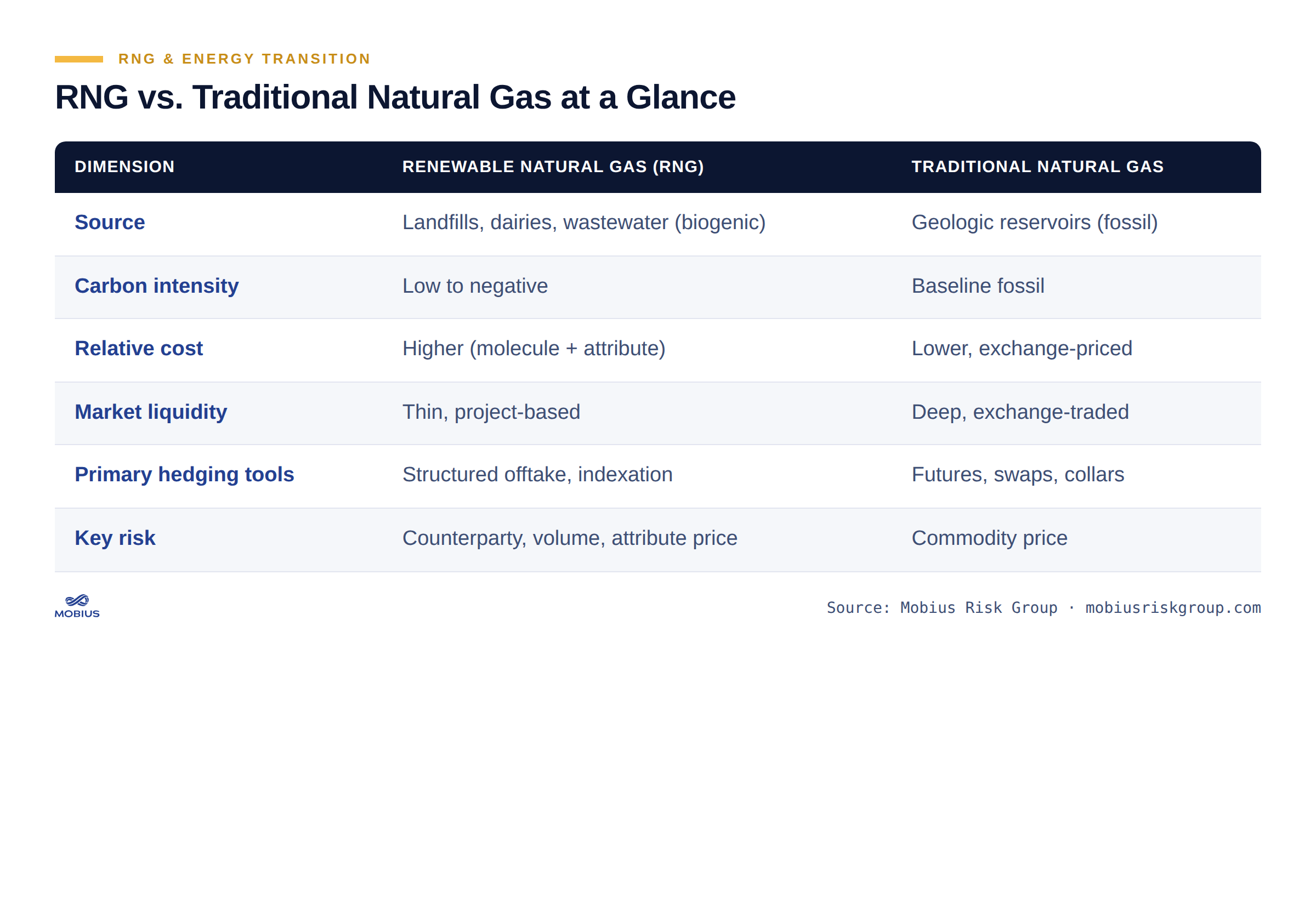
Renewable natural gas (RNG) is pipeline-quality biomethane from organic waste; traditional natural gas is a fossil fuel from geologic reservoirs. RNG carries far lower carbon intensity and environmental-attribute value, but costs more and trades in thinner markets — changing how a CFO budgets, contracts, and hedges energy exposure.
What is the difference between RNG and conventional natural gas?
Chemically, both are largely methane and are interchangeable in pipelines and equipment. The difference is origin and attributes. RNG is captured from landfills, dairies, and wastewater — waste streams that would otherwise emit methane — and upgraded to pipeline quality. Because it displaces fossil gas and avoids fugitive emissions, RNG carries a low or even negative carbon intensity score and generates environmental attributes (such as RINs or LCFS credits) that have their own market value.
How do the costs compare?
The commodity molecule of RNG typically costs several times more than Henry Hub gas. However, the economics rarely rest on the molecule alone: environmental-attribute credits can offset much of the premium, and in compliance markets the attribute can be worth more than the gas itself. For a CFO, the takeaway is that RNG cost is a bundle — molecule plus attribute — and each leg has its own price risk and market depth.
What are the supply and contracting risks?
RNG supply is project-specific and finite; volumes depend on individual facilities rather than a deep, liquid basin. Offtake is usually contracted directly with producers under multi-year agreements, which shifts risk from spot price toward counterparty, volume, and project-performance risk. Traditional gas, by contrast, offers deep exchange liquidity and standardized hedging tools. A blended procurement strategy has to manage both worlds.
How should hedging strategy change for RNG exposure?
Conventional gas exposure can be hedged with liquid futures, swaps, and collars. RNG's price and attribute legs are far less liquid, so hedging leans on structured offtake terms, indexation, and portfolio design rather than exchange-traded instruments. CFOs should treat attribute-price volatility (RIN/LCFS) as a distinct exposure and stress-test it separately from the gas curve.
Related from Mobius Risk Group: carbon and transition solutions, Strategy Direct for consumers, hedge strategy advisory.
RNG vs. Traditional Natural Gas at a Glance
Frequently asked questions
Is RNG chemically the same as natural gas?
Once upgraded to pipeline quality, RNG is nearly pure methane and is fully interchangeable with conventional gas in pipelines and end-use equipment. The difference is its biogenic origin and the environmental attributes it carries.
Why is RNG more expensive than natural gas?
RNG requires collecting and upgrading waste gas from many small sites, which costs more than producing conventional gas at scale. Much of the premium is offset by environmental-attribute credits in compliance and voluntary markets.
Can RNG be hedged like natural gas?
Only partially. The methane leg can reference gas indices, but RNG's attribute value trades in thin, separate markets, so RNG procurement relies more on structured contracts than on exchange-traded hedges.
Talk to an unconflicted commodity risk advisor
Mobius Risk Group has advised energy producers, industrial buyers, and CFOs on commodity risk since 2002. Schedule a conversation with our team →
Subscribe to receive the latest Mobius Research & updates