

August 28, 2026
Quick answer: A three-way collar is an oil & gas hedge that combines a purchased put (the floor), a sold call (the ceiling), and a second sold put below the floor (the sub-floor). The extra sold put generates premium that funds a higher floor or wider ceiling, but it reopens downside exposure if prices fall below the sub-floor strike.
How does a three-way collar work?
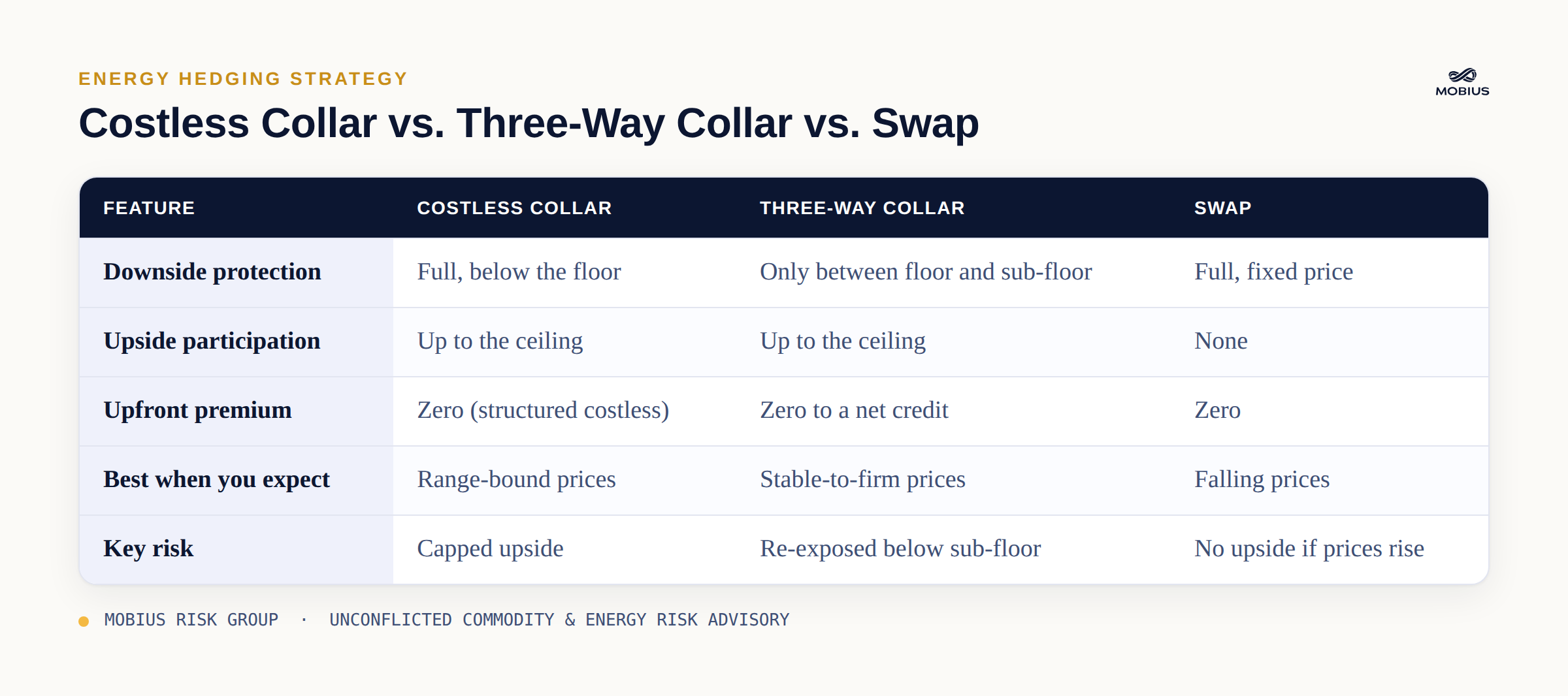
A three-way collar is built from three options on the same underlying volume and period. The producer buys a put to establish a price floor, sells a call to establish a ceiling, and sells a second put at a lower strike—the sub-floor. The premium collected from the two sold legs offsets the cost of the purchased put, so the structure is typically executed for zero upfront cost or a small net credit.
The trade-off sits in that sold sub-floor. Between the floor and the sub-floor, the producer is fully protected. Below the sub-floor, the short put re-engages and the producer once again participates in falling prices—so the effective protection is a fixed band, not an absolute floor.
Costless Collar vs. Three-Way Collar vs. Swap
Why would a producer choose a three-way collar?
Producers use three-way collars to raise the floor and lift the ceiling relative to a standard costless collar without paying premium. In a market where the forward curve is low but the producer believes a severe price collapse is unlikely, monetizing the tail below the sub-floor buys a more attractive protected band for the price range they consider probable.
The structure is common in reserve-based lending (RBL) contexts, where lenders require a minimum hedge percentage and producers want to satisfy that coverage while keeping economics attractive. It also appears in acquisition financing, where a buyer hedges acquired production to protect a borrowing base.
What is the risk of a three-way collar?
The defining risk is catastrophic downside re-exposure. If the commodity settles below the sub-floor at expiry, the producer effectively receives market price plus the fixed distance between the floor and sub-floor—but no longer a true floor. In a sharp sell-off, that gap can leave realized revenue well below what a plain collar or swap would have delivered.
This is precisely the scenario that punished some producers in past price crashes: structures that looked costless in a calm market removed protection at the exact moment it was needed. An unconflicted advisor models the sub-floor against stress scenarios, not the current forward curve alone.
How do you set the strikes on a three-way collar?
Strike selection is a balance between the protected band you want and the tail you are willing to sell. A wider gap between the floor and the sub-floor cheapens the structure but widens the unprotected zone. Mobius approaches this by defining the producer's minimum acceptable price—the level tied to debt covenants, capital plans, and breakevens—and then testing whether the sub-floor sits safely below any plausible stress case. If a downside scenario breaches the sub-floor, the structure is the wrong tool.
Frequently asked questions
Is a three-way collar the same as a costless collar?
No. A costless collar has two legs (a bought put and a sold call) and provides an absolute floor. A three-way collar adds a third leg—a sold put below the floor—which funds better strikes but removes protection below the sub-floor.
Does a three-way collar cost anything upfront?
Usually not. The premium from the sold call and sold put is structured to offset the purchased put, so it is typically executed at zero cost or a small net credit. The 'cost' is the downside you give up below the sub-floor.
When is a three-way collar a bad idea?
When a severe price decline is plausible. Because protection ends at the sub-floor, a three-way collar can underperform a simple collar or swap in a crash. It suits stable-to-firm expectations, not high-conviction downside views.
Who uses three-way collars?
Oil and gas producers—often in reserve-based lending or acquisition-financing contexts—use them to meet hedge-coverage requirements while keeping attractive protected price bands.
Subscribe to receive the latest Mobius Research & updates