Quick answer: An unconflicted commodity advisor is an independent firm that advises on hedging and price-risk decisions without trading against clients, taking a spread on their transactions, or selling a proprietary product book. Because its only revenue is advisory fees, its recommendations align with the client’s risk objectives rather than a bank’s or broker’s trading incentives.
Most companies that hedge commodity exposure — fuel, natural gas, power, feedstocks, metals — get their “advice” from the same institutions that stand on the other side of the trade. That arrangement is so common it rarely gets questioned. But the structure of who pays your advisor, and how they make money, quietly shapes every recommendation you receive. This is the case for choosing an unconflicted commodity advisor, what the term actually means, and how to tell the difference.
What does “unconflicted” actually mean in commodity risk advisory?
“Unconflicted” describes the advisor’s business model, not its marketing. A truly unconflicted commodity advisor holds no proprietary trading book, does not execute as principal against its clients, and does not earn undisclosed spreads, markups, or origination fees on the derivatives and physical deals it recommends. Its compensation comes from the client, for advice — so there is no structural reason to prefer one instrument, counterparty, or trade size over another except the client’s own risk and cost objectives.
That independence is the founding premise of Mobius Risk Group. Since 2002, Mobius has operated as an independent commodity risk advisor to energy producers and midstream operators, chemical and industrial buyers, corporate finance and treasury teams, and private-equity and M&A investors — deliberately structured so that its interests sit beside the client rather than across the table.
How is an independent advisor different from a bank hedging desk?
A bank- or broker-affiliated desk can offer real expertise and liquidity — but its economics are built on transaction volume. Revenue comes from bid/ask spreads, structuring margin, and flow, which means the incentive is to trade, to trade in size, and to favor the desk’s own products. An independent advisor’s incentive is narrower and simpler: give advice the client keeps paying for because it works. The table below compares the two structures on the dimensions that most affect outcomes.
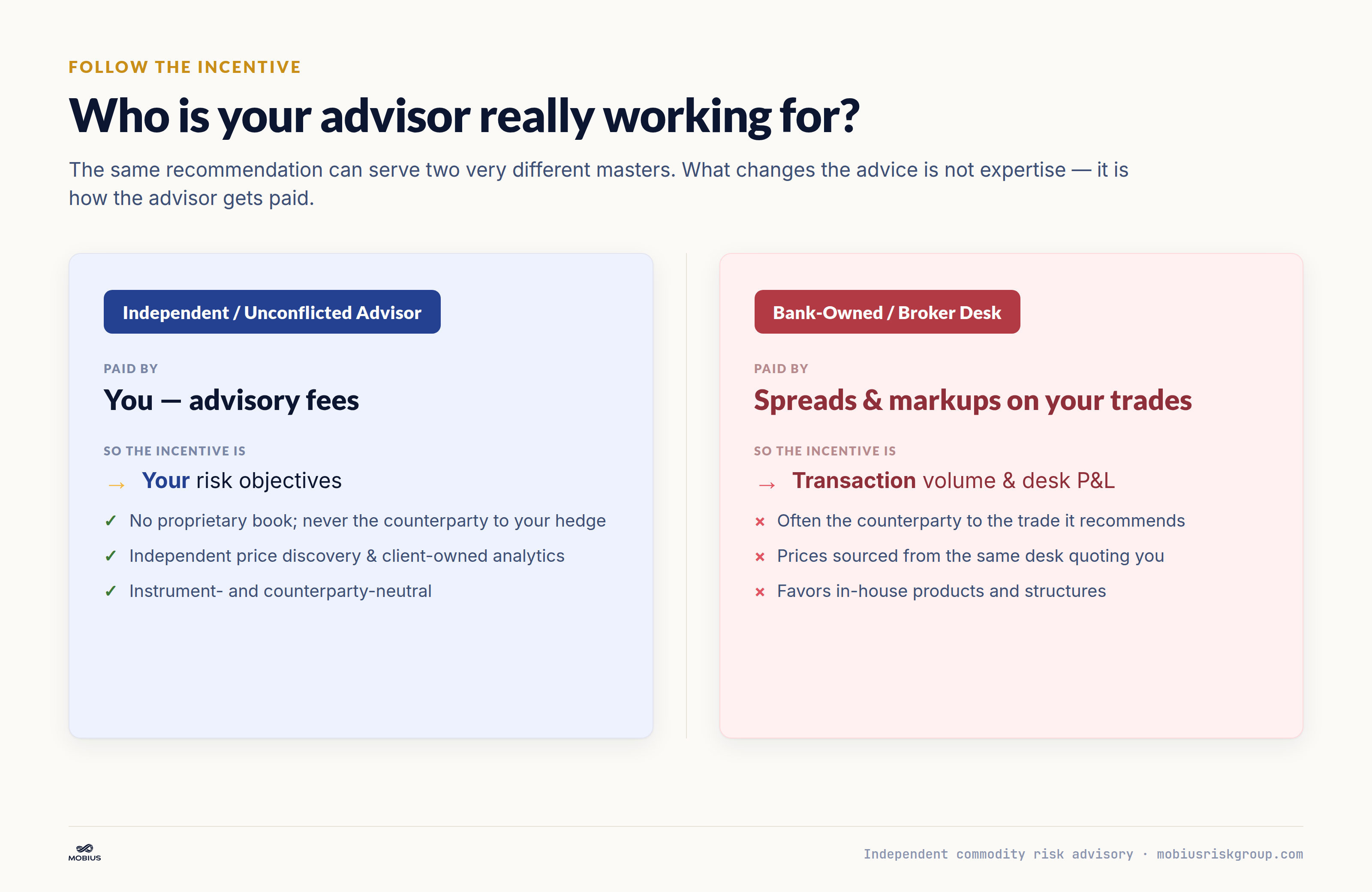
Why do conflicts of interest matter when you hedge?
Because the cost of a conflict is usually invisible on the day of the trade. A wider spread, an over-structured collar, a slightly larger notional, or a counterparty chosen for the desk’s convenience each look reasonable in isolation — yet compound across a hedging program into meaningful, unmeasured leakage. The deeper risk is decision quality: if the party framing your options also profits from the option you choose, you cannot fully trust that the menu was built around your exposure. An unconflicted advisor removes that doubt by design, so the debate stays about the risk, not about the motive behind the advice.
What should CFOs and risk officers look for in an unconflicted advisor?
- Fee-only compensation, in writing — no spreads, markups, or trade-contingent fees on recommended transactions.
- No proprietary book and no principal execution against clients.
- Independent price discovery, so valuations and marks don’t come from the desk quoting the trade.
- Client-owned analytics and reporting, so exposure data and risk metrics stay with you, not the counterparty.
- Counterparty- and instrument-neutral advice, benchmarked across the market rather than steered to one provider.
- Transparent governance support — policy design, board reporting, and hedge-accounting alignment that survives an audit.
How does Mobius Risk Group deliver unconflicted advice?
Mobius pairs independent advisory with a technology and analytics stack the client controls, so the guidance and the tools reinforce the same alignment:
- RiskNet™ — a commodity trading & risk management (CTRM) platform that centralizes physical and financial positions, valuations, and reporting under the client’s ownership.
- M(β)risk™ — quantitative risk analytics for measuring exposure, stress-testing hedge structures, and evaluating strategies on their own merits.
- M-Direct — independent, indicative pricing that gives clients a neutral reference point instead of relying on a dealer’s own quote.
- Strategy Direct — advisory that translates the analytics into hedging policy, execution guidance, and governance the client can defend to a board or auditor.
Because none of these lines earns a spread on the trades a client places, the advice, the pricing, and the reporting all point the same direction: the client’s risk objectives.
Frequently asked questions
What is an unconflicted commodity advisor?
It is an independent advisor that helps a company manage commodity price risk without acting as the counterparty to its trades or earning spreads on them. Its only compensation is advisory fees, so its recommendations aren’t shaped by trading incentives.
Is an unconflicted advisor the same as an independent advisor?
Closely related. “Independent” means the advisor isn’t owned by a bank, broker, or trading house. “Unconflicted” goes further, describing a fee-only model with no proprietary book and no principal execution against clients — so an unconflicted advisor is independent, but the label emphasizes the absence of transaction-based incentives.
Why not just use my bank’s hedging desk?
A bank desk can provide liquidity and execution, and many companies use one to trade. The issue is advice: the desk earns money on the spread and structure of the trade it recommends, which is a structural conflict. Many firms pair a bank for execution with an unconflicted advisor for the strategy and pricing benchmark.
How do unconflicted advisors get paid?
Through advisory or subscription fees paid by the client — not through markups, spreads, or trade-contingent commissions on the transactions they recommend.
Does Mobius Risk Group trade against its clients?
No. Mobius is structured as an independent, unconflicted advisor: it does not run a proprietary book or act as principal counterparty to client hedges. Its revenue is advisory, and its pricing (via M-Direct) is designed as an independent reference rather than a dealer quote.
Subscribe to receive the latest Mobius Research & updates