

July 14, 2026
Quick answer: A costless collar is a hedging strategy that protects against adverse price moves with little or no upfront premium. You buy a protective option (a floor or a cap) and simultaneously sell an offsetting option whose premium funds it — locking price inside a defined range instead of at a single fixed level.
What is a costless collar in simple terms?
A costless collar sets a price range. A hedger buys one option to protect against the price move they fear, then sells a second option in the opposite direction so the premium received roughly cancels the premium paid — which is why it is called costless (or zero-cost). The trade-off is that you give up the price outcomes beyond the sold option: you are protected inside the range but capped at its edges.
The word costless refers only to the upfront cash premium. A collar is not free of economic cost — you surrender potential favorable moves past the option you sold. Understanding that trade-off is central to using the structure well, and it is the kind of nuance an independent advisor like Mobius Risk Group is engaged to make explicit before a position is put on.
How does a costless collar work for a producer vs a buyer?
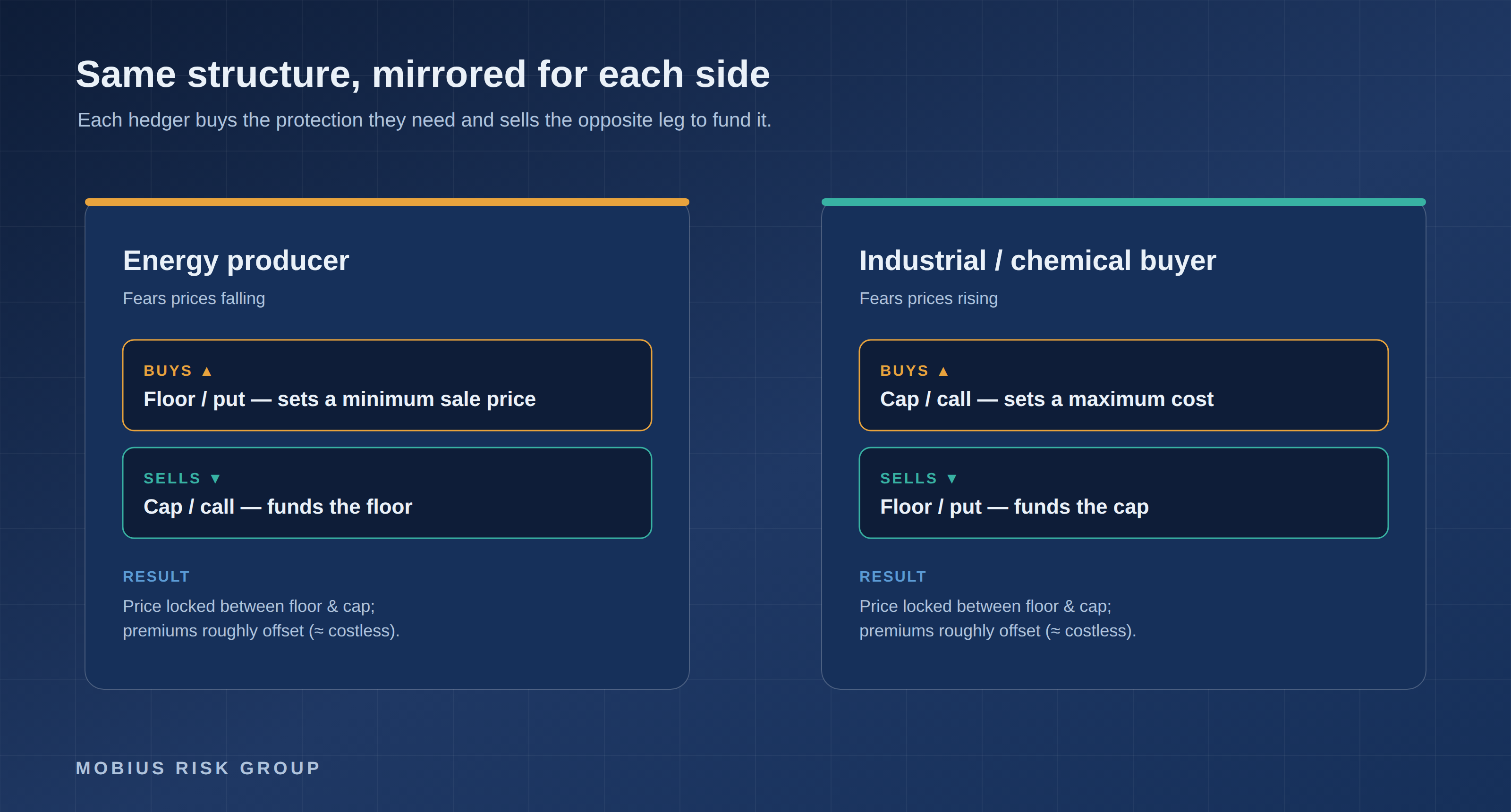
The structure flips depending on which direction of price you are exposed to. A producer fears falling prices; a consumer fears rising prices. Each buys the protection they need and sells the opposite side to fund it.
- Energy producer: fears prices falling, so buys a floor (put) to set a minimum sale price and sells a cap (call) to fund it. Result: sale price locked between floor and cap, giving up upside above the sold cap.
- Industrial or chemical buyer: fears prices rising, so buys a cap (call) to set a maximum purchase price and sells a floor (put) to fund it. Result: purchase cost locked between floor and cap, giving up savings below the sold floor.
In both cases the hedger has converted an open-ended price exposure into a bounded one for no upfront premium, accepting a capped best case in exchange.
Costless collar vs a swap: which should you use?
A swap fixes price at a single level; a collar fixes a range. The right choice depends on how much certainty you need and how much favorable movement you are willing to give up.
- Costless collar: little or no upfront premium; price lands in a range between the floor and cap; you keep favorable movement inside the range; best when you want protection but some flexibility; main drawback is being capped beyond the sold option.
- Fixed-price swap: no premium; price is fixed at a single level; no participation in favorable moves at all; best when you want maximum certainty.
Neither is universally better. A treasurer prioritizing budget certainty may prefer a swap; a producer who still wants some exposure to a price rally may prefer a collar. Mobius's role is to match the structure to the company's actual physical position and risk tolerance, not to default to one instrument.

What are the risks and watch-outs?
- Opportunity cost: if prices move strongly in your favor, the sold option caps your benefit at the range edge.
- Margin and credit: the sold leg can create margin calls or collateral requirements as prices move, so cash-flow planning matters.
- Basis mismatch: if the hedge references a benchmark that differs from your physical delivery point, residual basis risk remains.
- Sizing and rollover: collars must be sized to real exposure and rolled thoughtfully as they expire, or they drift out of alignment with the underlying position.
These are exactly the exposures Mobius's M(β)risk analytics quantify and RiskNet monitors on an ongoing basis, so the collar keeps doing its job across its life rather than only at inception.
Where a costless collar fits in a broader program
A costless collar is one tool inside a disciplined commodity-risk program, not a strategy on its own. It works best when the hedge ratio, instrument mix, and monitoring cadence are set deliberately — protecting the outcomes that threaten the business plan while preserving flexibility where the business can tolerate it. Mobius Risk Group builds and monitors those programs as an independent, unconflicted advisor through Strategy Direct, so the recommendation reflects the client's exposure rather than a dealer's inventory.
Key takeaways
- A costless collar bounds price inside a range for little or no upfront premium by pairing a bought option with a sold one.
- Producers buy a floor and sell a cap; buyers buy a cap and sell a floor — each gives up movement beyond the sold option.
- Choose a collar over a swap when you want protection plus some flexibility; watch opportunity cost, margin, and basis.
Frequently asked questions
Is a costless collar really free?
It is free of upfront cash premium, because the option you sell funds the option you buy. It is not free of economic cost — you give up any favorable price movement beyond the option you sold, and the sold leg can create margin requirements.
What is the difference between a costless collar and a zero-cost collar?
They are the same strategy under two names. Both describe pairing a bought protective option with a sold offsetting option so the net upfront premium is approximately zero.
When would a company choose a swap instead of a collar?
A company chooses a swap when it wants maximum price certainty and is willing to forgo all favorable price movement. A collar suits a company that wants downside or upside protection while keeping some participation in favorable moves within the range.
Does a costless collar eliminate basis risk?
Not by itself. If the collar references a benchmark price that differs from the company's physical delivery point, basis risk remains and may need separate hedging at the relevant hub.
Subscribe to receive the latest Mobius Research & updates