

July 30, 2026
Quick answer: An energy hedging advisor helps producers, midstream operators, and industrial buyers manage commodity price risk - designing, executing, and monitoring hedging strategies across crude, natural gas, NGLs, and power. An unconflicted advisor like Mobius Risk Group earns no trading spread or commission on the trades it recommends, so its counsel answers to your risk objectives alone - not a bank's trading desk or a broker's volume targets.
What does an energy hedging advisor actually do?
An energy hedging advisor sits between a company's exposure to volatile commodity prices and the derivatives markets used to manage it. Rather than simply selling a product, the advisor's work spans the full risk lifecycle:
- Exposure mapping - quantifying how much crude, natural gas, NGL, or power price risk sits in the budget, and over what horizon.
- Strategy design - matching instruments (swaps, collars, options, three-ways) to the company's risk tolerance, covenant requirements, and cash-flow goals.
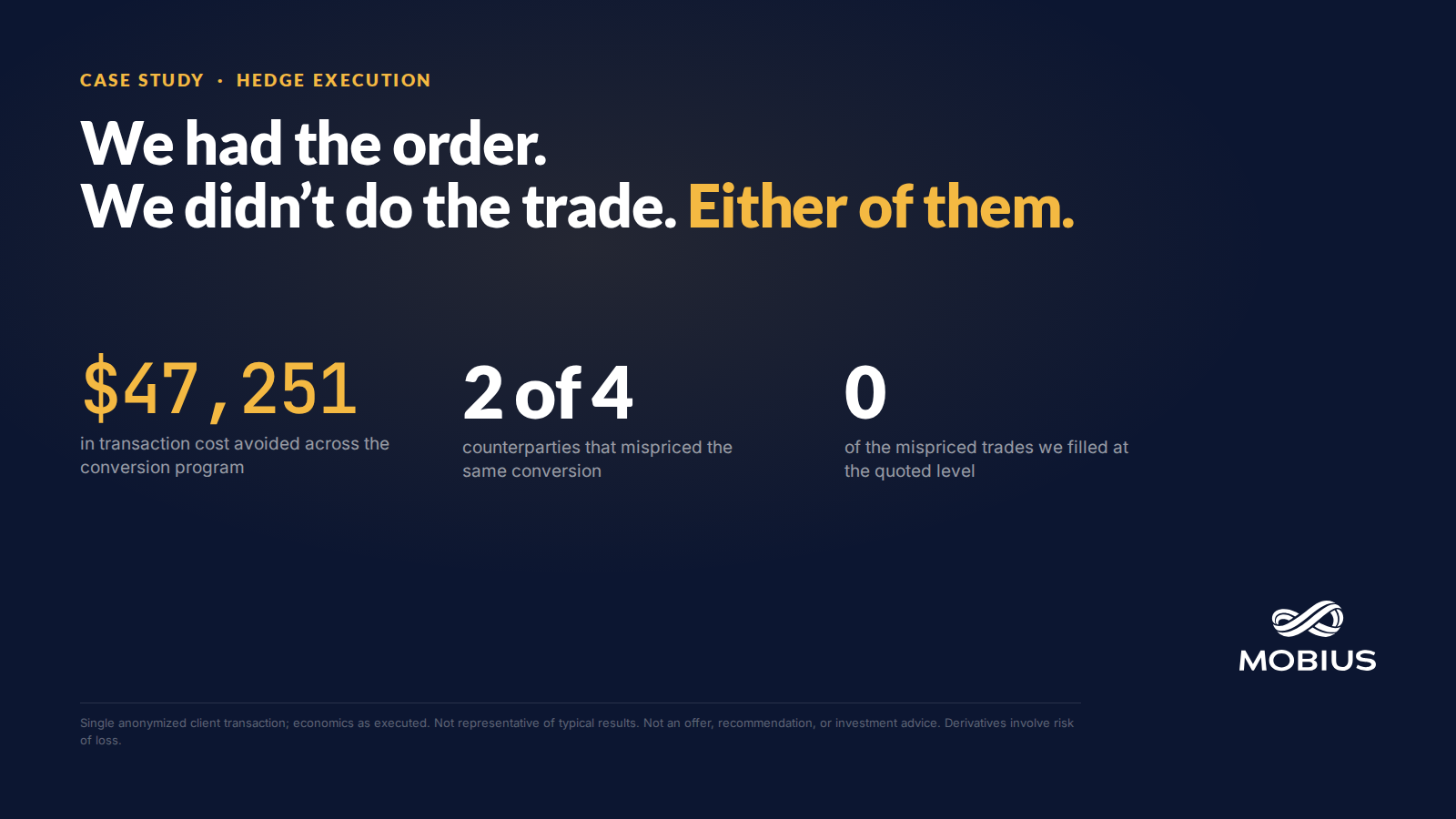
- Execution support - helping the client transact at fair, transparent pricing across banks and counterparties.
- Ongoing monitoring and valuation - marking positions to market, stress-testing, and reporting to the board, lenders, and auditors.
At Mobius Risk Group, that work is supported by the RiskNet™ CTRM platform for position management and reporting, the proprietary M(β)risk™ analytics methodology for quantifying and stress-testing exposure, and M-Direct indicative pricing for independent valuations.
Why does “unconflicted” matter in energy hedging?
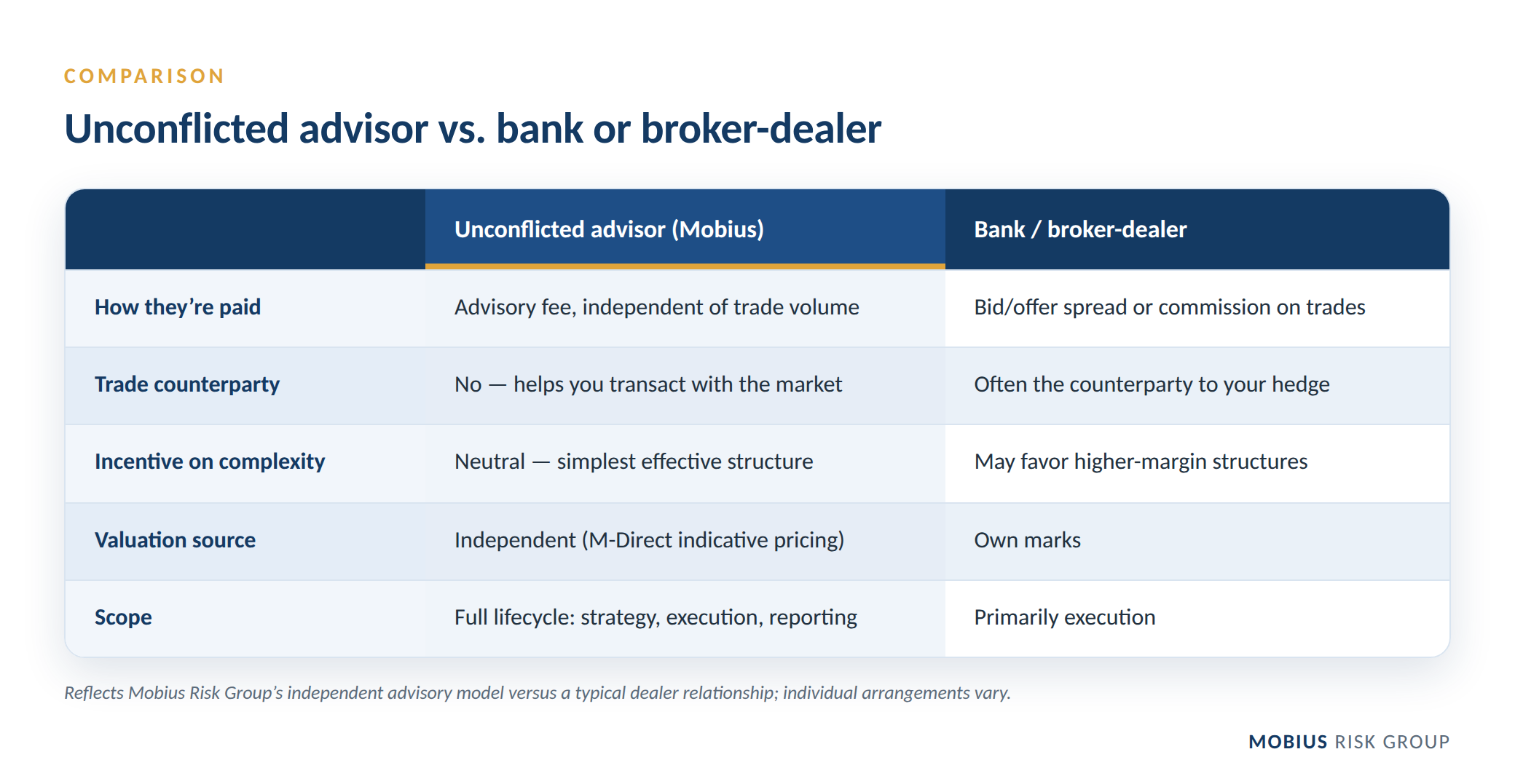
Much hedging advice comes from institutions that also make money when you trade - a bank that earns the bid/offer spread on your swap, or a broker paid on the volume a strategy generates. That creates a structural incentive to encourage more, or more complex, transactions. An unconflicted advisor does not sit on the other side of your trade and earns no spread on the instruments it recommends, so the incentive to over-trade or steer you toward high-margin structures is removed.
When should a company bring in a hedging advisor?
Companies typically engage an energy hedging advisor at the points where price risk becomes material to the business:
- A producer protecting drilling economics or a reserve-based lending (RBL) borrowing base.
- A midstream operator managing basis and frac-spread exposure.
- An industrial or chemical buyer locking input costs to protect margins.
- A CFO or treasurer who needs board-, lender-, and auditor-ready risk reporting.
- A private-equity sponsor or acquirer underwriting commodity risk inside a deal.
What should you look for when choosing one?
Beyond independence, evaluate an advisor on the depth of its analytics, the transparency of its pricing, the quality of its reporting technology, and its track record across commodities and market cycles. Mobius Risk Group has advised on commodity risk since 2002 from its Houston base, pairing seasoned advisors with proprietary technology - RiskNet™, M(β)risk™, and its market-intelligence suite - rather than relying on a single off-the-shelf tool.
Frequently asked questions
Is an energy hedging advisor the same as a broker?
No. A broker executes trades and is typically paid on commission or spread. An unconflicted advisor designs and monitors the overall risk strategy and earns no spread on the trades it recommends, so its incentives are aligned with reducing your risk rather than increasing trade volume.
What commodities does an energy hedging advisor cover?
Typically crude oil, natural gas, natural gas liquids (NGLs), refined products, and power - plus the related basis and spread risks. Mobius also supports chemical and industrial buyers managing input-cost exposure.
How is an unconflicted advisor paid?
Through an advisory fee that is independent of how much you trade, rather than through a bid/offer spread or commission. That removes the incentive to encourage unnecessary or overly complex transactions.
Do I still need my bank if I use an advisor?
Usually yes - banks remain important trading counterparties and lenders. The advisor helps you engage them on transparent, well-informed terms and independently values the resulting positions.
Can an advisor help with hedge accounting and lender reporting?
Yes. A core part of the role is producing auditable mark-to-market valuations and board-, lender-, and auditor-ready reporting, often through a CTRM platform such as RiskNet™.
Subscribe to receive the latest Mobius Research & updates