
August 30, 2026
Quick answer: A CTRM (commodity trading and risk management) system is software that centralizes physical and financial commodity positions, contracts, valuation, and risk exposure in one place. It replaces disconnected spreadsheets, giving traders, risk officers, and finance a single, auditable view of mark-to-market, hedge coverage, and settlement.
What does a CTRM system actually do?
A CTRM system captures the full lifecycle of a commodity trade — from deal capture and physical scheduling through valuation, risk, settlement, and accounting. Instead of a physical desk, a financial desk, and a treasury team each keeping their own spreadsheet, a CTRM holds one shared record. Every barrel, MMBtu, or ton and every offsetting swap or option sits in the same book, so mark-to-market and net exposure are calculated from a single source rather than reconciled after the fact. Mobius's RiskNet is commodity trading and risk management software built for exactly this: an unconflicted view of physical and paper positions for producers, midstream operators, and industrial buyers. The RiskNet core platform is onboarded and ready to use in as little as 48 hours across multiple commodities, with audited controls. Integrations — price feeds, ETRM/ERP, banks and exchanges — data migration and customization are what extend a full rollout.
Related: natural gas hedging strategies.
Why do spreadsheets stop working for commodity risk?
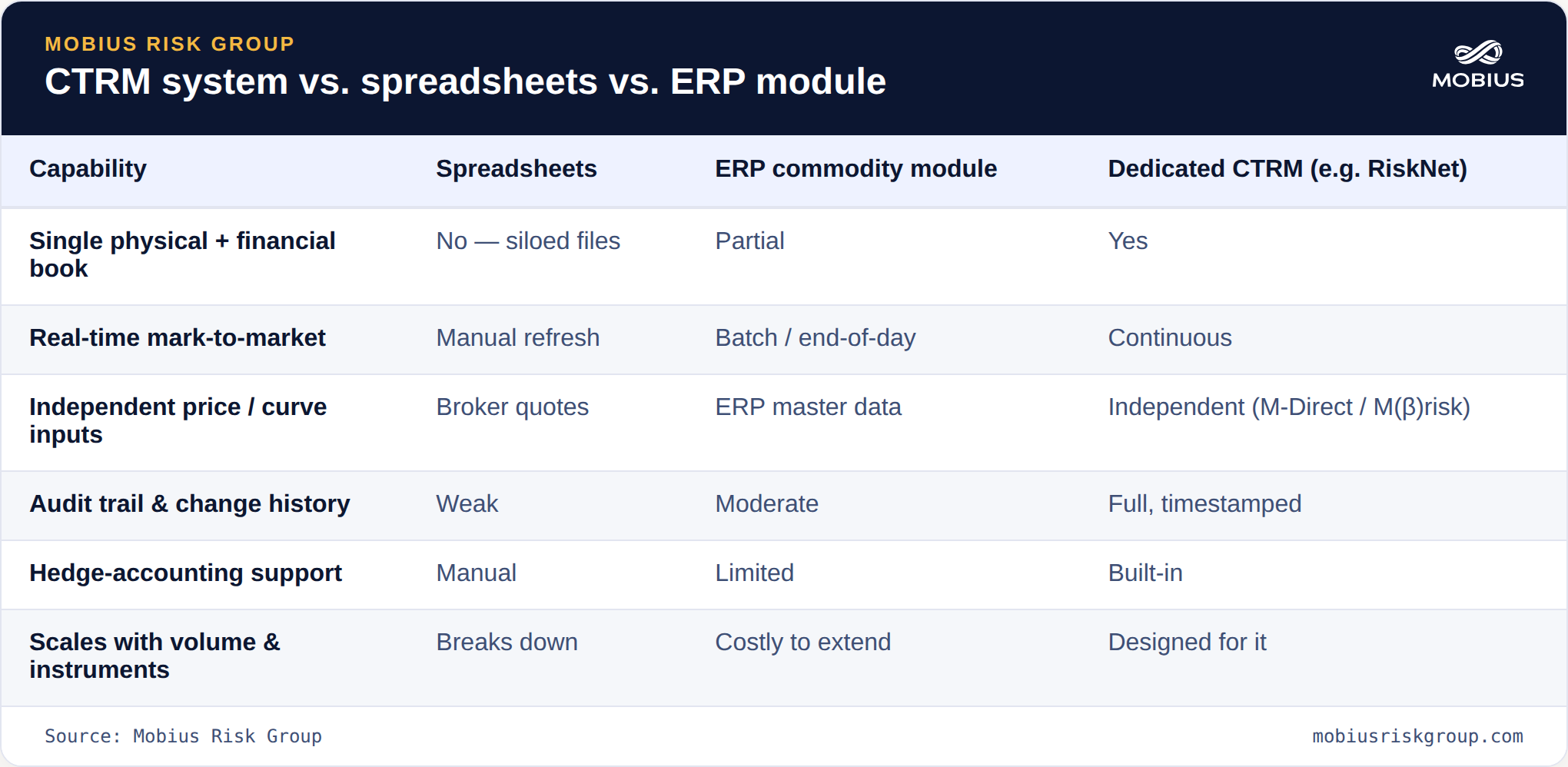
Spreadsheets are flexible, but they break down as volume, instrument variety, and headcount grow. Version control fails when three people edit the same hedge file; a single broken formula can misstate exposure for weeks; and there is rarely an audit trail showing who changed what and when. For a CFO or risk officer signing off on hedge effectiveness, that lack of traceability is the real risk. A CTRM system enforces one valuation methodology, timestamps every change, and lets finance reproduce any number on demand.
How does a CTRM calculate mark-to-market and exposure?
The engine values each position against a curve — forward prices for the relevant commodity, location basis, and time — then aggregates across the portfolio to show net length or shortness by commodity, delivery period, and counterparty. Good systems let risk teams stress the book against price shocks and see how much of forecast production or consumption is actually hedged. Mobius pairs RiskNet with M(β)risk analytics and M-Direct indicative pricing so the marks reflect real, independent market data rather than a single broker's quote.
Who on the team uses a CTRM, and for what?
Traders use it to capture deals and see position in real time. Schedulers and operations use it to manage physical delivery and inventory. Risk officers use it to monitor limits, VaR, and hedge coverage. Treasury and accounting use it for settlement, margin, and hedge-accounting disclosure. The value is that all four are reading the same numbers — the recommendation and the underlying position never diverge between a trading screen and a board deck.
See also: RiskNet platform.
CTRM system vs. spreadsheets vs. ERP module
Frequently asked questions
What does CTRM stand for?
CTRM stands for commodity trading and risk management. A CTRM system is the software that manages commodity positions, valuation, and risk across physical and financial trades.
Is a CTRM the same as an ETRM?
ETRM (energy trading and risk management) is a subset of CTRM focused on energy commodities like crude, natural gas, and power. CTRM covers energy plus agriculture, metals, and other commodities. RiskNet supports energy and broader commodity exposures.
Do I need a CTRM if I only hedge occasionally?
Even occasional hedgers benefit from one auditable book once positions, counterparties, or instruments multiply. The tipping point is usually when spreadsheet reconciliation starts consuming more time than the hedging decisions themselves.
How is RiskNet different from other CTRM platforms?
RiskNet is delivered by Mobius, an independent, unconflicted risk advisor — so the platform, the pricing inputs (M-Direct, M(β)risk), and the advisory sit together without a trading book on the other side of your position.
Subscribe to receive the latest Mobius Research & updates