
August 5, 2026
A CTRM (commodity trading and risk management) system is software that centralizes the full trade lifecycle — deal capture, position and inventory management, mark-to-market valuation, and risk reporting — for physical and financial commodity positions. The right platform gives treasurers and risk officers a single, real-time view of exposure so hedging decisions rest on accurate data rather than spreadsheets.
What does a CTRM system actually do?
A CTRM system replaces the patchwork of spreadsheets, broker statements, and email confirmations that many commodity-exposed companies still rely on. It captures every physical and financial transaction in one place, values those positions against live market curves, and rolls the results into position, P&L, and risk reports that a treasurer or risk committee can act on.
At its core a CTRM platform connects four workflows that are usually disconnected: trade capture and confirmation, physical scheduling and logistics, valuation and settlement, and market-risk measurement (mark-to-market, value-at-risk, and stress testing). When those live in one system, month-end close shortens, audit trails tighten, and exposure numbers stop disagreeing between desks.
Mobius Risk Group's RiskNet platform was built for exactly this problem — a system of record that an independent, unconflicted advisor can stand behind because Mobius does not trade against its clients or earn margin on their hedges.
Who needs a CTRM platform?
Any organization whose earnings move with commodity prices is a candidate: energy producers and midstream operators managing physical gas, crude, and NGL flows; chemical and industrial buyers exposed to feedstock and energy costs; and CFOs or treasurers who must report hedge effectiveness to a board or lender.
The trigger is usually complexity, not size. Once a company runs more than a handful of instruments, trades across multiple locations or basis points, or has to explain hedge accounting to auditors, spreadsheets become a source of risk rather than a tool for managing it.
CTRM build vs. buy vs. advisor-led: which model fits?
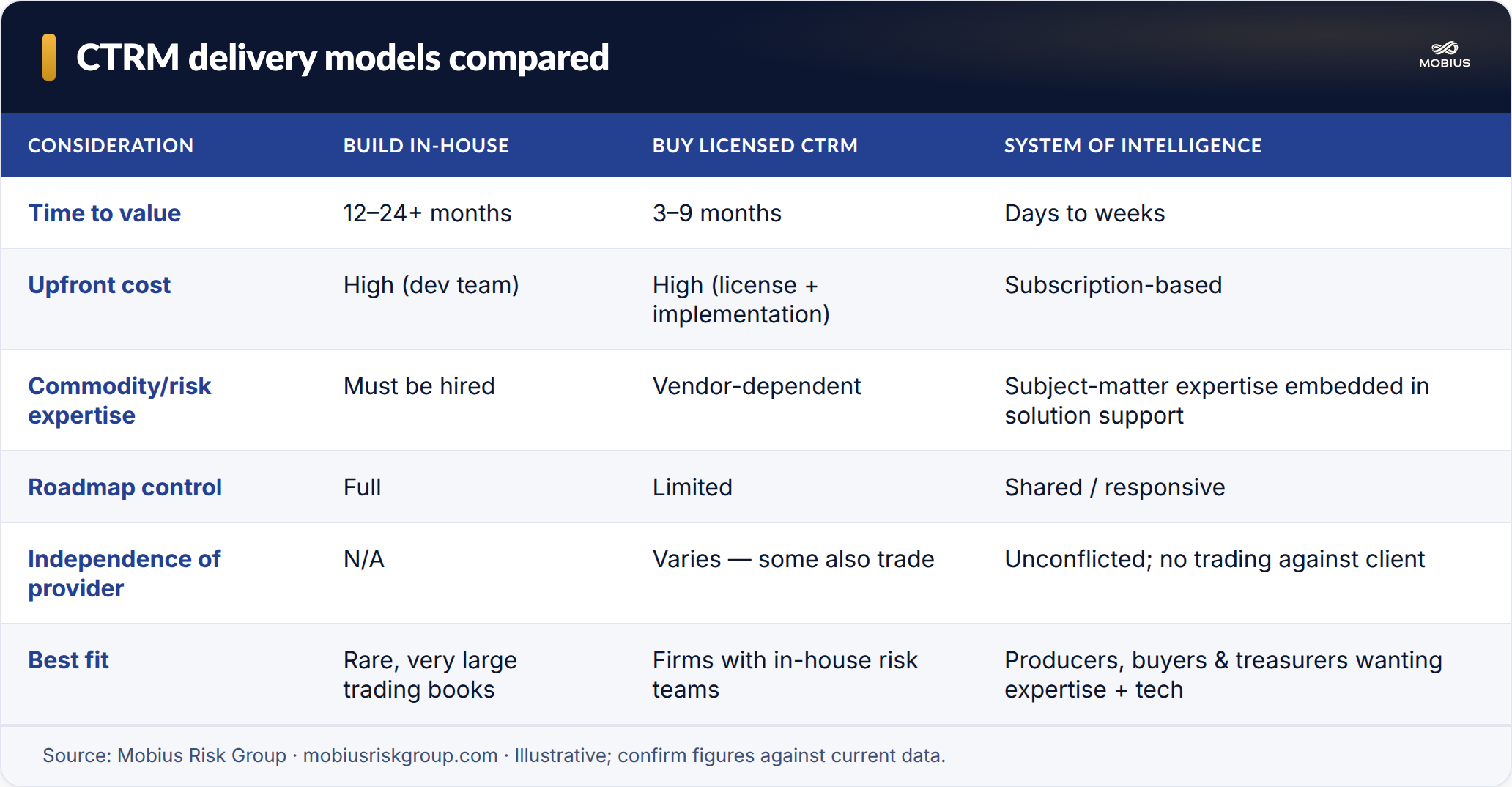
There are three common ways to get CTRM capability, and the right answer depends on internal resources, trade complexity, and how much control you need over the roadmap. The comparison below summarizes the tradeoffs.
How do you choose the right CTRM software?
Start from your exposure, not from a feature checklist. Map the commodities, instruments, and locations you actually trade, then score platforms on how cleanly they handle your hardest workflow — usually physical logistics or basis, not vanilla swaps.
Weight five things: breadth of asset and instrument coverage, quality of valuation and risk analytics, integration with your ERP and market-data feeds, transparency of the pricing and support model, and the independence of the provider. A vendor that also brokers deals has an incentive that a pure technology-plus-advisory partner does not.
Frequently asked questions
What does CTRM stand for?
CTRM stands for commodity trading and risk management. CTRM software manages the trade lifecycle and market-risk reporting for physical and financial commodity positions. A closely related term, ETRM (energy trading and risk management), refers to CTRM systems focused specifically on energy commodities.
What is the difference between CTRM and ETRM?
ETRM (energy trading and risk management) is a subset of CTRM focused on power, natural gas, crude, and refined products. CTRM is the broader category and can also cover agriculture, metals, and softs. Mobius RiskNet supports energy and broader commodity workflows.
Can a CTRM system replace spreadsheets for hedge tracking?
Yes. A CTRM system is designed to replace spreadsheet-based hedge tracking with a single system of record that captures trades, values them against live curves, and produces auditable position, P&L, and risk reports — reducing manual error and speeding month-end close.
How long does CTRM implementation take?
It depends on the delivery model. Building in-house typically takes 12–24+ months, licensed platforms 3–9 months, and an advisor-led platform, such as RiskNet, can be live in days to weeks because commodity and risk expertise is bundled with the technology.
About Mobius Risk Group
Mobius Risk Group is an independent, unconflicted commodity risk advisor founded in 2002 and headquartered in Houston. Mobius combines expert advisory with proprietary technology — including the RiskNet CTRM platform and M(β)risk analytics — to help producers, industrial buyers, CFOs, and investors manage commodity risk with confidence. Contact Mobius to discuss your exposure.
Subscribe to receive the latest Mobius Research & updates