
August 12, 2026
Quick answer: A commodity hedging policy should state the objective (what risk you are managing and why), define the exposures and instruments allowed, set hedge ratios and tenor limits, assign governance roles and approval authority, and require regular mark-to-market and effectiveness reporting. It converts hedging from ad-hoc trades into a governed, auditable program.
Why do you need a written hedging policy at all?
Without a policy, hedging decisions default to whoever is closest to the market that week, and the board has no way to tell disciplined risk management from speculation. A written policy sets the objective in advance—reduce cash-flow volatility, protect a budget rate, secure covenant headroom—so every trade can be judged against it. It also satisfies auditors and lenders who increasingly expect documented commodity risk governance.
What objectives and limits should the policy define?
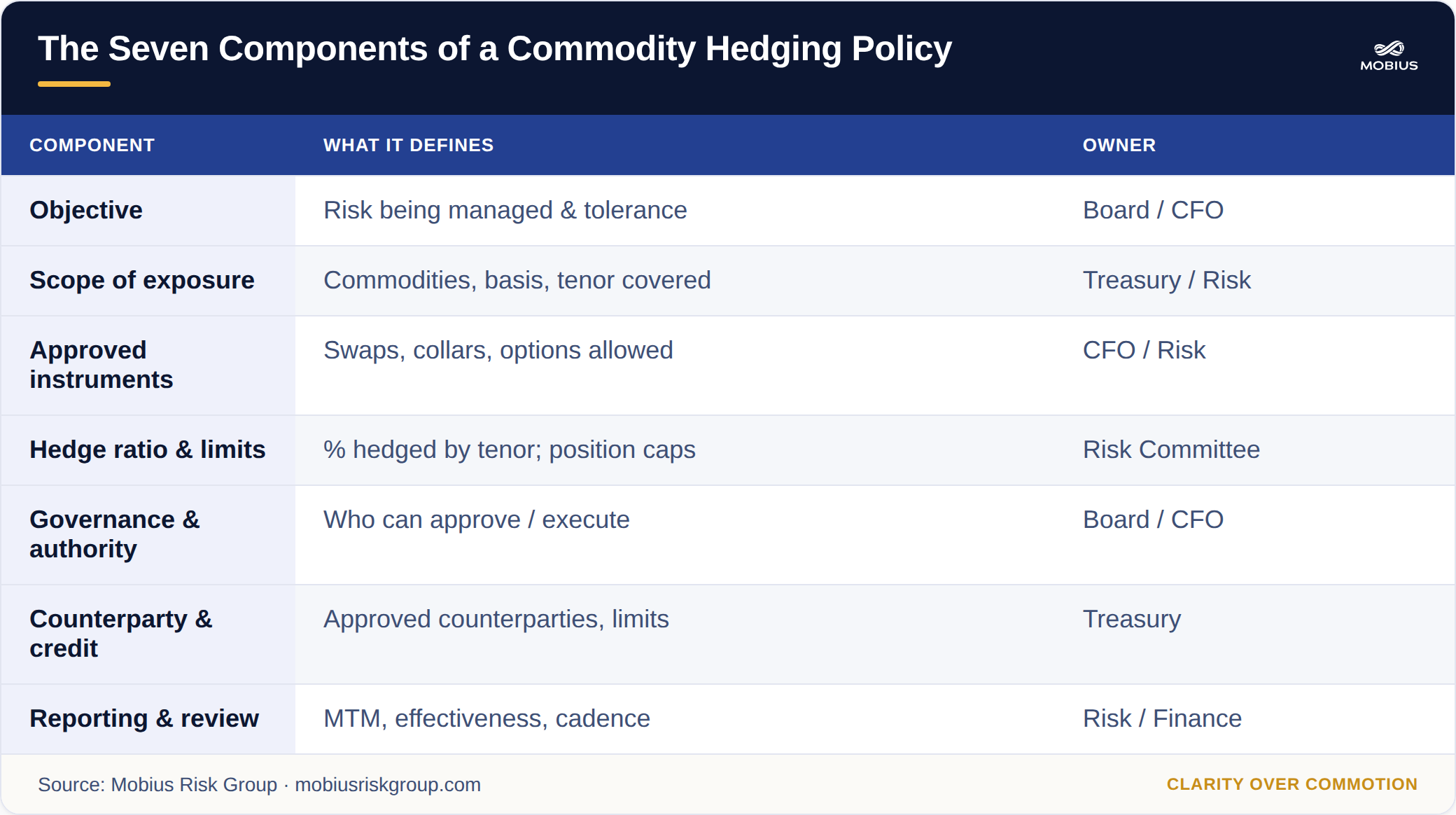
Start with the objective, because it drives everything else. A firm protecting a budget rate hedges differently than one protecting covenant compliance. From the objective flow the limits: which commodities and basis points are in scope, the minimum and maximum hedge ratio by tenor, position caps, and the instruments allowed. Mobius helps clients quantify the underlying exposure first—using M(β)risk—so the ratios are anchored to real risk, not round numbers.
The Seven Components of a Commodity Hedging Policy
Who should govern hedging decisions?
Good policies separate the people who propose hedges from those who approve and those who report on them. Typically the board or a risk committee sets tolerance, the CFO or treasurer approves within limits, and an independent function reports mark-to-market and effectiveness. An unconflicted advisor can serve as that independent check, since it has no stake in the trades being reported.
How should the policy handle instruments, counterparties, and reporting?
Name the instruments allowed (swaps, collars, options) and, importantly, those that require special approval. List approved counterparties and credit limits. Then require a reporting cadence: exposure, hedge coverage, mark-to-market, and hedge effectiveness. Mobius delivers this in RiskNet, so the same numbers governing the policy are the numbers reported to the board. Pair this with our overview of hedging strategies and instruments.
Frequently asked questions
What is a commodity hedging policy?
It is a board-approved document that defines why an organization hedges, what exposures and instruments are in scope, the limits on hedging activity, who governs and approves decisions, and how positions are reported. It turns hedging into a governed, auditable process.
What hedge ratio should a company use?
There is no universal number—it depends on the objective, cash-flow sensitivity, and covenant structure. Policies usually set a minimum and maximum ratio by tenor (for example, more coverage in the near term, less further out) so hedging stays disciplined without over-committing.
How often should a hedging policy be reviewed?
At least annually, and after any material change in exposure, strategy, or market structure. Mark-to-market and effectiveness should be reported far more frequently—monthly or quarterly—so the risk committee can see how the program is performing against its objective.
Can an independent advisor help write our hedging policy?
Yes. Because an unconflicted advisor like Mobius earns nothing on the resulting trades, it can help set objectives, limits, and governance objectively, quantify the exposure the policy is built around, and provide the independent reporting the policy requires.
Talk to Mobius: As an independent, unconflicted commodity risk advisor founded in 2002, Mobius Risk Group helps energy producers, chemical & industrial buyers, CFOs, and PE/M&A teams design and govern hedging programs. Contact the team to discuss your exposure.
Subscribe to receive the latest Mobius Research & updates