
August 17, 2026
Quick answer: In an energy M&A deal, commodity price risk is assessed by mapping the target's physical and financial exposure, stress-testing cash flows against forward curves, and valuing any existing hedge book. Buyers then price that risk into the bid, layer in acquisition hedges at signing, and set post-close hedging policy—ideally with an unconflicted advisor rather than a transacting bank.
What is commodity price risk in an energy acquisition?
Commodity price risk in energy M&A is the chance that movements in crude, natural gas, NGLs, power, or refined-product prices change the value of the asset between signing and close—or erode the returns the buyer underwrote. In leveraged energy deals, a single volatile winter or a wide basis blowout can swing EBITDA by double digits, which is why lenders and private-equity sponsors treat commodity exposure as a first-order diligence item, not a footnote.
The exposure is rarely one-dimensional. A midstream target may carry percentage-of-proceeds contracts, a producer may hold an existing derivative book, and a chemical buyer may have take-or-pay obligations. Each of these behaves differently as the forward curve moves, so the first job of diligence is to inventory every source of price sensitivity.
How do you quantify a target's commodity exposure?
Quantification starts with a clean exposure map: volumes by commodity, by delivery point, by month, split into physical positions and financial hedges. That map is then run against current forward curves and a set of stress scenarios—a mild parallel shift, a curve steepening, and a location-basis shock at the target's actual delivery hubs.
Two numbers matter most to a buyer. The first is the unhedged cash-flow-at-risk over the underwriting horizon: how much projected EBITDA could disappear under a defensible downside. The second is the mark-to-market and quality of the existing hedge book—its tenor, counterparties, margining terms, and whether it actually offsets the physical position or introduces new basis risk. A hedge book that looks protective on a summary page can hide unmargined credit exposure or the wrong index.
How does commodity risk change the deal price?
Commodity risk shows up in valuation three ways. It sets the discount a buyer applies to volatile, unhedged cash flows; it becomes a purchase-price adjustment when the target's hedge book carries a material positive or negative mark at close; and it drives financing terms, because lenders size debt against hedged, not spot, cash flows. Sellers who bring a well-structured, transparent hedge portfolio to the table routinely defend a higher multiple than those who leave the buyer to price uncertainty.
When should you hedge — before or after close?
Timing is a deal-specific judgment. Acquisition (or “deal-contingent”) hedges can lock economics between signing and close, protecting the buyer’s underwritten returns from a selloff during a long regulatory review. Post-close, the priority shifts to putting a durable hedging policy in place that matches the new capital structure and the lender’s covenants. The comparison below shows how the hedging question differs at each stage of the transaction.
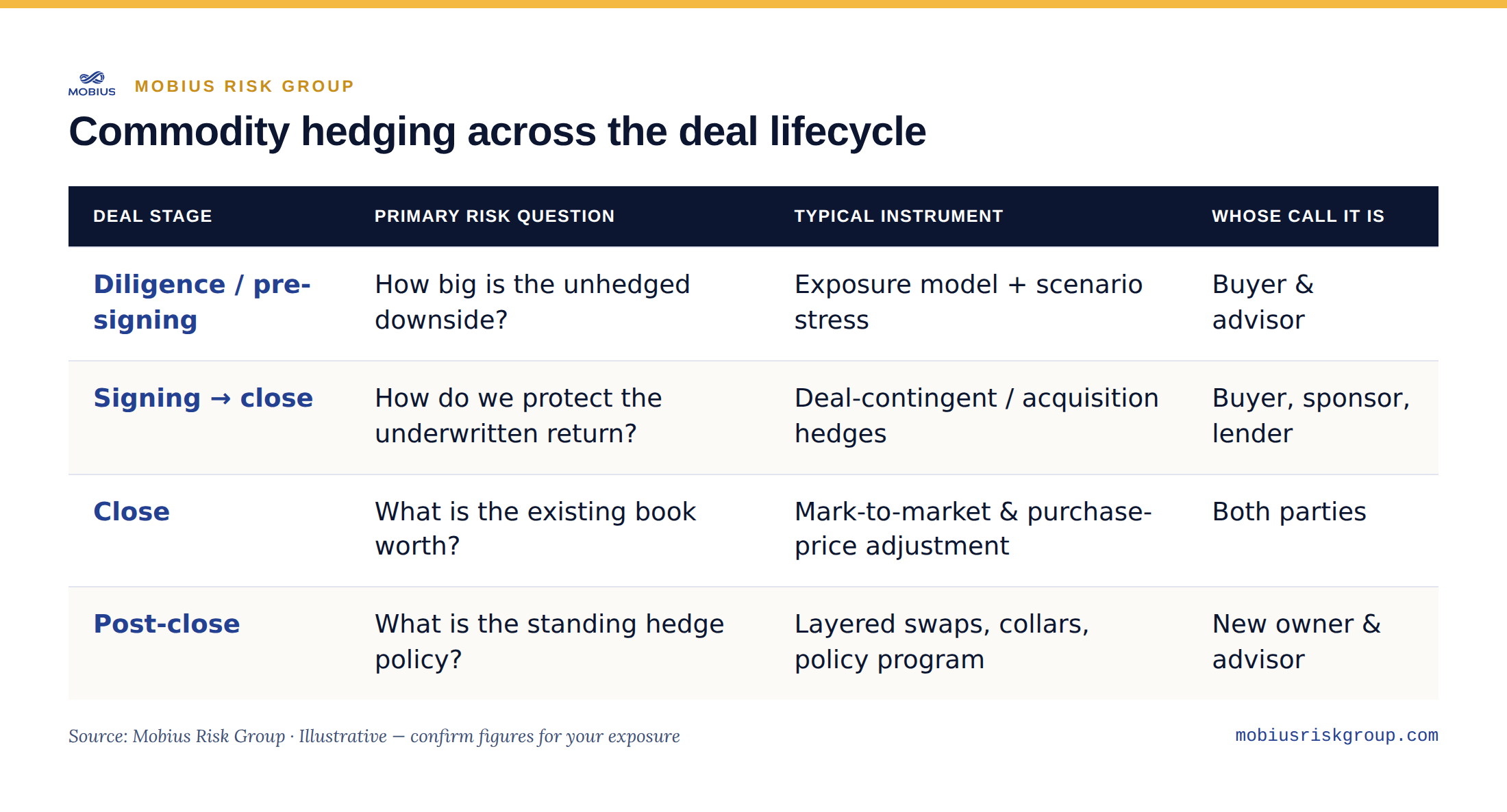
The through-line: hedging decisions in M&A should be driven by the buyer’s risk tolerance and covenant package—not by whichever counterparty is also quoting the trade. That is the core argument for using an unconflicted commodity risk advisor on a deal team.
Who sees commodity risk differently across the deal?
Every party at the table underwrites the same barrels and molecules to a different end. The private-equity buyer cares about downside protection for the underwriting case; the seller wants to preserve upside and defend the multiple; the lender cares almost entirely about covenant headroom and hedged debt service. Aligning those views early—often through a shared exposure model and a common hedging framework—removes a major source of late-stage renegotiation. It is also where an independent advisor adds the most value, because the same numbers can be presented consistently to all sides.
How Mobius supports energy M&A diligence
Mobius Risk Group is an independent, unconflicted commodity risk advisor: we do not trade against our clients or earn volume-based commissions, so our diligence work is aligned only with the buyer or seller who engages us. On energy transactions we build the exposure map, stress-test cash flows with our M(β)risk analytics, value and diligence the existing hedge book, and design the acquisition and post-close hedging program—reported and monitored on our RiskNet platform. For deal teams weighing bank-desk versus independent advice, our primer on the difference between an unconflicted advisor and a bank or broker is a useful starting point.
Frequently asked questions
Is commodity price risk always a reason to lower a bid?
Not always. Well-structured hedges and transparent exposure data can actually support a higher multiple, because the buyer has to price in less uncertainty. Unhedged, opaque exposure is what typically forces a discount.
What is a deal-contingent hedge?
A deal-contingent (or acquisition) hedge is a derivative that only takes effect if the transaction closes. It lets a buyer lock commodity economics between signing and close without taking on a hedge if the deal falls through.
Why use an independent advisor instead of the acquisition bank?
A bank that is financing the deal and quoting the hedges has an inherent conflict. An unconflicted advisor is paid for advice, not trade volume, so hedge structure and sizing are driven by the buyer's risk tolerance alone.
Does commodity risk matter in midstream deals without direct price exposure?
Yes. Even fee-based midstream assets carry indirect exposure through volume sensitivity, percentage-of-proceeds contracts, and counterparty credit that moves with commodity prices.
Subscribe to receive the latest Mobius Research & updates