
August 16, 2026
Quick Answer
Commodity price risk in energy M&A is the chance that oil, gas, or power price moves change a target's value between signing and integration. Due diligence examines the target's existing hedge book, basis exposure, mark-to-market positions, and margin obligations so the buyer can price that risk accurately.
Why does commodity price risk matter in energy M&A?
In an energy acquisition, much of the target's value is a direct function of forward commodity prices. A producer's cash flow, a midstream operator's throughput economics, and an industrial buyer's margins all move with the curve. That means the price deck a buyer underwrites is one of the largest swing factors in the deal, and any hedges already in place can materially change the economics the buyer inherits. Getting this wrong is one of the most expensive mistakes in energy dealmaking.
What should buyers examine in a target's hedge book?
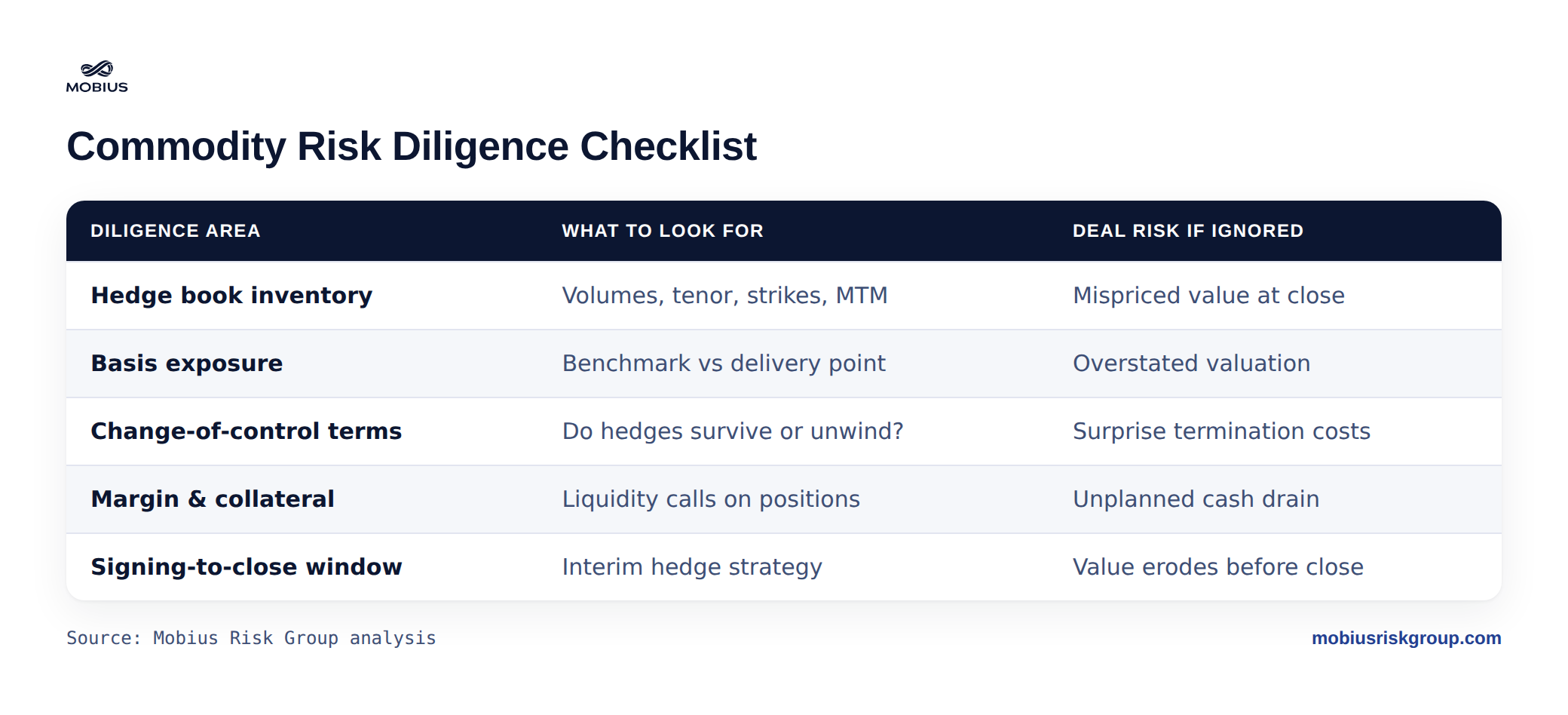
The existing derivatives portfolio is the first place price risk hides. Diligence should map every position: instrument type, volumes, tenor, strike levels, counterparties, and current mark-to-market. A deeply in-the-money or out-of-the-money book changes the value transferred at close. Buyers also need to understand margining and collateral terms, whether hedges survive or terminate on change of control, and how the positions align (or conflict) with the buyer's own view and existing exposures.
How does basis risk affect deal value?
Headline benchmark hedges can mask basis exposure, the difference between the benchmark price and the price at the target's actual delivery point. A target hedged at a national benchmark but selling into a discounted regional market still carries meaningful uncovered risk. Underwriting the deal on benchmark prices alone can overstate value. Quantifying location and quality basis is essential to an accurate valuation, and it is frequently underestimated.
What hedging happens around the transaction itself?
Beyond diligence, price risk exists in the deal window. Private equity buyers and acquirers often hedge commodity exposure between signing and close to protect the underwritten value, and they plan a day-one hedging strategy for the combined entity. Deciding what to layer on, unwind, or restructure at close is its own workstream, best handled by an advisor with no stake in the transaction volume. Mobius supports acquirers and PE sponsors with independent exposure analysis and hedge strategy built on the target's real positions, reinforced by M(β)risk analytics. Because Mobius is an unconflicted commodity risk advisor, the analysis reflects the buyer's economics, not a dealer's incentive to transact.
Commodity risk diligence checklist
Frequently asked questions
Who handles commodity risk diligence in an energy deal?
It is a joint effort across the deal team, but the specialized analysis of hedge books, basis, and mark-to-market is often supported by an independent commodity risk advisor who can value the positions objectively.
Should a hedge book increase or decrease a target's price?
Either. An in-the-money hedge book can add value; an out-of-the-money book, or one with onerous margin or change-of-control terms, can subtract it. The point of diligence is to quantify the effect rather than assume it.
Why use an independent advisor instead of the deal's bank?
A bank that may also transact the hedges has an incentive tied to the trade. An unconflicted advisor values and structures the risk with only the buyer's outcome in view, which matters most when the positions are large.
De-risk your next energy transaction
Mobius Risk Group advises acquirers and private equity sponsors on commodity exposure in energy M&A as an independent, unconflicted advisor. Schedule a conversation with our team →
Subscribe to receive the latest Mobius Research & updates