
April 27, 2026
QUICK ANSWER
A commodity risk analytics platform is software that consolidates physical and financial positions, marks them to market against live curves, and runs scenario and risk-pricing analysis in one place. It replaces the spreadsheets most teams start with, giving a single, auditable view of exposure so hedging decisions are based on measurement rather than a stale workbook.
As a hedging program grows, the spreadsheet that once tracked it becomes the risk. Positions live in different files, the mark-to-market is only as fresh as the last manual update, and a single broken cell can misstate the whole book. A commodity risk analytics platform exists to solve that — to turn a pile of positions into one measured, controllable view.
What does a commodity risk analytics platform do?
At its core, a platform answers three questions continuously: what is my exposure, what is it worth right now, and what happens to it under stress. In practice that means aggregating physical and financial positions, marking them to market against live forward curves, surfacing basis and location risk, running scenarios and risk pricing, and producing reporting an auditor or lender can trust. The value is not any single number — it is having all of them in one reconciled place.
Why not just use spreadsheets?
Spreadsheets are where most programs begin, and they work until scale, complexity, or scrutiny catches up. The comparison below shows where a purpose-built platform pulls ahead.
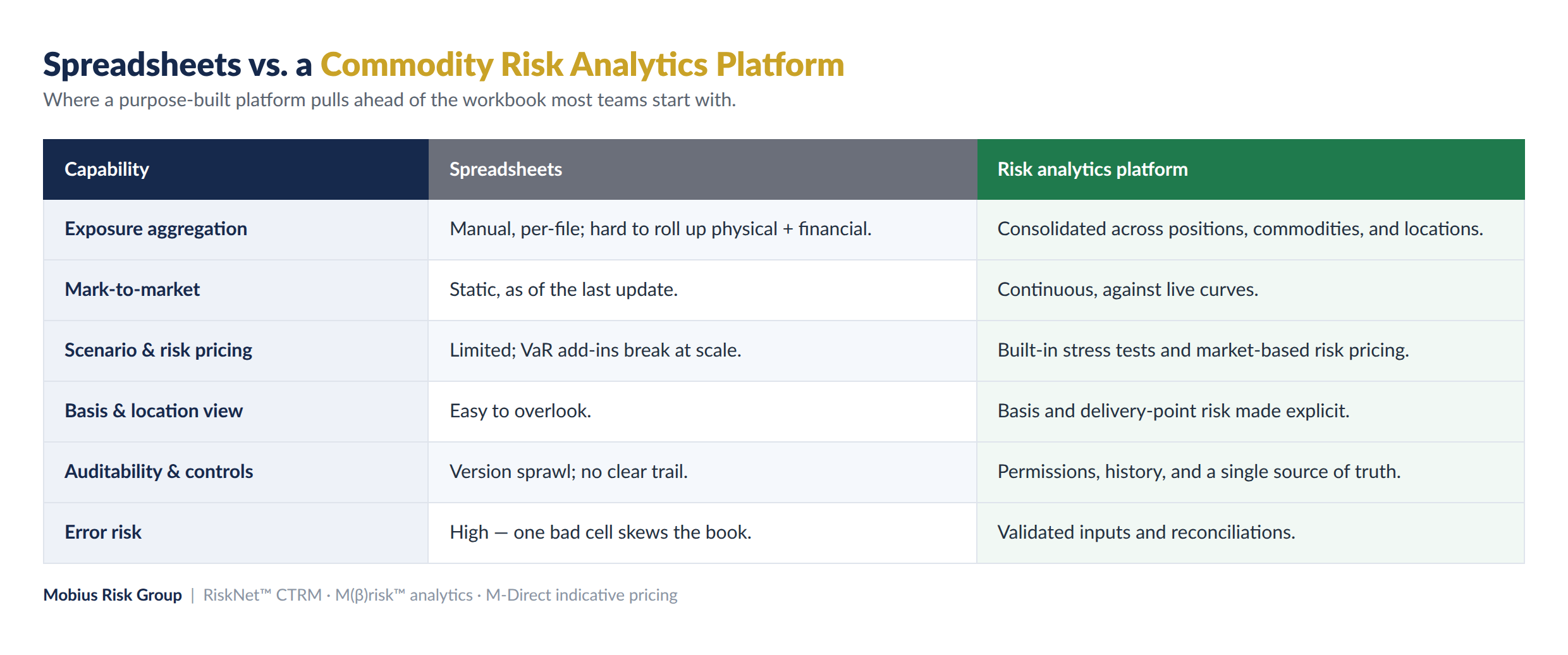
The pattern is consistent: spreadsheets are fine for a snapshot but weak on aggregation, live valuation, scenario analysis, and control. A platform makes those continuous and auditable — which matters most exactly when markets are volatile and decisions are time-sensitive.
What should you look for in a commodity risk analytics platform?
- Physical + financial in one view — exposure that nets across the whole position, not just derivatives.
- Live mark-to-market — valuation against current curves, not a periodic manual refresh.
- Scenario and risk pricing — stress tests and market-based risk measures that hold up at scale, beyond a simple VaR add-in.
- Basis and location analytics — delivery-point and basis risk made explicit, not buried.
- Controls and auditability — permissions, history, and a single source of truth.
- Reporting — board, covenant, and management packs generated from the same data.
Should you build a platform or buy one?
A few large trading organizations build in-house, but most companies get there faster and cheaper by adopting a purpose-built system. The deciding factors are how complex the portfolio is, whether physical and financial need to sit together, and how much control and audit trail lenders or boards expect. For most hedgers, buying a proven platform — and pairing it with advisory support — beats maintaining a fragile spreadsheet stack or a costly internal build.
How does Mobius Risk Group approach analytics?
Mobius Risk Group built its platform around exactly this problem. RiskNet™, its CTRM platform, tracks physical and financial positions, exposure, and mark-to-market in one place; M(β)risk™ adds market-based risk pricing and scenario analysis designed to overcome the limits of traditional VaR; and M-Direct provides indicative pricing so valuations and quotes can be benchmarked independently. Because Mobius is an unconflicted advisor, the analytics serve the client’s decisions rather than a trading desk’s.
Frequently Asked Questions
What is a commodity risk analytics platform?
Software that consolidates physical and financial positions, marks them to market against live curves, and runs scenario and risk analysis in one place — replacing spreadsheets with a single, auditable view of exposure.
How is it different from a CTRM system?
A CTRM (commodity trading and risk management) system manages positions and transactions; the analytics layer adds valuation, scenario analysis, and risk pricing on top. Modern platforms, including RiskNet™, combine both.
Is a platform worth it over spreadsheets?
Once a book spans multiple commodities, locations, or counterparties — or faces lender and board scrutiny — the control, live valuation, and scenario analysis of a platform outweigh the flexibility of spreadsheets.
What is market-based risk pricing?
An approach that prices the actual market risk to cash flow and capital plans, rather than relying on assumptions of constant volatility and correlation that limit traditional VaR. Mobius built M(β)risk™ for this purpose.
Subscribe to receive the latest Mobius Research & updates