
July 13, 2026
QUICK ANSWER
When you ask several banks for a hedge price at once, they can tell they are being shopped and fade their quotes — and you have signaled your intentions to the market before you are even ready to trade. The fix is to value the derivative independently first, using a live indicative-pricing feed, so you already know what the trade is worth and can go to market once, quietly, only when you are ready to act.
The moment you reach out to the market for a price, you have already told the market something. That is the part of hedging that rarely makes it into the strategy meeting. Whether you are a producer protecting a floor, an end user capping input costs, or any participant managing exposure to a commodity, you spend enormous energy deciding what to hedge — how much, at what level, in what structure — and comparatively little on how you go to market to get it done. Yet the mechanics of that outreach can quietly cost more than the structure itself.
What does it mean to "show your cards" when hedging?
Showing your cards means revealing your intentions to the market before you have transacted: which direction you need to go, roughly how much, and when. Counterparties who know what you need — and know you are still shopping — have every incentive to quote you worse. Keeping your strategy confidential until you are ready to act is what preserves your pricing power.
Why does shopping multiple banks make pricing worse?
The instinct is reasonable: to get the best price, get more prices. So the request goes out to a handful of banks at once — sometimes as a single email with several counterparties on the line, or BCC'd so no one sees the others.
The trouble is that the banks can tell. Desks that trade with each other, clear through the same brokers, and see the same flow do not need to be told they are in a competition — they can feel it. And the instant a counterparty senses it is being shopped, its incentive flips. Rather than sharpening the price to win the trade, it fades. The level you were quoted five minutes ago backs away from you, because the desk now assumes someone else will take the other side and it has no reason to lead. Blast the same indicative request to five banks and, more often than not, you have made all five of them worse at once.
There is a second-order effect, too. Those desks hedge their own exposure back-to-back through the same brokers you would never see. Information about a participant looking to trade a particular tenor or shape — to buy protection or to sell it — does not stay in one inbox. It moves. By the time you are ready to actually transact, the market you are transacting into already knows you are coming.
The hidden cost: you may not even be ready to trade
Much of the time, the outreach is not even a real order — it is reconnaissance. You want the lay of the land: where the curve is trading, what a collar would look like, how a cap or a floor stacks up against a swap. That is a perfectly sensible thing to want before a board meeting, a budget cycle, or a lender conversation.
But there is no such thing as a quiet question to a trading desk. The act of asking puts your intentions into the market whether you are ready to act on them or not. What was meant as a fact-finding exercise becomes a signal — one you cannot take back, sent at a moment when you had no intention of trading. The information is now out there, and you gained nothing durable in exchange for it.
The back-and-forth tax
Even setting leakage aside, the conventional process is slow and leaky by construction. A hedger without a live price feed has to ask for everything — the tenor, the shaped volumes, the swap level, the floor, the cap, the collar, the hypothetical if prices move. Each of those is another email, another callback, another day. Ten, twelve, fifteen messages later, you have a rough picture and a bottleneck, and every one of those touches was another chance to reveal where you are headed. The friction is not just an annoyance; it is exposure spread across a dozen small disclosures.
How to price a hedge without tipping the market
The alternative is to reverse the order of operations. Instead of pricing by asking, you price before asking — arriving at a defensible value for the derivative independently, on your own side of the table, and only approaching a counterparty when you already know what the trade is worth and you are genuinely ready to do it.
That requires a bank-quality view of value that lives on your side of the table rather than the dealer's. With a live indicative-pricing feed, you can see where a swap, a floor, a cap, or a collar should price across the tenor you care about, run the hypotheticals privately, and understand the marketing charge a bank is baking in — all without sending a single order. When you finally do go to the market, it is once, with conviction, at a level you have already validated: not as a shopper working the phones, but as a counterparty who knows exactly what they want and what it is worth.
Does this apply to producers and end users alike?
Yes. The dynamic is identical whether you are hedging a sale or hedging a purchase — the structures simply flip to match your exposure. A producer buying downside protection and a manufacturer or utility capping its input costs both face the same reality: ask the market for a price and you have told the market what you are trying to do. The discipline of pricing privately and moving once protects every hedger, regardless of which side of the barrel they sit on.
How Mobius Risk Group helps
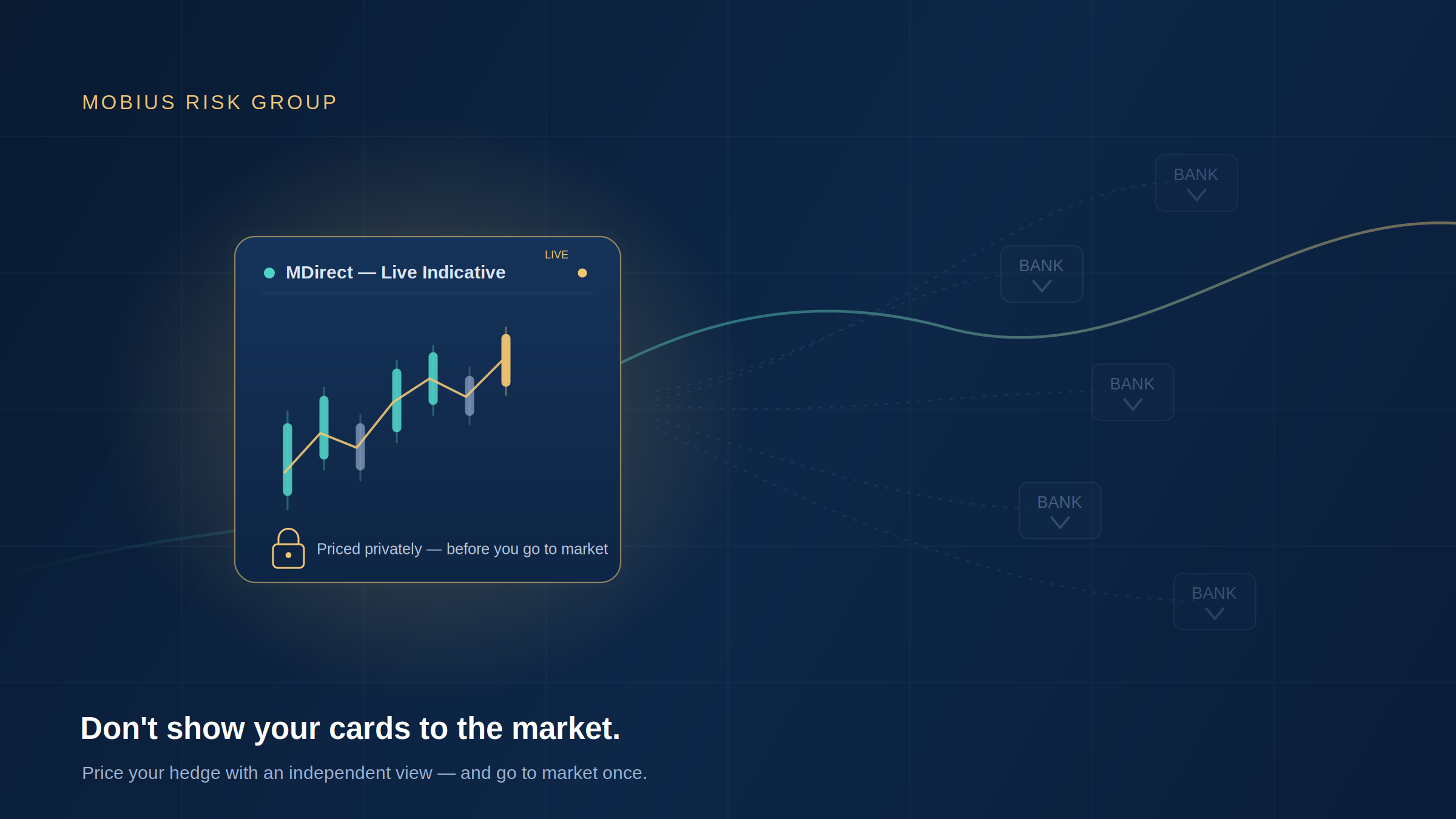
Mobius gives clients that independent, bank-quality view through M-Direct, an indicative-pricing platform built for hedgers rather than dealers. It refreshes live — every few seconds rather than every fifteen or twenty minutes — across WTI, natural gas, Brent, dated Brent, basis, and crude differentials, with custom tenors, shaped volumes, swaps, put floors, call ceilings, cashless collars, and hypothetical scenarios all available on demand. The marketing charge a counterparty bakes in to cover its credit and liquidity cost is shown explicitly, so you can back-calculate what a bank is actually charging and push back from a position of knowledge rather than hope. Because Mobius earns no spread on your trades and takes no fees from counterparties, that price view is genuinely independent — the five to ten questions that used to trigger a chain of outreach get answered before you ever contact a bank, and your intentions stay confidential until you are ready to move.
See M-Direct in action. Request a demo to price live structures on your own exposure — without tipping your hand to the market.
Frequently Asked Questions
Why is it bad to send a hedge request to multiple banks at once?
Because counterparties can tell they are being shopped and respond by fading their quotes rather than sharpening them. Information about your intentions also spreads between desks that clear through the same brokers, so the market prices against you before you trade.
What is indicative pricing?
An indicative price is a live, non-binding estimate of what a derivative — a swap, floor, cap, or collar — should cost, based on current market conditions. A good indicative feed lets you value a hedge and test structures privately before ever contacting a counterparty.
Does this only matter for oil and gas producers?
No. Any commodity hedger — producers protecting a floor and end users such as manufacturers or utilities capping input costs — faces the same information-leakage risk. Pricing privately and going to market once protects both.
How does M-Direct keep my strategy confidential?
M-Direct lets you price live structures and run hypotheticals on your own side of the table, so you can validate a trade before reaching out to any bank. Nothing leaves your screen until you decide to act, so your market intentions are not telegraphed to counterparties prematurely.
Subscribe to receive the latest Mobius Research & updates