
March 9, 2026
QUICK ANSWER
A power purchase agreement (PPA) shifts several kinds of price risk at once: settlement or merchant price, the shape mismatch between generation and load, nodal/basis differences, variable renewable volume, and long-term counterparty credit. Managing a PPA means addressing each of these, not just the headline contract price.
PPAs are often signed as a clean way to lock power costs or support a renewable project, but the risk they transfer is more layered than a single price. Understanding where that risk sits is what separates a well-managed PPA from a surprise on the settlement statement.
Why is a PPA more than a fixed price?
A PPA ties a buyer to a specific generator over a long term. Because renewable output is variable and settles at a specific grid node, the buyer takes on timing, location, and volume risk on top of price — exposures a simple “fixed price” framing hides.
Where does PPA price risk hide?
The table below maps the main risks in a PPA and how each is managed.
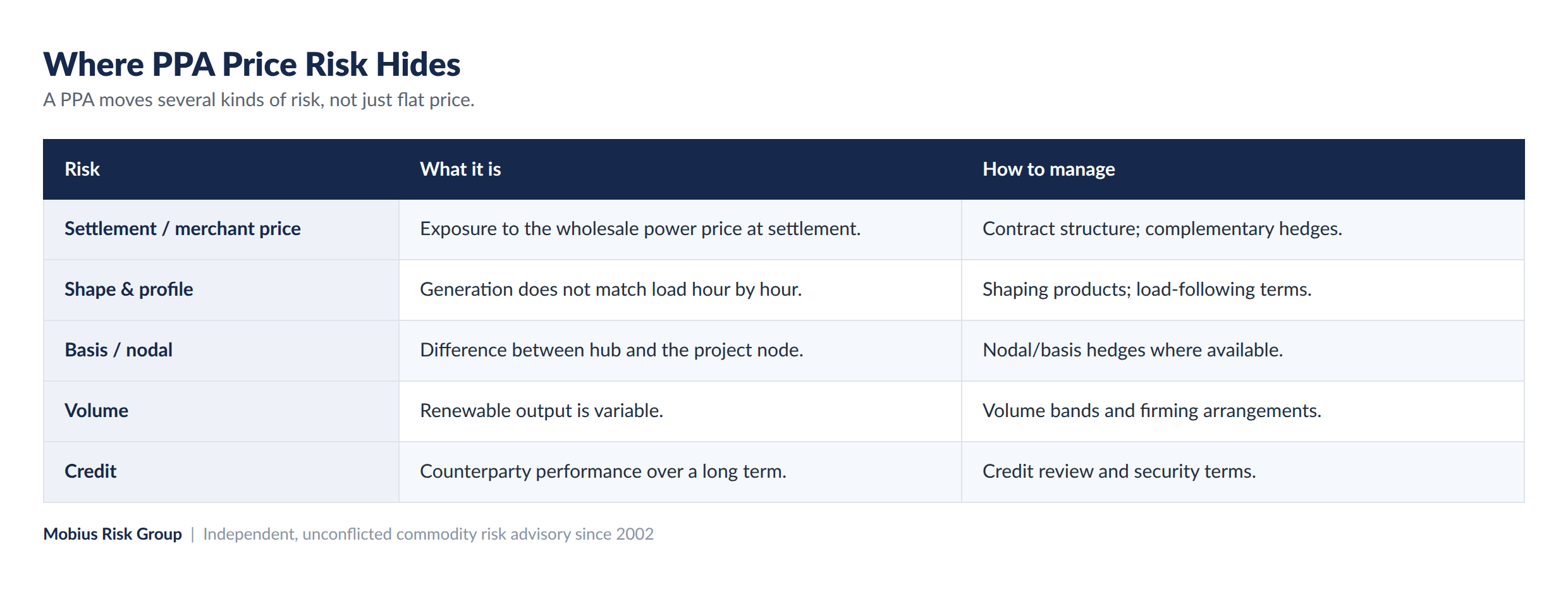
The two that surprise buyers most are shape (generation rarely matches load hour by hour) and basis (the project node can settle away from the trading hub). Both can turn an attractive contract price into a less attractive realized cost.
How do buyers manage PPA risk?
Through a mix of contract structure and financial hedging: shaping and firming arrangements for the profile, nodal or basis hedges where liquidity allows, volume bands for variability, and credit terms for the long tenor. The starting point is modeling the combined exposure rather than the headline price alone.
How Mobius Risk Group helps
Mobius helps buyers and offtakers quantify PPA exposure, structure complementary hedges, and report on the position in RiskNet™ — as an unconflicted advisor with no stake in the contract.
Frequently Asked Questions
What is PPA price risk?
The combined price-related risk in a power purchase agreement — settlement/merchant price, shape, basis/nodal, volume, and credit — not just the contract’s headline price.
What is shape risk in a PPA?
The mismatch between when a generator produces and when the buyer consumes, which means the realized value differs from a flat-price expectation.
What is basis or nodal risk in a PPA?
The difference between the price at the project’s grid node and the trading hub, which can move the economics even when the hub price is stable.
Subscribe to receive the latest Mobius Research & updates