

April 20, 2026
QUICK ANSWER
A commodity risk management firm helps companies measure, manage, and hedge exposure to commodity prices. Its work spans strategy and policy, execution support, analytics and systems, market intelligence, and reporting. The best firms are independent and unconflicted — paid by the client rather than earning a spread on the trades they recommend.
Companies exposed to energy, metals, or agricultural prices face a choice: build a risk function in-house or partner with a firm that does it for a living. A commodity risk management firm brings the strategy, analytics, market view, and execution discipline that most finance and operations teams do not have the bandwidth to maintain — and, done right, keeps price risk from dictating results.
What does a commodity risk management firm do?
The category covers more than placing hedges. A full-service firm works across the whole lifecycle of price risk, from defining what a company is trying to protect to reporting on the program after trades are on. The table below breaks the work into its main service areas.
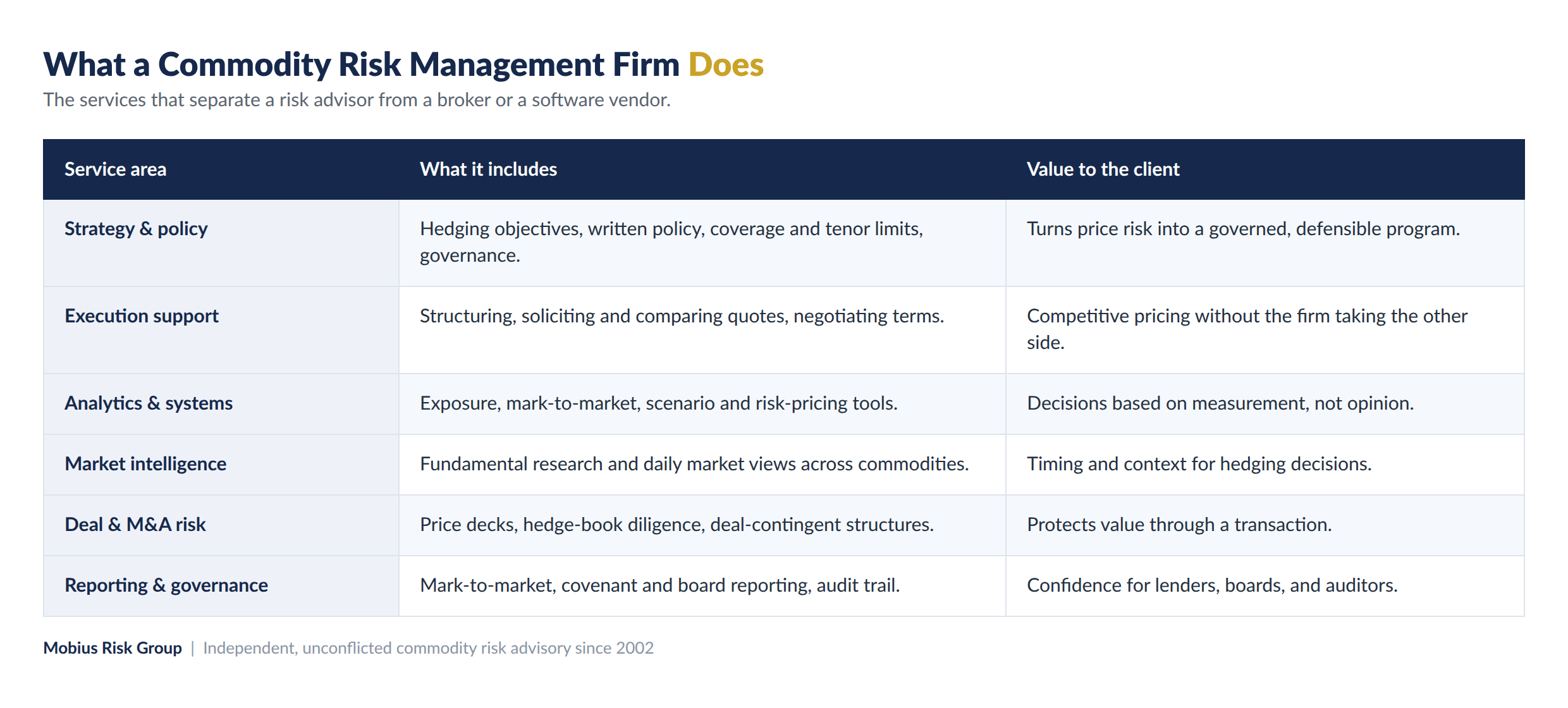
Not every firm covers every area, and that is the first thing to check. A broker executes trades; a software vendor supplies tools; a true risk management firm ties strategy, analytics, execution oversight, and reporting together around the client’s objective.
How is a firm different from a bank, a broker, or software?
Each plays a different role. A bank or dealer sells and prices hedges — and earns the spread. A broker executes trades for a commission. Software gives you tools but no judgment. A commodity risk management firm sits above all three: it sets the strategy, brings the analytics, and oversees execution across counterparties. The critical question is how the firm is paid, because that determines whose interest its advice serves.
When should a company hire one?
- Material, recurring exposure — commodity prices are a top variable cost or revenue driver.
- No dedicated desk — finance or operations is managing risk off the side of the desk.
- Lender or board pressure — covenants or governance require a defensible, well-reported program.
- A transaction — an acquisition or financing puts a hedge book and price risk into play.
- A program that has outgrown spreadsheets — exposure now spans commodities, locations, and counterparties.
How do you choose a commodity risk management firm?
Weigh independence first: is the firm paid only by you, or does it earn from the trades it recommends? Then look at breadth (does it cover strategy, analytics, and execution oversight, or just one slice?), systems (does it bring a real analytics platform?), market expertise across your commodities, and track record. An independent, unconflicted firm keeps its advice aligned with your outcome rather than transaction volume.
Why Mobius Risk Group
Mobius Risk Group has been an independent, unconflicted commodity risk management firm since 2002, based on the Gulf Coast. It combines advisory (Strategy Direct), a CTRM and analytics platform (RiskNet™ and M(β)risk™), indicative pricing (M-Direct), and a market-intelligence suite — all under a model where the firm earns no spread or commission on client hedges, so its guidance is aligned with the client’s results.
Frequently Asked Questions
What is a commodity risk management firm?
A firm that helps companies measure and manage exposure to commodity prices through strategy, analytics, execution support, market intelligence, and reporting — ideally as an independent, unconflicted advisor.
How is it different from a bank or broker?
A bank prices and sells hedges and earns the spread; a broker executes for commission. A risk management firm sets strategy, provides analytics, and oversees execution across counterparties — and, if unconflicted, takes no side of the trade.
When should a company hire a commodity risk management firm?
When commodity prices are a material cost or revenue driver, there is no dedicated in-house desk, lenders or the board require a defensible program, or a transaction puts a hedge book in play.
What does “unconflicted” mean for a risk management firm?
It is paid only by the client and earns no spread, markup, or commission on the hedges it recommends, so its advice is aligned with the client’s outcome rather than transaction volume.
Subscribe to receive the latest Mobius Research & updates