
August 15, 2026
Quick Answer
A costless collar is a hedging structure that combines buying a floor (a put) and selling a ceiling (a call) so the premiums offset to roughly zero. It locks in a price range: producers keep downside protection while giving up upside above the cap, at no upfront cost.
How does a costless collar work?
A costless collar is built from two options struck around the current forward price. A commodity producer buys a put option that sets a price floor and simultaneously sells a call option that sets a price ceiling. The premium earned from selling the call is used to pay for the put, so the net cost is designed to be near zero — hence "costless." The result is a defined price band: if prices fall below the floor, the put pays out; if prices rise above the ceiling, gains are capped.
Who uses collars — producers or consumers?
Both. An oil or natural gas producer collars to protect revenue: the put floor guarantees a minimum realized price while the sold call caps the maximum. A commodity consumer (for example, a chemical or industrial buyer) uses a reverse structure — buying a call for a price cap and selling a put for a floor — to protect budgeted input costs. The mechanics mirror each other; the direction of protection flips.
What are the trade-offs of a zero-premium collar?
The appeal is no upfront cash outlay, which matters for hedgers who want protection without paying option premium or posting the same margin as an outright option purchase. The cost is opportunity: by selling the cap, you forgo favorable price moves beyond the ceiling. Widening the collar (a lower floor and higher ceiling) preserves more upside but weakens protection. Choosing the strikes is the real decision, and it should follow from a documented risk policy, not a market view.
How do collars compare with swaps and outright options?
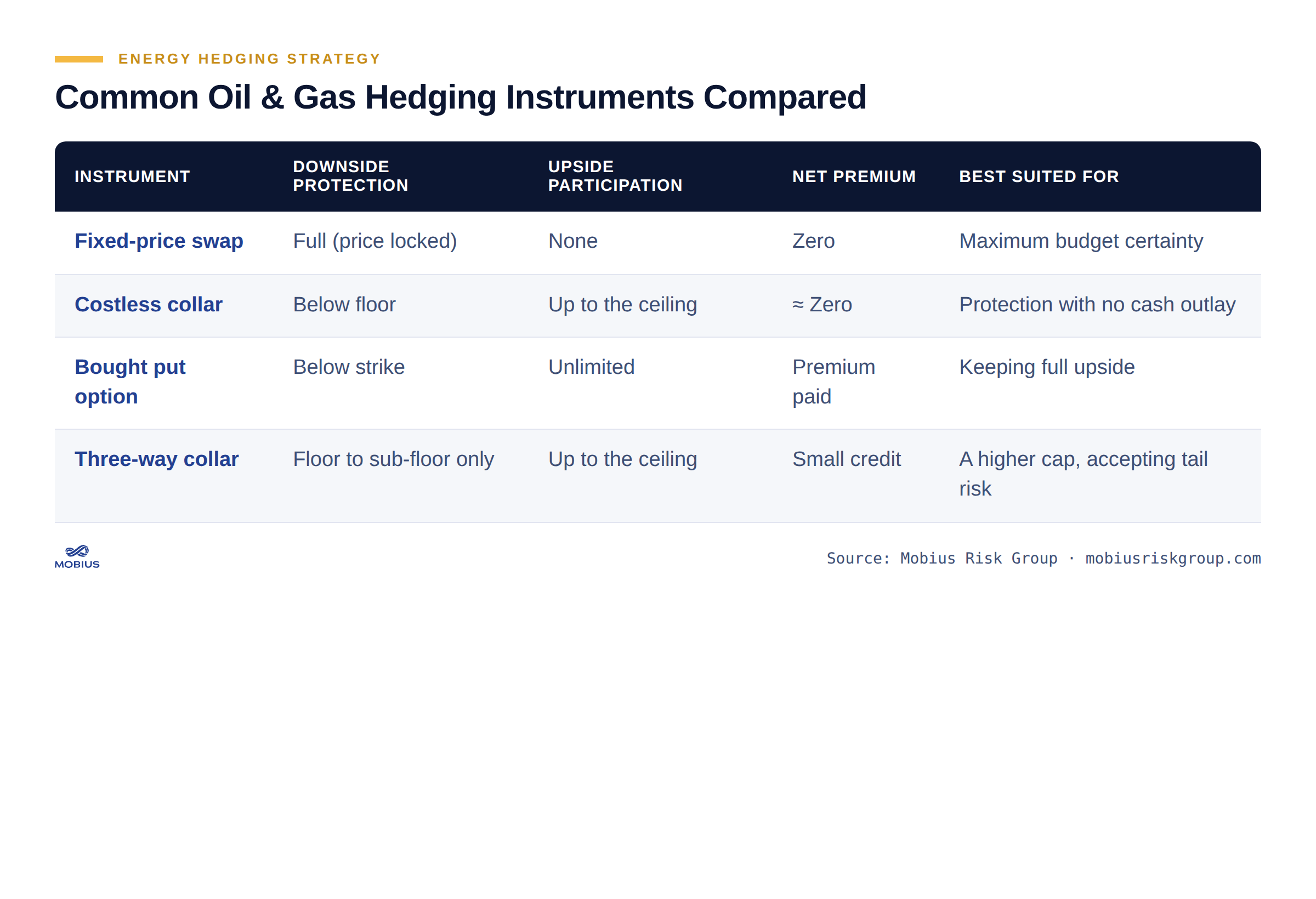
A swap fixes a single price with full protection and zero upside participation. An outright put buys a floor and keeps unlimited upside, but costs premium. A costless collar sits between them: partial upside, defined downside, no net premium. A three-way collar adds a sold put below the floor to raise the ceiling, reintroducing some tail risk. The comparison below summarizes how these instruments differ.
Related from Mobius Risk Group: hedge strategy advisory, hedge execution, M(β)risk analytics.
Common Oil & Gas Hedging Instruments Compared
Frequently asked questions
Is a costless collar really free?
There is no upfront premium, but it is not free in economic terms — you pay by giving up price upside above the ceiling. There may also be margin or credit requirements depending on how the collar is executed and cleared.
What is the difference between a collar and a three-way collar?
A standard collar has a floor and a ceiling. A three-way collar adds a second sold option below the floor, which raises the ceiling (more upside) but reintroduces downside risk if prices fall below that lower strike.
Do costless collars qualify for hedge accounting?
They can, when properly documented and effective under ASC 815 (or IFRS 9). Structuring and documentation matter; Mobius advises clients on both the strategy and the accounting treatment.
Talk to an unconflicted commodity risk advisor
Mobius Risk Group has advised energy producers, industrial buyers, and CFOs on commodity risk since 2002. Schedule a conversation with our team →
Subscribe to receive the latest Mobius Research & updates