
March 16, 2026
QUICK ANSWER
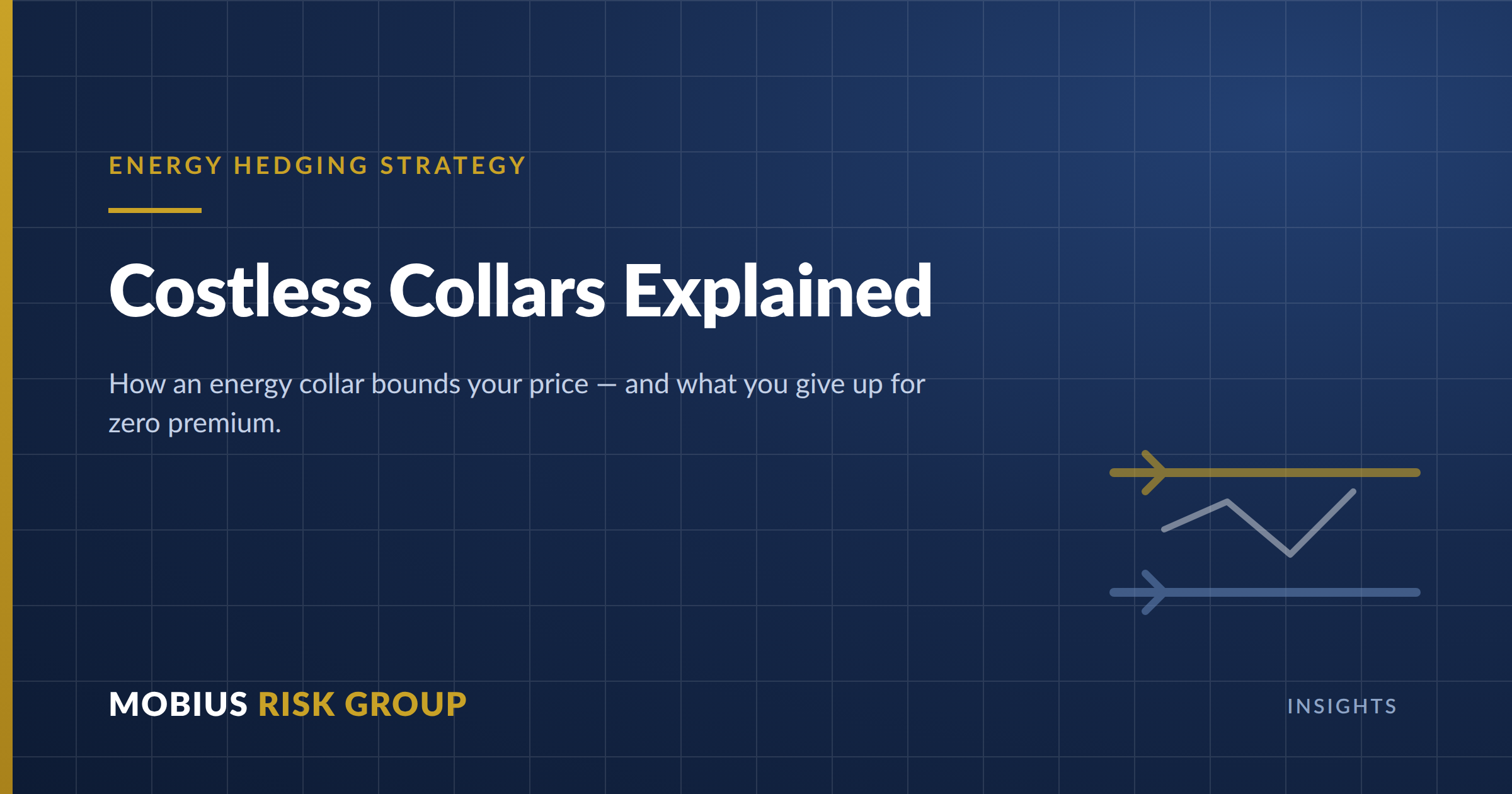
A costless collar combines a bought option and a sold option so their premiums roughly offset, bounding a price between a floor and a cap for little or no upfront cost. A producer buys a floor and sells a cap; a buyer buys a cap and sells a floor. In exchange for free protection, you give up the favorable move beyond the sold strike.
The collar is the workhorse of energy hedging because it solves a real budget problem: how to get downside protection without paying an option premium. The trade-off is that you surrender some of the upside to fund it.
How does a costless collar work?
A collar pairs two options at different strikes. One is bought for protection; the other is sold to pay for it. The strikes are chosen so the premiums approximately cancel, which is what makes the structure “costless.” The result is a price that floats freely within a band and is fixed at the edges.
What are the parts of a collar?
The graphic below breaks a collar into its components and shows how each behaves as prices move.
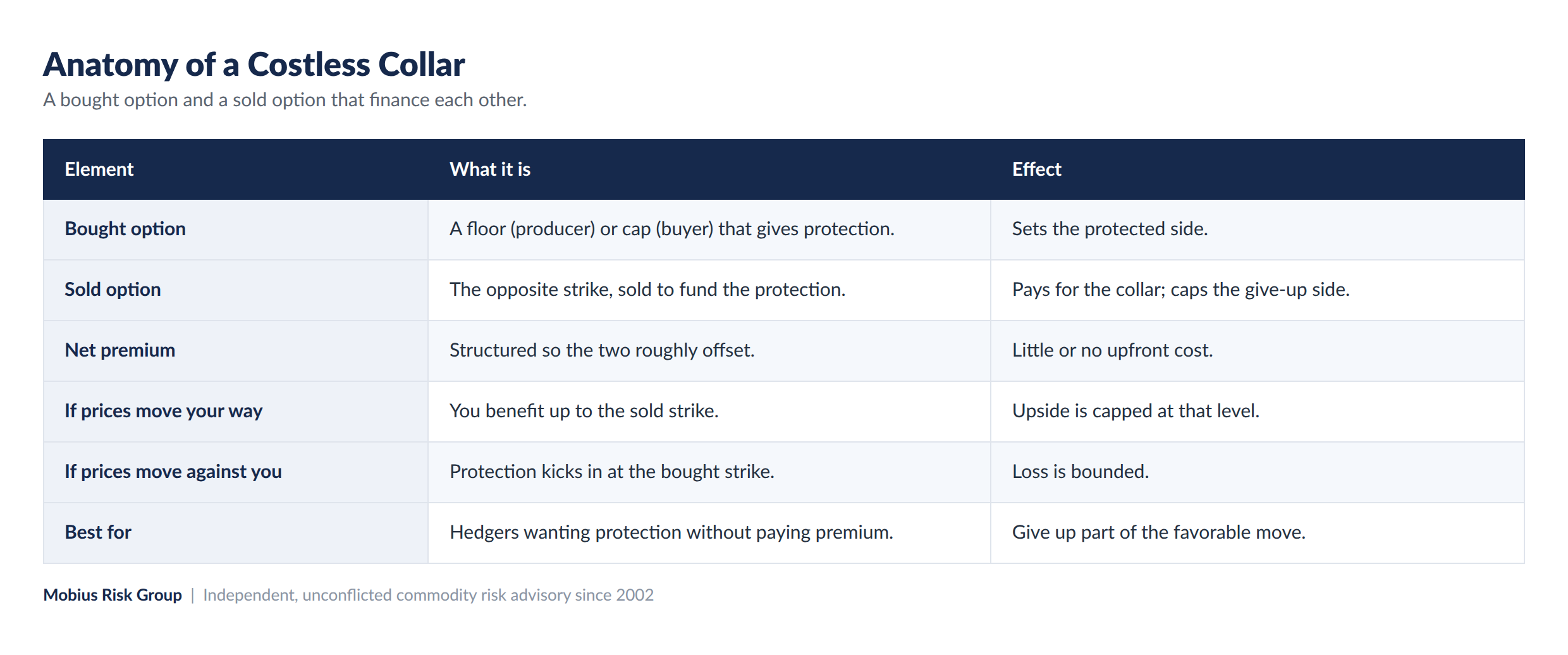
The key point is that “costless” does not mean free — the cost is the upside you give up beyond the sold strike. A collar simply moves the cost from an upfront premium to a capped opportunity.
When should you use a collar?
Collars fit hedgers who want protection but cannot or prefer not to pay a premium, and who are willing to give up part of a favorable move. Producers use them to protect cash flow; buyers use them to cap costs. They are especially common when option premiums are expensive because volatility is high.
Costless collar vs a swap: which should you use?
A swap fixes price at a single level; a collar fixes a range. The right choice depends on how much certainty you need and how much favorable movement you are willing to give up.
- Costless collar: little or no upfront premium; price lands in a range between the floor and cap; you keep favorable movement inside the range; best when you want protection but some flexibility; main drawback is being capped beyond the sold option.
- Fixed-price swap: no premium; price is fixed at a single level; no participation in favorable moves at all; best when you want maximum certainty.
Neither is universally better. A treasurer prioritizing budget certainty may prefer a swap; a producer who still wants some exposure to a price rally may prefer a collar. Mobius’s role is to match the structure to the company’s actual physical position and risk tolerance, not to default to one instrument.

What are the risks and watch-outs?
- Opportunity cost: if prices move strongly in your favor, the sold option caps your benefit at the range edge.
- Margin and credit: the sold leg can create margin calls or collateral requirements as prices move, so cash-flow planning matters.
- Basis mismatch: if the hedge references a benchmark that differs from your physical delivery point, residual basis risk remains.
- Sizing and rollover: collars must be sized to real exposure and rolled thoughtfully as they expire, or they drift out of alignment with the underlying position.
These are exactly the exposures Mobius’s M(β)risk analytics quantify and RiskNet monitors on an ongoing basis, so the collar keeps doing its job across its life rather than only at inception.
What about three-way collars?
A three-way collar starts from the same two legs as a costless collar and adds a third sold option below the floor. That extra premium widens the protected range or lifts the cap, but it reintroduces exposure if prices fall past the lowest strike — protection that stops precisely when the market gets worst. It is a deliberate trade of tail coverage for a better everyday range, not a strictly better collar. Three-way structures sit alongside swaps, options and basis hedges in our wider guide to natural gas hedging strategies.
How Mobius Risk Group helps
Mobius helps clients decide whether a collar, swap, or straight option fits the objective, structures the strikes, and benchmarks pricing against M-Direct indicative levels — as an unconflicted advisor with no stake in the trade.
Frequently Asked Questions
What is a costless collar?
A hedge that pairs a bought option (protection) with a sold option (to fund it) at strikes chosen so the premiums roughly offset, bounding price between a floor and a cap for little or no upfront cost.
Is a costless collar really free?
There is no upfront premium, but you give up the favorable move beyond the sold strike. The cost is opportunity, not cash.
Who uses collars — producers or buyers?
Both. Producers buy a floor and sell a cap to protect revenue; buyers buy a cap and sell a floor to protect cost.
What is the difference between a costless collar and a zero-cost collar?
They are the same strategy under two names. Both describe pairing a bought protective option with a sold offsetting option so the net upfront premium is approximately zero.
Does a costless collar eliminate basis risk?
Not by itself. If the collar references a benchmark price that differs from the company’s physical delivery point, basis risk remains and may need separate hedging at the relevant hub.
Subscribe to receive the latest Mobius Research & updates