
August 24, 2026
Quick answer: ETRM and CTRM software cost resolves into three layers: a recurring license or subscription, one-time implementation and data migration, and ongoing integration and support. Budget on total cost of ownership over three to five years, not the license. Implementation is usually the largest and least predictable layer.
Ask three vendors what an energy or commodity trading and risk management system costs and you will get three numbers that are not comparable. One quotes a license, one a license plus a large implementation, one a subscription with integration handled later through change orders. They are simply pricing different layers. The useful question is not “what is the license” but “what is the total cost of ownership over three to five years, and which parts of it are fixed versus open-ended.”
What are the main components of ETRM software cost?
Every ETRM quote resolves into three layers.
First, the recurring platform fee — a perpetual license plus annual maintenance, or a SaaS subscription. It is usually priced by some mix of users, commodities covered and modules enabled. This is the line most buyers anchor on, and it is the one layer that is genuinely contracted and predictable.
Second, one-time implementation: configuration, data migration, testing and training. This is where the system stops being a product and starts being your system — historical positions mapped, contracts loaded, reports validated.
Third, ongoing integration and support: price-feed connections, ERP and bank or exchange links, upgrades, environment and user administration, and the internal staff time to run all of it. This layer scales with the number of connections you keep alive, not with the number of people logging in.
Why is implementation usually the largest and least predictable layer?
The platform itself can be ready quickly. The work that surrounds it is what takes time. Mapping historical positions and contracts, connecting live price feeds, reconciling against existing accounting, and validating reports against a period you already know the answer for — all of that sits in the implementation layer. When a rollout runs long, that is almost always where it ran long.
It is also the layer with the widest range between quotes, because it is scoped by effort rather than contracted by unit. Two vendors can quote the same platform fee and differ sharply on implementation purely because one assumed you would do the data migration yourself.
Mobius builds RiskNet, a CTRM platform whose core is onboarded and ready to use in as little as 48 hours across multiple commodities, with audited controls. Integrations — price feeds, ETRM/ERP, banks and exchanges — data migration and customization are what extend a full rollout, not standing the system up. RiskNet provides functionality beyond that of legacy CTRM software, at a fraction of the commonly seven-figure platform fees. Shortening the predictable part does not remove the variable part, but it narrows the range you have to budget against.
How do license and subscription models differ for budgeting?
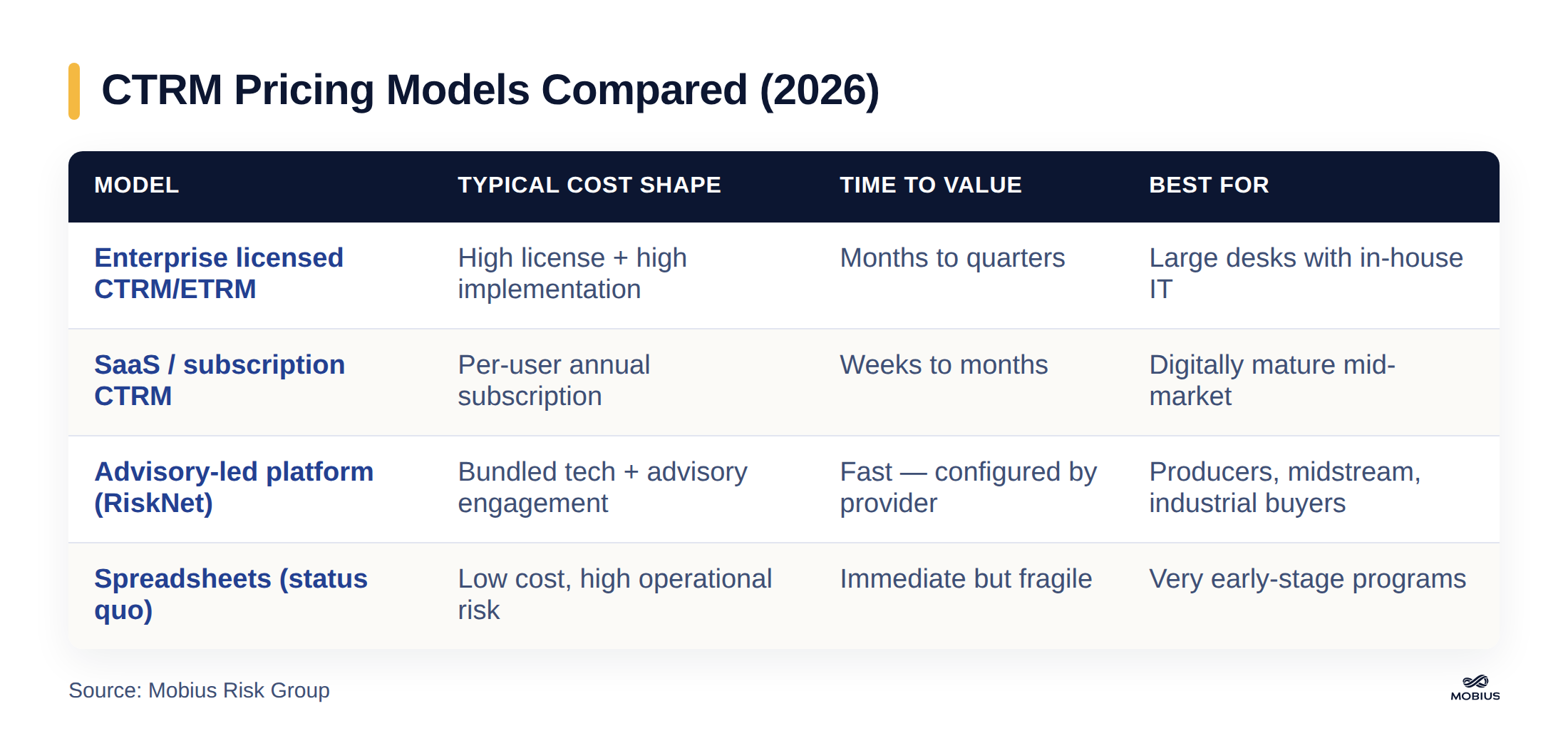
A perpetual license is capital-heavy up front with lower recurring maintenance. A subscription spreads the cost evenly but never ends. For a risk system you expect to run for a decade, the three-to-five-year totals often converge, so decide on cash-flow shape and speed to live rather than on the sticker.
The detail that matters more than the model is metering. Watch for per-connection and per-report charges that turn a flat subscription into a variable one as you add commodities, counterparties or feeds. Ask what the price does in year three if you add two commodities and four integrations, and get the answer in the contract rather than the proposal.
What hidden costs should buyers budget for?
The costs that surprise buyers are rarely in the license. Budget for additional price-feed and market-data subscriptions; each ERP, accounting or bank integration; environment and user administration; upgrade projects on on-premise deployments; and the internal staff time to run the system day to day. A quote that looks cheap because integration is marked out of scope is not cheap — the work has moved onto your side of the line, where your people will do it at your cost.
ETRM cost components: what drives each one
| Cost layer | What it covers | Pricing basis | How predictable |
|---|---|---|---|
| Recurring platform fee | License or subscription, plus maintenance | Users, commodities, modules | High — contracted |
| Implementation | Configuration, data migration, testing, training | Scope and effort | Low — largest overrun risk |
| Integration | Price feeds, ERP, banks, exchanges | Per connection | Medium — scales with links |
| Ongoing support | Upgrades, administration, market data | Annual fee plus internal time | Medium |
Illustrative cost structure for comparing ETRM quotes on a like-for-like basis. Actual figures depend on scope, commodities and integration count.
How do you review ETRM software before you buy?
An ETRM review should test the system against your book, not against the vendor’s. Four steps do most of the work.
Take references from firms of a similar shape. Similar commodities, similar contract types, similar volumes, similar team size. A reference from a firm ten times your size trading one commodity tells you very little about how the system will behave for you. Ask those references specifically what the implementation actually cost against what was quoted.
Book your own trades live in the demo. Bring three or four real deals — including the awkward ones, the physical deal with an optional volume clause or the trade with a non-standard settlement — and have them entered in front of you. A scripted demo shows you the happy path; your own trades show you where the workarounds start.
Reproduce a known position’s valuation. Pick a position and a date where you already know the mark, and ask the system to produce it. That one test exercises the curve handling, the contract model and the reporting together — and if the number is wrong, you have found the gap before you sign.
Get integration scope in writing. Which systems, which direction, which frequency, who builds each connection, and what is explicitly out of scope. This single document is the difference between a fixed implementation and an open one.
What should an ETRM cost comparison include?
To make three quotes comparable, normalize them onto one basis before you look at any total.
- Which of the three layers each quote covers. Most quotes cover one or two fully and gesture at the third. Mark which is which.
- What is explicitly out of scope. Out-of-scope items are not savings; they are costs you have accepted. List them and price them yourself.
- Per-connection and per-report charges. Count the connections and reports you will realistically run in year two, not the minimum needed to go live.
- Internal staff time. Estimate the days your own people will spend on migration, testing and ongoing administration, and put a cost against them. This is usually the largest line nobody writes down.
- The comparison period. Use the same three-to-five-year window for every quote, including renewal and uplift terms.
Where does Mobius sit in this?
A disclosure worth making plainly: Mobius is an independent, unconflicted advisor that does not take the other side of client trades, and Mobius also builds RiskNet — a commercial interest in the platform being described. The structural points above hold whether or not you choose RiskNet; they are the same points we would apply to our own quote.
RiskNet is delivered in three models — self-serve, supported and managed — which changes which of the three cost layers sits with you and which sits with us. That choice, more than the license line, is what determines your total cost of ownership.
Frequently asked questions
How much does ETRM software cost?
There is no single number: a figure quoted without scoping your commodities, users and integrations is pricing one layer, not the system. What you can pin down is the structure — a recurring license or subscription, a one-time implementation, and ongoing integration and support. Ask each vendor to price all three against the same scope, then compare three-to-five-year totals rather than the first-year figure.
What is the total cost of ownership of an ETRM system?
Total cost of ownership is the recurring platform fee plus one-time implementation and data migration plus ongoing integration and support, across the period you will actually run the system — usually three to five years. It should also include your own staff time: the people who administer the system, maintain the connections and produce the reports. TCO is a more reliable comparison than the headline license, because the license excludes the largest variable costs.
How do you review ETRM software vendors?
Review the system the way you will use it, not the way it demos. Take references from firms of a similar shape — comparable commodities, contract types and volumes. Book your own trades live in the demo rather than watching a scripted one. Reproduce the valuation of a position you already know the answer to. Then get the integration scope in writing, including what is explicitly out of scope.
Is a subscription cheaper than a perpetual license?
Not necessarily. A subscription lowers the up-front outlay but continues indefinitely; a perpetual license front-loads the cost and carries lower ongoing maintenance. Over three to five years the totals often converge, so the decision is really about cash-flow shape, how quickly you need to be live, and how much per-connection or per-report metering sits on top of the recurring fee.
Subscribe to receive the latest Mobius Research & updates