
August 25, 2026
Quick answer: ETRM (energy trade and risk management) software covers power, gas, crude and refined products. CTRM (commodity trade and risk management) software covers those plus agriculturals, metals and industrials. Most vendors supply both under one platform, so the practical question is not which category to buy but which supplier models your commodities and contracts.
Buyers usually arrive at this comparison because two shortlists have come back using different words for what looks like the same product. The labels are real, but they describe breadth rather than a technical boundary — and they tell you less about a supplier than the category of company it belongs to.
What does CTRM software do?
Commodity Trading and Risk Management (CTRM) software is the system of record for a commodity book. It captures physical and financial trades, tracks positions in real time, values them mark-to-market, and quantifies market, credit, and operational risk. A modern CTRM platform also handles logistics — storage, transport, and delivery scheduling — plus settlement, invoicing, and the audit trail regulators expect.
Mobius Risk Group built RiskNet as multi-commodity CTRM software so producers, midstream operators, and industrial buyers can see exposure and hedge performance in one place rather than stitching together spreadsheets. The RiskNet core platform is onboarded and ready to use in as little as 48 hours across multiple commodities, with audited controls. Integrations — price feeds, ETRM/ERP, banks and exchanges — data migration and customization are what extend a full rollout.
What does ETRM software do?
Energy Trading and Risk Management (ETRM) software is CTRM applied to energy markets. It carries everything a CTRM system does but is tuned for the mechanics of power and gas: pipeline nominations, transmission scheduling, granular delivery points, and the shaped, highly seasonal forward curves those commodities trade on. If your book is entirely power, natural gas, crude, and refined products, an ETRM-focused system speaks your language natively.
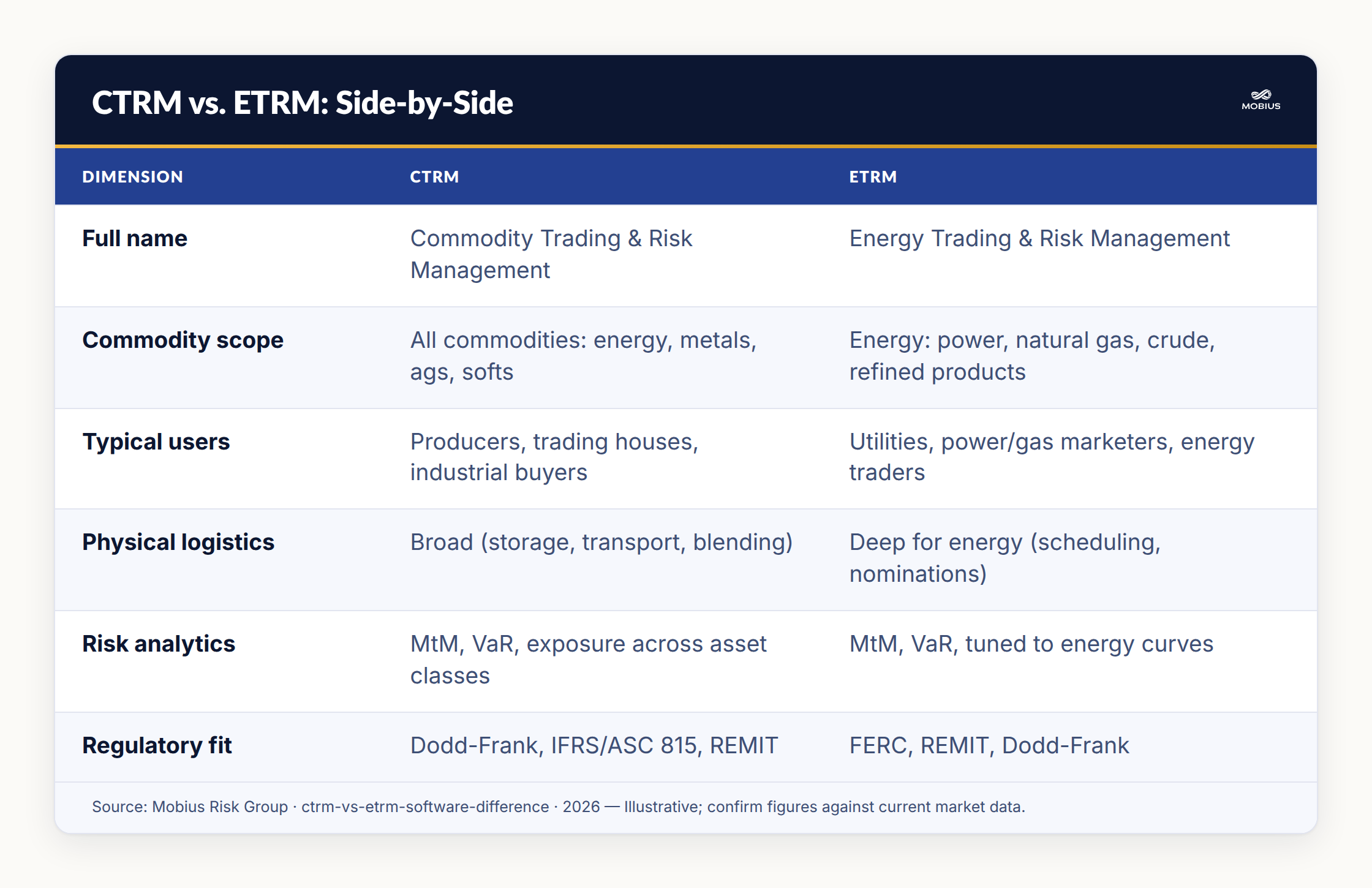
CTRM vs. ETRM: side-by-side
So what is the actual difference between CTRM and ETRM?
The honest answer: the two acronyms describe the same discipline at different breadths. ETRM is a subset of CTRM. Every ETRM system is a CTRM system narrowed to energy; not every CTRM system handles energy logistics deeply. Vendors and analysts use the labels loosely, so a product called "ETRM" may cover metals, and one called "CTRM" may be energy-only in practice.
Because the labels blur, the buying decision should turn on capability, not vocabulary. Ask which commodities are supported to the depth you need, how the system models your forward curves, whether it automates your regulatory reporting, and how quickly it reflects a new hedge in your risk numbers.
Who are the ETRM software vendors, and how do they differ?
ETRM providers are easier to compare once you stop treating them as a flat list. They sort into four categories, and the category predicts fit better than any individual feature.
Enterprise suites offer the widest functional coverage and the deepest configurability, and expect you to bring a team to configure them; implementations run in quarters or years. Mid-market platforms cover the core well — trade capture, positions, valuation, risk, reporting — arrive with opinions about how a book should be structured, and deploy far faster. Advisor-built platforms come from firms that also run commodity risk for clients, so the software encodes an operating process; the thing to test is the supplier's own commercial interest in the platform. ERP bolt-on modules sit inside an ERP the business already runs and suit simple hedging, but rarely carry the curve management and mark-to-market depth an energy book needs.
Our buyer's guide to CTRM and ETRM software companies sets out what to score each category on, and is explicit about where RiskNet fits and where it does not.
Is an ETRM company different from a CTRM company?
Usually not. The same supplier will describe itself as an ETRM company to a utility and a CTRM company to a multi-commodity trading group, and both descriptions can be accurate. The label tends to follow where a vendor started: a firm that grew up in power and gas scheduling carries the ETRM name, one that grew up across commodity classes carries CTRM.
Where the distinction does carry weight is depth. An ETRM software company that has spent twenty years on nominations, transmission and ISO settlement will model those better than a generalist, and a CTRM company built across commodity classes will hold a mixed book in one netted view more comfortably. Ask which of those two problems you actually have.
How do you evaluate an ETRM software company?
Four tests separate suppliers faster than a feature matrix. Book your own trades in the demo rather than watching theirs, including the contract type you find hardest. Reproduce a known position's valuation yourself, so you can see the curve and the assumptions rather than a number. Get the integration scope in writing, because connections rather than the platform usually set the timeline. And compare total cost of ownership across three to five years, not headline license price — our cost and pricing guide sets out what belongs in that comparison.
Add one question buyers often skip: ask each supplier and each advisor in the process what they sell and where their revenue comes from. Software selection is frequently bundled with brokerage or trading incentives. Mobius is deliberately unconflicted — we do not take the other side of client trades — and we also build RiskNet, which is a commercial interest you should weigh in exactly the same way.
How do you choose between a CTRM and an ETRM platform?
Start from your book, not the brand name. If you trade only energy, prioritize depth in scheduling, nominations, and energy curve modeling. If you touch multiple commodity classes — say natural gas feedstock plus metals or agricultural inputs — favor a broader commodity management system that can hold them in one exposure view. Then weigh integration with your ERP and market-data feeds, the quality of the risk analytics, hedge-accounting support under ASC 815, and total cost of ownership including implementation.
Related reading from Mobius Risk Group
- CTRM software companies: a buyer's guide to vendors and categories
- ETRM and CTRM evaluation checklist, by buyer type
- ETRM and CTRM software cost and total cost of ownership
Frequently asked questions
Is ETRM the same as CTRM?
ETRM is a subset of CTRM. Energy Trading and Risk Management systems are Commodity Trading and Risk Management systems focused on energy commodities such as power, natural gas, and crude. CTRM is the broader category that also covers metals, agriculture, and softs.
Who are the main ETRM software vendors?
ETRM software vendors sort into four categories rather than a flat list: enterprise suites built for the largest trading operations, mid-market platforms aimed at producers and industrial buyers, advisor-built platforms supplied by firms that also run commodity risk, and commodity modules inside an existing ERP. Identifying the right category removes most of a shortlist before you compare individual products.
Is an ETRM company different from a CTRM company?
Usually not. Most suppliers serve both under one platform, and the label reflects a vendor's origin and marketing more than its capability. A firm that began in power and gas tends to describe itself as an ETRM company; one that began in multi-commodity trading tends to say CTRM. Judge the platform on the commodities and contracts it actually models.
How do you evaluate an ETRM software company?
Bring your own trades to the demo and have the vendor book them live. Reproduce a known position's valuation yourself. Ask how the platform handles your hardest contract type rather than its favourite one, confirm which integrations are in scope, and compare total cost of ownership over three to five years rather than headline license price.
Do I need a CTRM system if I only hedge natural gas?
Not always. Small programs can run on spreadsheets, but as trade volume, counterparties, and hedge-accounting requirements grow, a CTRM or ETRM platform reduces operational risk and gives auditable, real-time exposure.
Does CTRM software handle hedge accounting?
Leading CTRM platforms support hedge accounting under ASC 815 (US GAAP) and IFRS 9, including designation, effectiveness testing, and journal-entry generation. Confirm the specific standards and testing methods each vendor supports before selecting.
Mobius Risk Group is an independent, unconflicted commodity risk advisor. This article is educational and not financial or accounting advice; confirm figures and rules against current market data and your own advisors.
Subscribe to receive the latest Mobius Research & updates