
July 28, 2026
Quick answer: CTRM (commodity trading and risk management) software is a system that centralizes a company’s physical and financial commodity positions, tracks market exposure and P&L in real time, and streamlines hedge execution, valuation, and reporting. It replaces spreadsheets with an auditable single source of truth for risk decisions.
What is CTRM software?
CTRM software is a platform that manages the full lifecycle of commodity transactions — from a physical purchase or sale to the financial hedges placed against it — in one connected system. It brings deal capture, position keeping, mark-to-market valuation, exposure measurement, and reporting together so that risk, trading, and finance teams all work from the same numbers.
The alternative most companies start with — a patchwork of spreadsheets and email — breaks down as volume, commodities, and counterparties grow. CTRM software exists to remove that fragility: it gives treasurers and risk officers a real-time, auditable view of where the company is exposed and what its hedges are worth.
What does a CTRM system actually do?
A modern CTRM platform typically covers six core functions:
- Deal & position capture — records physical and financial trades and maintains a live view of net positions by commodity, location, and tenor.
- Exposure & risk measurement — quantifies market risk (price, basis, volumetric) and aggregates it across the portfolio.
- Valuation & mark-to-market — values positions and hedges against current forward curves and indicative pricing.
- Hedge execution support & accounting — supports hedge placement and the documentation needed for hedge accounting treatment.
- Scenario & analytics — stress-tests the book against price moves, so decisions are made on quantified outcomes rather than intuition.
- Reporting & audit trail — produces board-, lender-, and auditor-ready reporting with a defensible record of every decision.
Mobius’s RiskNet™ platform is built to deliver these functions for commodity-exposed companies, paired with the M(β)risk™ analytics engine for exposure and scenario modeling and M-Direct for indicative pricing inputs.
CTRM vs. ETRM: what’s the difference?
The terms overlap and are often used interchangeably. The practical distinction is scope:
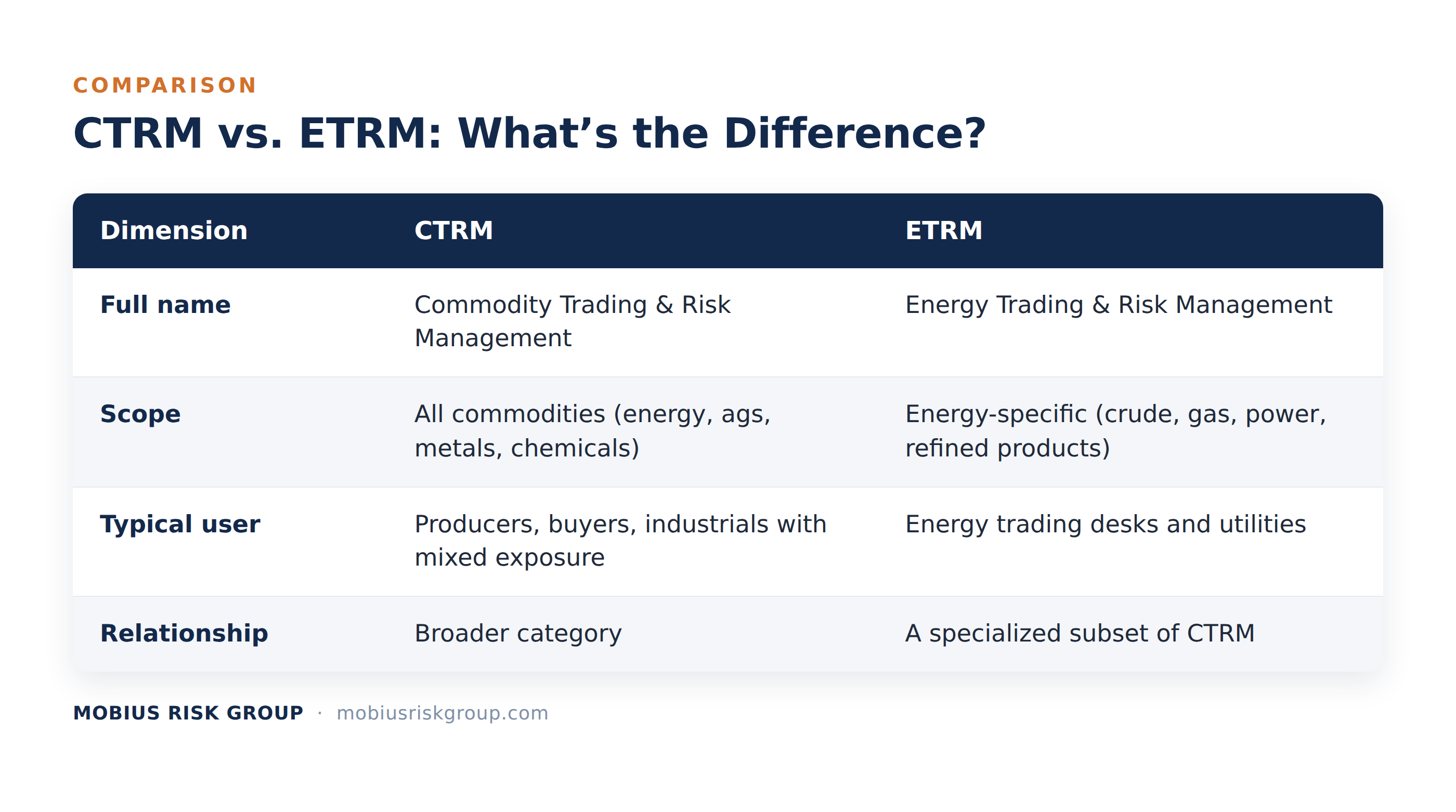
For most commodity-exposed corporates, “CTRM” is the safer umbrella term because their exposure is rarely limited to energy. If a vendor markets an “ETRM,” confirm it can handle every commodity you actually trade or consume.
Who needs CTRM software?
CTRM software earns its keep when exposure becomes too large or too complex to track by hand. Common triggers include:
- Energy producers and midstream operators managing hedges across multiple products and delivery points.
- Chemical and industrial buyers hedging feedstock, natural gas, or power to protect margins.
- CFOs, treasurers, and risk officers who must report exposure and hedge effectiveness to boards and lenders.
- Private-equity owners and acquirers who need a defensible view of commodity risk across a portfolio company.
What should you look for in a CTRM platform?
Use this checklist when evaluating CTRM software:
- Coverage of every commodity and instrument you use — physical and financial, including basis and options.
- Real-time position and P&L, not overnight batch — decisions happen intraday.
- Hedge-accounting support and audit trail that satisfy your auditors and lenders.
- Analytics depth — scenario and stress testing, not just record-keeping.
- Data quality — reliable market and forward-curve inputs feeding valuation.
- Independence of advice — whether the platform is sold alongside brokerage or trade execution that could bias recommendations.
How is RiskNet different?
RiskNet™ is Mobius Risk Group’s CTRM platform, and its differentiator is the firm behind it. Mobius is an independent, unconflicted commodity risk advisor: it does not take positions against clients or earn brokerage on the trades it recommends. That means the analytics, valuations, and hedge recommendations RiskNet surfaces are aligned with the client’s outcome, not a trading counterparty’s.
RiskNet is also delivered as part of an advisory relationship rather than as standalone software. Clients pair the platform with Mobius’s Strategy Direct advisory and market-intelligence suite, so the numbers on screen are backed by analysts who help interpret and act on them. For a deeper look at what independent advice means, see our guide to what an energy hedging advisor does.
Frequently asked questions
What does CTRM stand for?
CTRM stands for Commodity Trading and Risk Management. CTRM software is a system that centralizes commodity positions, exposure, valuation, and reporting in one auditable platform.
Is CTRM software only for large companies?
No. While the largest traders were early adopters, any commodity-exposed company that has outgrown spreadsheets — often when it hedges multiple products or must report to a board or lender — benefits from CTRM software.
What is the difference between CTRM and ETRM?
ETRM (Energy Trading and Risk Management) is an energy-specific subset of CTRM. CTRM is the broader category covering all commodities, including energy, agriculture, metals, and chemicals.
Can CTRM software replace a hedging advisor?
No. CTRM software measures and reports risk, but it does not decide strategy. Pairing a platform like RiskNet with independent advisory helps ensure the data drives sound, unconflicted hedging decisions.
How does RiskNet handle hedge accounting?
RiskNet supports the position tracking, valuation, and documentation that underpin hedge accounting and audit-ready reporting.
Subscribe to receive the latest Mobius Research & updates