
July 2, 2026
QUICK ANSWER
A deal-contingent hedge locks in a price — for FX, interest rates, or a commodity — that only takes effect if a pending transaction such as an M&A deal or financing actually closes. If the deal falls through, the hedge disappears at no cost to the buyer. You pay for that protection through the hedge rate, not an upfront premium.
Acquirers, private-equity sponsors, and project developers face a timing problem: they are exposed to market moves between signing and closing, but a normal hedge is risky to put on because the deal might not happen. A deal-contingent hedge is built for exactly that gap.
What is a deal-contingent hedge?
A deal-contingent hedge is a derivative — most often an FX forward, interest-rate swap, or commodity forward — whose execution is conditional on a specified transaction closing. The hedge only becomes live if the deal completes. If the transaction is abandoned, the hedge terminates automatically and the buyer walks away with no settlement obligation and no premium paid.
How does deal-contingent hedging work?
Unlike a standard option, there is no upfront premium. The cost of the contingency — the risk the provider takes that the deal breaks after markets have moved — is embedded in the hedge rate, which is set slightly away from the prevailing market. In effect, the buyer accepts a modestly worse rate in exchange for full protection with zero downside if the deal collapses.
How is it different from a standard hedge?
The difference shows up entirely in the “what if the deal breaks” scenario, as the table makes clear.
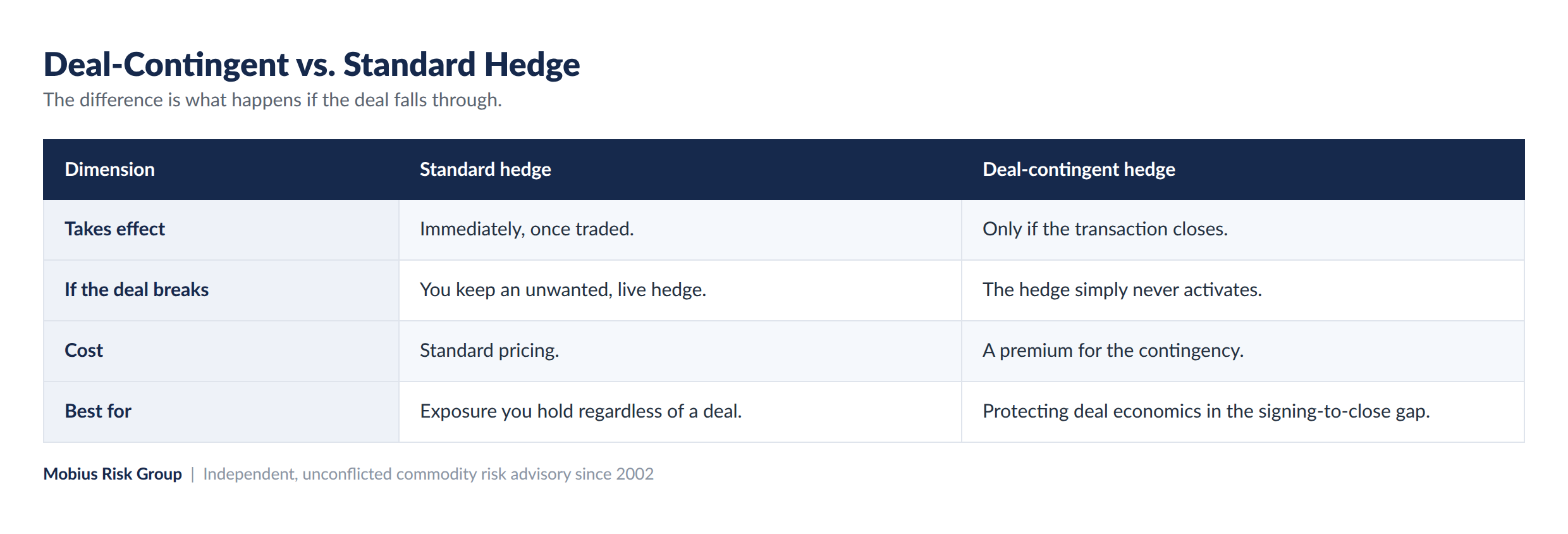
With a standard hedge, a failed deal leaves the buyer holding a live position it never wanted. With a deal-contingent hedge, that risk is removed — which is exactly why it is used in M&A and financing. Sizing that decision well depends on seeing the exposure clearly, which is where an independent commodity risk analytics platform and a documented energy hedging strategy do the work.
When should you use one?
Deal-contingent hedges are common in cross-border M&A (locking the exchange rate on a foreign-currency purchase price), acquisition financing (fixing rates before debt is drawn), and energy asset acquisitions where commodity prices drive the value of what is being bought. They pair naturally with asset and acquisition review and are frequently used by sponsors evaluating oil and gas investments.
What structures are available?
The most common are deal-contingent FX forwards, interest-rate swaps or caps, and commodity forwards and swaps. Each mirrors its vanilla equivalent, with the contingency layered on top. The right structure depends on which exposure — currency, rates, or commodity price — most affects deal value.
What drives the pricing?
Three factors dominate: the probability the deal closes, the tenor (how long the contingency runs to expected close), and the volatility of the underlying market. A high-certainty deal with a short timeline and calm markets prices close to a standard hedge; a longer, less-certain deal in volatile markets costs more.
What are the risks and trade-offs?
The buyer gives up a little on rate versus an outright hedge and takes on provider concentration — deal-contingent hedges are offered by a limited set of banks and require disclosure of deal details. Edge cases such as a partial close or a change in deal structure must be documented carefully, because they determine whether the contingency is triggered.
How is a deal-contingent hedge accounted for?
Because the instrument is contingent, hedge designation and effectiveness testing under ASC 815 require care — the timing of when the hedge becomes effective, and how it is documented, drives the accounting treatment. Involving your accounting advisor early avoids surprises at close.
How Mobius Risk Group helps
Mobius advises acquirers and sponsors on whether a deal-contingent hedge fits the transaction, what structure and tenor to use, and how the quoted rate compares to fair value — as an unconflicted advisor with no stake in the trade. For oil and gas M&A, that means protecting deal economics without overpaying for the contingency.
Frequently Asked Questions
What happens to a deal-contingent hedge if the deal fails?
It terminates automatically. The buyer owes nothing and has paid no premium.
Is there an upfront cost?
No. The cost of the contingency is built into the hedge rate rather than charged as a premium.
Who provides deal-contingent hedges?
A limited set of banks, which is why independent benchmarking of the quoted rate matters.
Subscribe to receive the latest Mobius Research & updates