
August 31, 2026
Quick answer
A deal-contingent hedge lets an acquirer lock in a commodity price, interest rate, or FX level that only takes effect if the transaction closes. If the deal falls through, the hedge disappears with no breakage cost. In energy M&A it protects the economics of a signed deal against price moves during the sign-to-close period.
What is a deal-contingent hedge?
A deal-contingent hedge (DCH) is a derivative whose existence is tied to a specific transaction closing. The acquirer fixes today's price — for a commodity such as crude or natural gas, or for the interest rate or currency behind the financing — but the hedge only becomes a live obligation if and when the deal completes. If the transaction is abandoned, the hedge simply falls away.
That single feature solves a problem every dealmaker knows: the period between signing and closing, when the acquirer is economically exposed to a price it has effectively agreed to pay but cannot yet control.
How does a deal-contingent hedge work in an energy transaction?
Consider a buyer acquiring a package of producing gas assets. The purchase model assumes a forward curve; if gas prices fall before close, the acquired cash flows — and the deal's returns — fall with them. A deal-contingent swap or collar lets the buyer lock the curve at signing. If the deal closes, the hedge is in place from day one. If regulatory approval or financing collapses and the deal dies, the buyer walks away owing nothing on the hedge.
The trade-off is priced in: the dealer takes on the risk that the deal breaks after prices have moved, and charges a premium for it. Understanding your underlying basis exposure matters here, because a contingent hedge is only as good as the curve and location it references.
Deal-contingent vs. standard hedge: what's the difference?
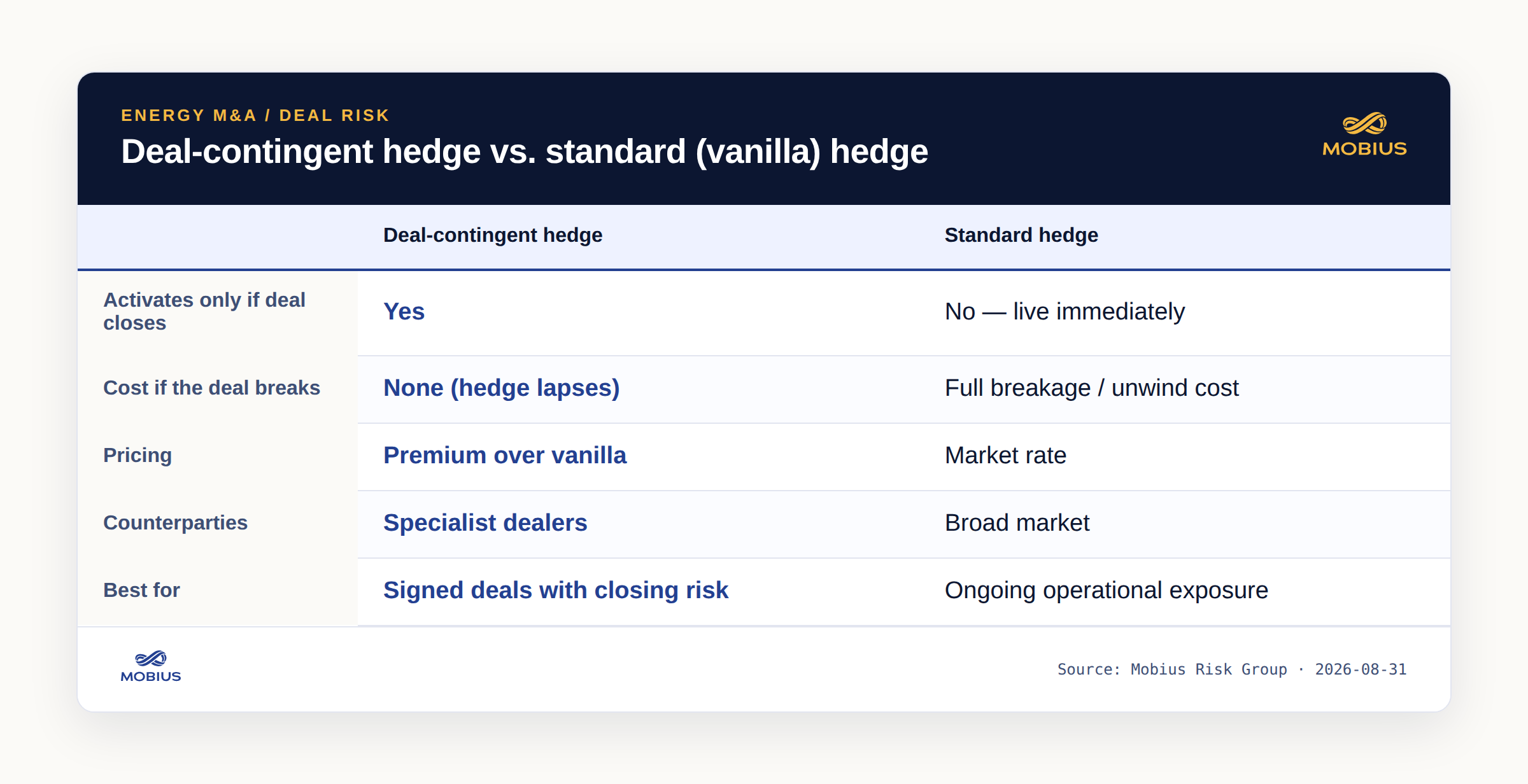
A standard hedge is live the moment it is struck; unwinding it early — for example because a deal collapses — can carry a real breakage cost. A deal-contingent hedge moves that risk to the dealer in exchange for a premium. The comparison below shows the core differences.
When should an acquirer use a deal-contingent hedge?
DCHs fit best when three conditions hold: the deal is signed or highly probable, the value at stake is sensitive to commodity, rate, or FX moves before close, and the closing window is long enough that prices can realistically move (regulatory review, financing, or shareholder approval). Private-equity buyers and corporate acquirers in oil, gas, and midstream are the typical users.
What does a deal-contingent hedge cost?
Pricing reflects the probability the deal closes, the volatility of the underlying, and the length of the contingency window — so the premium over a vanilla hedge widens as any of those rise [confirm current market premium ranges]. Because pricing is bespoke and quoted by a small set of specialist desks, an independent advisor is useful for testing whether the quote is fair.
Frequently asked questions
Who offers deal-contingent hedges?
A relatively small set of specialist bank and dealer desks underwrite them, because the desk absorbs the risk that the deal fails after markets move. That concentration is a reason to seek independent pricing review.
What happens to the hedge if the deal collapses?
It lapses. The acquirer owes no breakage or unwind cost — which is the defining benefit versus a standard hedge that would have to be torn up at market value.
Can a deal-contingent hedge cover interest rate or FX risk too?
Yes. The contingent structure is used across commodities, interest rates, and currencies, and a single cross-border energy deal may hedge more than one of them.
How does this relate to our post-close hedge program?
A DCH bridges the sign-to-close gap; once the deal closes, most buyers roll into a standard operating hedge program aligned to the acquired assets' exposure and their lender's requirements.
Talk to an unconflicted advisor. Mobius Risk Group has advised on physical and financial commodity risk since 2002. Request a conversation →
Subscribe to receive the latest Mobius Research & updates