
August 25, 2026
Quick answer: Basis risk in natural gas hedging is the risk that the price at your local delivery point moves differently from the Henry Hub benchmark you hedged with. A NYMEX Henry Hub futures hedge locks the national price, but your gas prices at a regional hub, so the basis differential between the two can widen or narrow and leave your hedge imperfect. Producers and buyers manage it with basis swaps and locational hedges.
What causes natural gas basis risk?
Natural gas trades against a national benchmark — NYMEX Henry Hub — but physical gas is bought and sold at hundreds of regional hubs (Waha, Chicago Citygate, Algonquin, SoCal, and others). The price at each hub is Henry Hub plus or minus a basis differential that reflects local pipeline capacity, demand, weather, and storage. When you hedge with a Henry Hub instrument, you lock the benchmark but not that differential. If the basis moves against you, your effective price differs from what you thought you fixed. That gap is basis risk.
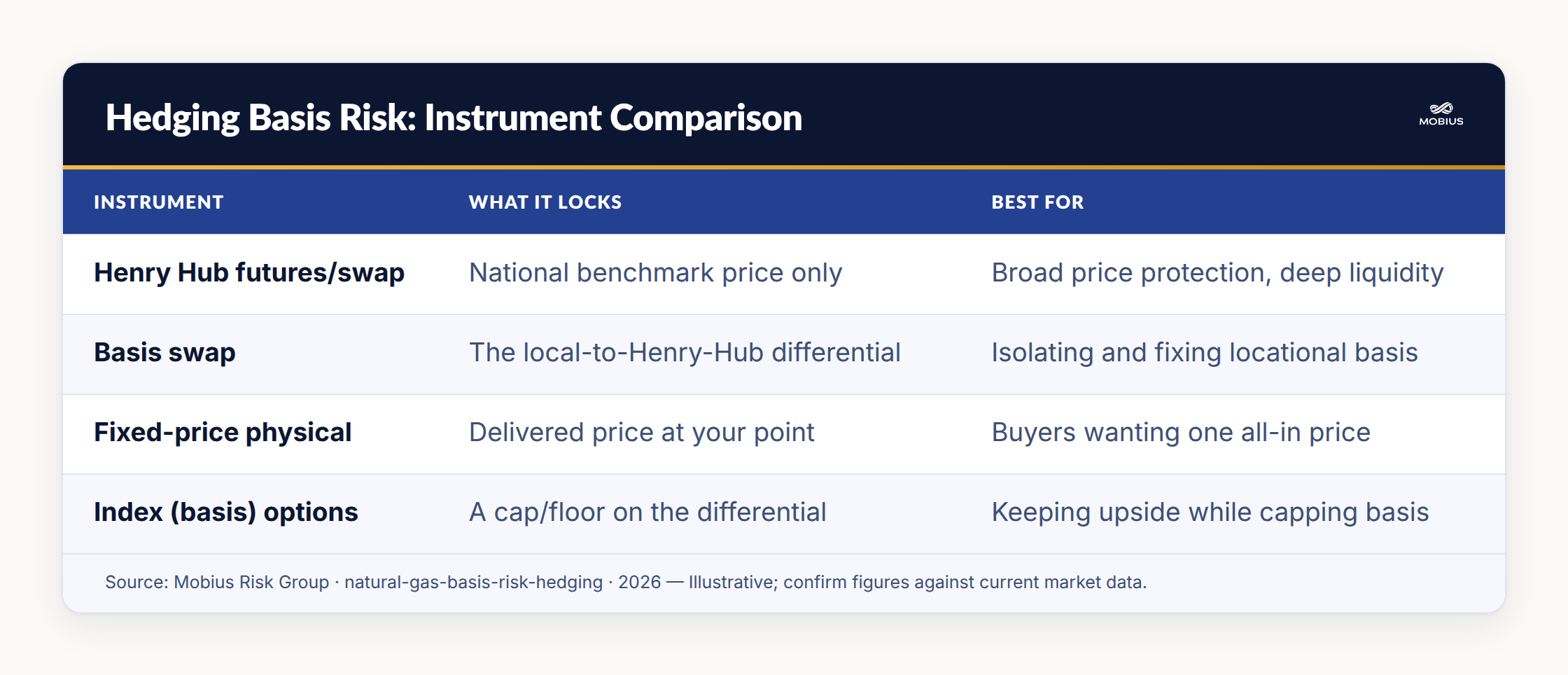
Hedging Basis Risk: Instrument Comparison
How big can basis risk be?
Basis can be small and stable in a well-supplied region and violent in a constrained one. In pipeline-constrained basins, negative basis can blow out when production overwhelms takeaway capacity; in demand-spike events, delivered-market basis can spike far above Henry Hub. Either move can overwhelm the value of an otherwise well-placed benchmark hedge — which is why locational exposure deserves its own analysis, not just a benchmark hedge ratio. [confirm current basis levels for your specific hubs]
How do you hedge natural gas basis risk?
The cleanest tool is a basis swap, which fixes the differential between your local hub and Henry Hub. Combine a Henry Hub swap (for the flat price) with a basis swap (for the location) and you have effectively locked your delivered price. Buyers who want a single number can instead buy fixed-price physical gas at their point, pushing the basis management onto the supplier. Where you want protection but not a full lock, index (basis) options cap the differential while keeping favorable moves.
The right mix depends on your hubs, volumes, and risk tolerance. Mobius models each delivery point's basis behavior and builds a hedge structure that protects the delivered price, not just the screen price.
Who should worry about basis risk?
Any producer selling gas away from Henry Hub, any utility or industrial buyer taking delivery at a regional hub, and any CFO relying on a hedge program to stabilize cash flow. If your hedge accounting assumes a benchmark instrument offsets local-price exposure, unmanaged basis can undermine hedge effectiveness testing under ASC 815 — a reporting problem as well as an economic one.
Related reading from Mobius Risk Group
- Natural Gas Hedging Strategies for CFOs and Treasurers
- Crude Oil Hedging Strategies for Producers: Swaps, Collars & Three-Ways
- What Is a Costless Collar in Oil & Gas Hedging?
Frequently asked questions
What is basis in natural gas?
Basis is the price difference between a local delivery hub and the Henry Hub national benchmark. It reflects regional pipeline capacity, demand, weather, and storage. A negative basis means local gas is cheaper than Henry Hub; a positive basis means it is more expensive.
What is the difference between price risk and basis risk?
Price risk is exposure to moves in the flat benchmark price. Basis risk is exposure to moves in the differential between your local price and that benchmark. A Henry Hub hedge removes flat-price risk but leaves basis risk unless you also hedge the differential.
How do you hedge natural gas basis risk?
Most commonly with a basis swap that fixes the local-to-Henry-Hub differential, often paired with a Henry Hub swap for the flat price. Alternatives include fixed-price physical supply and basis options that cap the differential while keeping upside.
Can basis risk make a hedge lose money?
Yes. If the basis differential moves against you, the local price you receive or pay can differ materially from the benchmark you hedged, so the combined position underperforms even when the benchmark hedge worked as designed.
Mobius Risk Group is an independent, unconflicted commodity risk advisor. This article is educational and not financial or accounting advice; confirm figures and rules against current market data and your own advisors.
Subscribe to receive the latest Mobius Research & updates