
August 14, 2026
Quick Answer
CFOs and treasurers hedge natural gas to convert volatile fuel or feedstock costs into budget certainty. The core tools are swaps (fix a price), collars (cap a range at low cost), and options (insure against adverse moves while keeping upside). The right mix depends on budget tolerance, physical exposure, and hedge-accounting goals.
Why do CFOs hedge natural gas?
For chemical, industrial, and power-exposed companies, natural gas is often the largest variable input cost and the least controllable. Hedging is not speculation — it is the deliberate reduction of earnings volatility so that a board can commit to a budget, protect margins, and avoid covenant surprises. The treasury goal is predictability, not calling the market.
Which hedging instruments should a treasurer consider?
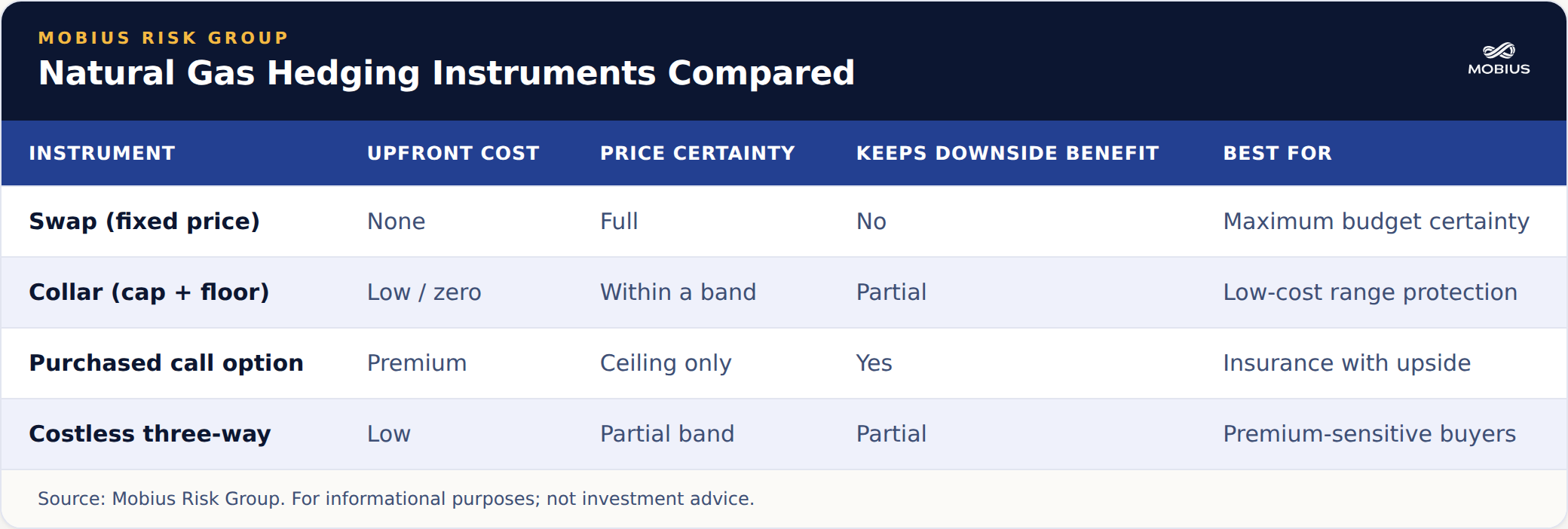
Three instruments cover most corporate programs. A swap locks a fixed price and removes all price uncertainty but forfeits any benefit if prices fall. A collar buys a cap and sells a floor, defining a price band at little or no upfront cost. A purchased option (a call for buyers) sets a ceiling while preserving downside benefit, in exchange for a premium. The comparison below frames the trade-offs.
Natural Gas Hedging Instruments Compared
How do you size and govern the program?
Sizing starts with mapping physical volume to a hedge ratio the board is comfortable with — often laddered across quarters so no single settlement dominates. Governance matters as much as instrument choice: a written hedging policy, mark-to-market reporting, and hedge-accounting alignment keep the program defensible. Mobius builds these programs with RiskNet for position and exposure tracking and M(β)risk for value-at-risk and scenario testing, while M-Direct indicative pricing lets treasury verify dealer quotes independently.
Related: hedging Gulf Coast weather-driven price risk.
Frequently asked questions
What is the difference between a swap and a collar?
A swap fixes a single price and removes all uncertainty and all benefit from falling prices. A collar sets a ceiling and a floor, so cost floats within a defined band, usually at little or no upfront premium.
How much of our natural gas exposure should we hedge?
There is no universal ratio; most programs ladder coverage across future quarters and set the hedge ratio to the board's tolerance for earnings volatility. An advisor sizes it against actual physical volume and budget targets.
Does hedging require special accounting?
To smooth earnings, many companies elect hedge accounting under ASC 815, which has documentation and effectiveness-testing requirements. Aligning the program with those rules from the start avoids restatements.
Talk to an unconflicted advisor. Mobius Risk Group has advised energy and industrial clients on commodity risk since 2002. Start a conversation →
Subscribe to receive the latest Mobius Research & updates