
April 6, 2026
QUICK ANSWER
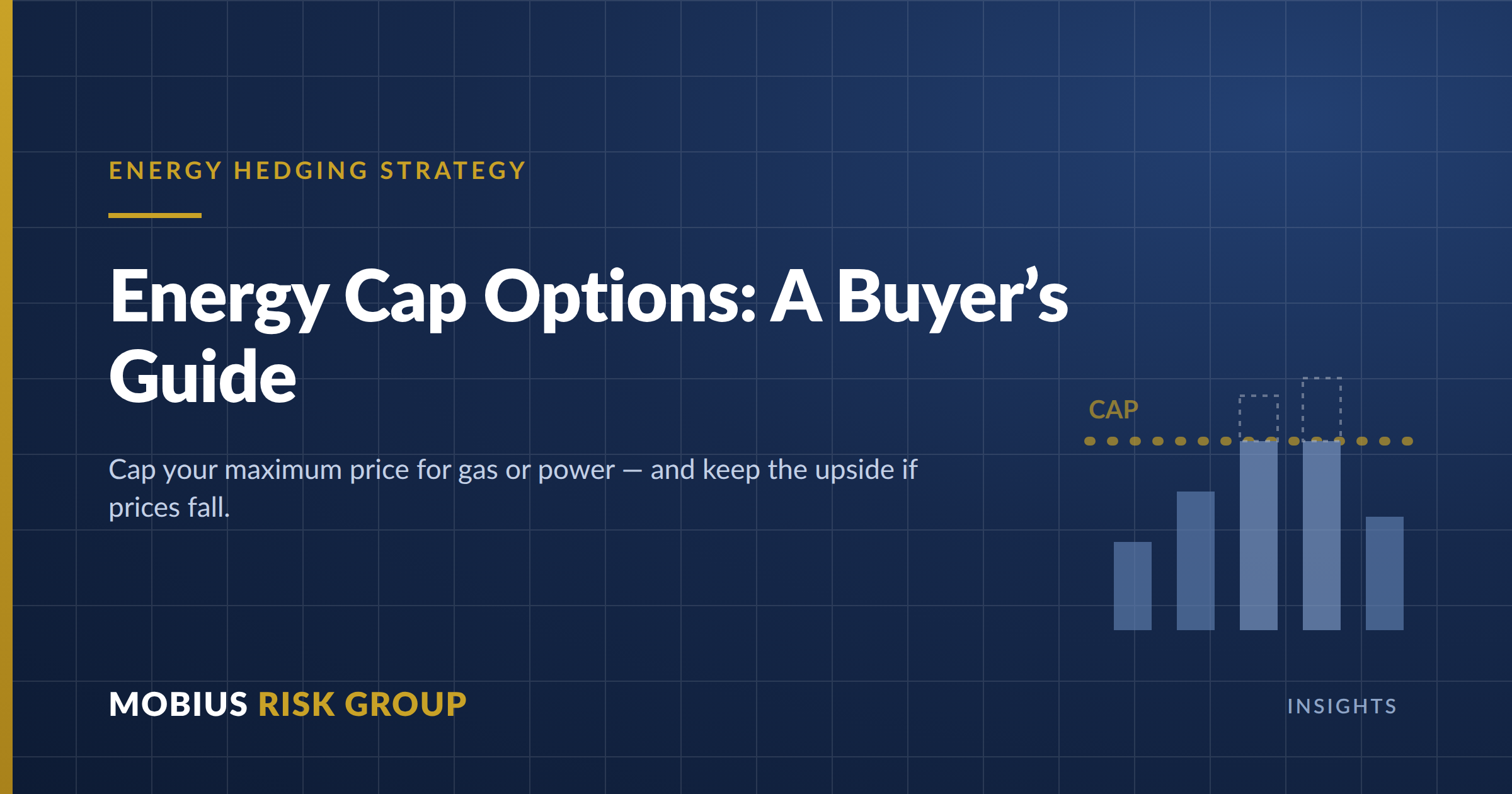
An energy cap option lets a buyer set a maximum price for natural gas or power while keeping the benefit if prices fall. The buyer pays a premium up front; in exchange, cost is protected above the cap (strike). Caps suit energy buyers who need protection against price spikes but do not want to lock in a fixed price and lose the savings if the market drops.
For an energy buyer, the hardest part of hedging is protecting against a spike without giving up the benefit of a fall. A fixed swap removes the spike but also removes the upside. A cap — a call option bought on gas or power — solves that trade-off directly: it sets a ceiling on cost while leaving the downside open.
What is an energy cap option?
A cap is a call option a buyer purchases on an energy price. If the market settles above the cap (the strike price), the option pays the difference, so the buyer’s effective cost is held at the cap. If the market settles below, the option simply expires and the buyer pays the lower market price — having spent only the upfront premium. In effect, the cap is insurance against high prices.
Why would a buyer use a cap instead of a swap?
Because a cap keeps the upside. The comparison below shows how a cap, a swap, and a collar each treat a buyer’s downside, spike protection, and budget.
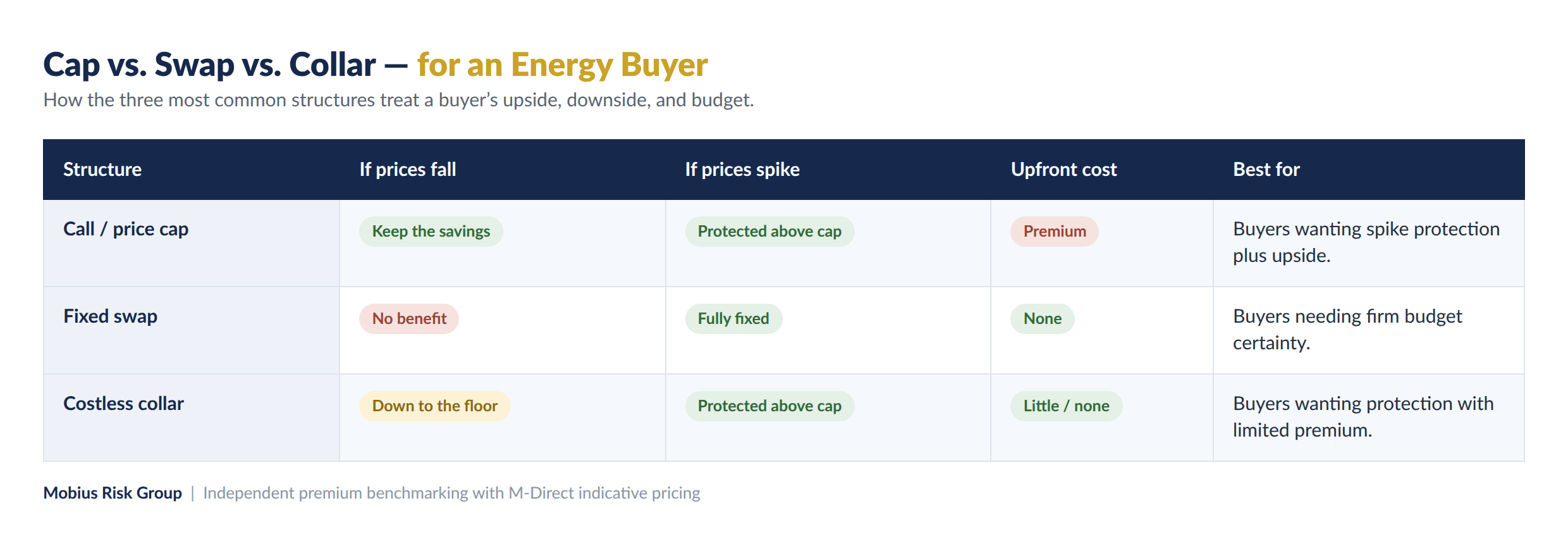
A swap gives firm budget certainty at zero upfront cost but no benefit if prices fall. A cap costs a premium but protects against spikes while preserving the savings of a falling market. A costless collar sits between them — little or no premium, spike protection, but the buyer gives up savings below a floor. The right choice depends on how much a buyer values keeping the downside versus avoiding a premium.
How much does an energy cap cost?
The premium depends on the strike level, the term, and market volatility. A cap set close to the current price costs more (it is more likely to pay out); a higher cap costs less but offers protection only against larger spikes. Volatility matters too — premiums rise when markets are turbulent, which is often exactly when buyers start shopping for protection. Buying ahead of volatility, rather than during it, is usually cheaper.
When do caps make sense for an energy buyer?
- Budget protection with upside — you must not exceed a cost ceiling but want to benefit if prices fall.
- Uncertain or seasonal exposure — you expect volatility (e.g., winter or hurricane season) and want event protection.
- A view that prices could drop — locking a swap would forgo a likely decline.
- Premium tolerance — you can fund the upfront cost in exchange for flexibility.
How do you buy energy caps well?
Three habits separate a good cap program from an expensive one: buy before volatility spikes rather than after; ladder purchases across time and strikes rather than committing all at once; and benchmark the premium against an independent reference before paying it, since option pricing is where dealer margin is easiest to hide. An independent advisor can price the cap against indicative levels so a buyer knows the quote is fair.
How Mobius Risk Group helps energy buyers
Mobius Risk Group is an unconflicted advisor: it helps buyers decide whether a cap, swap, or collar fits the objective, structures and times the purchase, and benchmarks the premium against M-Direct indicative pricing — without earning a spread or commission on the trade. Exposure and positions are tracked in RiskNet™ and sized with M(β)risk™ analytics.
Frequently Asked Questions
What is an energy cap option?
A call option a buyer purchases on gas or power that sets a maximum price. Above the cap the option pays the difference; below it the buyer pays the lower market price, having spent only the premium.
Is a cap better than a swap for an energy buyer?
It depends. A cap preserves the benefit of falling prices for an upfront premium; a swap gives firm certainty at no premium but no downside benefit. Buyers expecting possible price declines often prefer caps.
How much does an energy price cap cost?
The premium depends on the strike, the term, and market volatility. Caps near the current price cost more; higher caps cost less. Premiums rise in volatile markets, so buying ahead of volatility is usually cheaper.
What is the difference between a cap and a collar?
A cap only limits the maximum price, keeping full downside benefit for a premium. A collar adds a sold floor to offset the premium, so it costs little or nothing but gives up savings below the floor.
Subscribe to receive the latest Mobius Research & updates