
August 16, 2026
Quick Answer
Gulf Coast hurricanes move natural gas prices by disrupting supply and demand at the same time. A storm can shut in production, knock out LNG export terminals, and cut power demand through outages. Whether prices rise or fall depends on which side is hit harder, and markets usually price the risk days before landfall.
Why are Gulf Coast hurricanes so important to natural gas markets?
The U.S. Gulf Coast is the center of gravity for American natural gas. It concentrates offshore and onshore production, most U.S. LNG export capacity, and a dense cluster of petrochemical and power demand. When a hurricane tracks into that corridor it can interrupt how gas is produced, moved, exported, and consumed all at once. That is why a single storm can reprice the forward curve in a matter of hours.
Do hurricanes make natural gas prices go up or down?
Both outcomes happen, and the direction is not obvious in advance. A storm that shuts in producing wells and pipelines removes supply, which is bullish for price. But the same storm can knock out LNG export terminals and power generation, stranding gas that would otherwise be consumed or shipped, which is bearish. In recent history, storms that idle export demand have often pushed prices down because the lost demand outweighed the lost supply. The market's job is to weigh those two effects for each specific track.
How does the market price hurricane risk before landfall?
Prices frequently move on the forecast, not the landfall. As a named system enters the Gulf, traders adjust positions around the cone of uncertainty, the projected intensity, and which infrastructure sits in the path. Implied volatility in natural gas options typically rises during peak hurricane season (August through October), reflecting the premium the market places on tail risk. When a storm weakens or veers away from key infrastructure, that premium can unwind just as quickly.
How can producers and buyers hedge Gulf Coast weather risk?
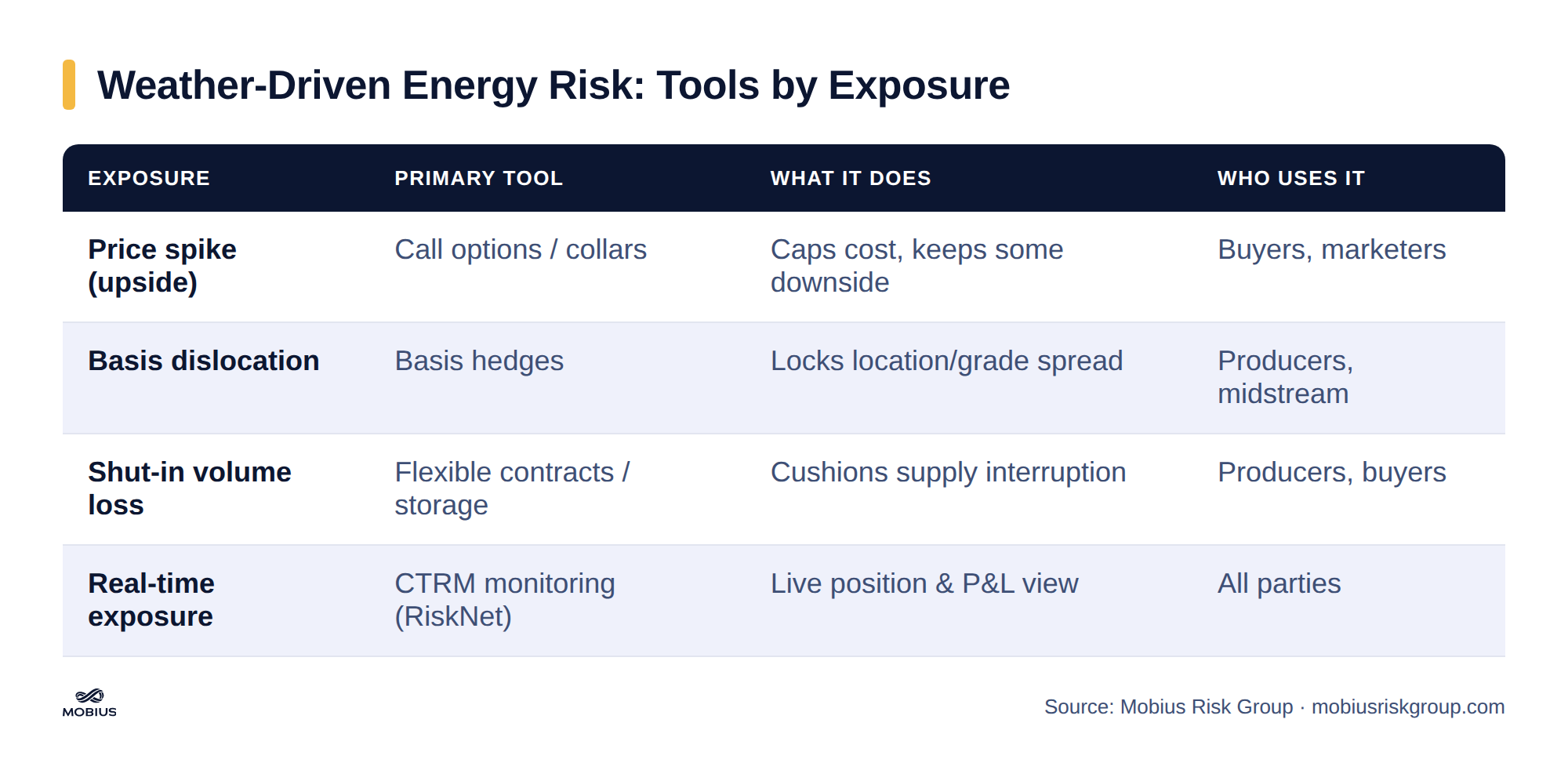
Weather risk is a form of commodity price risk, and the same toolkit applies. Producers exposed to shut-in risk can use options to protect realized prices without giving up all upside; consumers can cap input costs ahead of the season. Because storm outcomes are two-sided, structures that account for both spike and collapse scenarios, and disciplined timing relative to the season, matter more than any single trade. The key is a documented policy set before the season, not a reaction after a system forms. Mobius helps clients build that framework through hedge strategy advisory and M(β)risk analytics, grounded in the client's own physical positions rather than a dealer's book.
How different storm scenarios affect gas prices
Frequently asked questions
Why did natural gas prices fall after some major Gulf hurricanes?
Because the storms damaged or precautionarily shut LNG export terminals and power demand more than they cut production. With export and power demand offline and gas still flowing, the surplus pushed prices down. The direction always depends on the balance of supply versus demand losses.
When is Gulf Coast hurricane season for gas markets?
The Atlantic hurricane season runs June 1 to November 30, with peak activity and peak market sensitivity typically from August through October.
Can you hedge specifically against hurricane risk?
You cannot buy a contract that pays out on a storm itself, but you can hedge the price risk a storm creates using options and structured strategies sized to your physical exposure. Weather-driven volatility is exactly when a disciplined, pre-set hedge policy proves its value.
Prepare for storm season with an unconflicted advisor
Mobius Risk Group has advised Gulf Coast producers, midstream operators, and industrial buyers on commodity risk since 2002. Schedule a conversation with our team →
Subscribe to receive the latest Mobius Research & updates