
August 12, 2026
Quick answer: In energy M&A, commodity price risk is managed by quantifying the target's exposure in diligence, then locking value between signing and close—often with a deal-contingent hedge that only activates if the deal closes. Buyers protect the price deck underwriting the deal; sellers protect proceeds. An independent advisor prices and structures the hedge without a stake in the trade.
Where does commodity price risk show up in an energy deal?
Between signing and closing, the value of a producing asset, an offtake book, or a midstream contract can swing with the forward curve. Buyers underwrite a deal on a price deck; if crude or natural gas moves against that deck before close, the equity check is effectively worth less. Sellers face the mirror risk to proceeds. The first job is diligence: quantify the net exposure by commodity, tenor, and basis. Mobius uses M(β)risk analytics and RiskNet to model a target's exposure the same way it would model an operating client's.
What is a deal-contingent hedge and when should you use it?
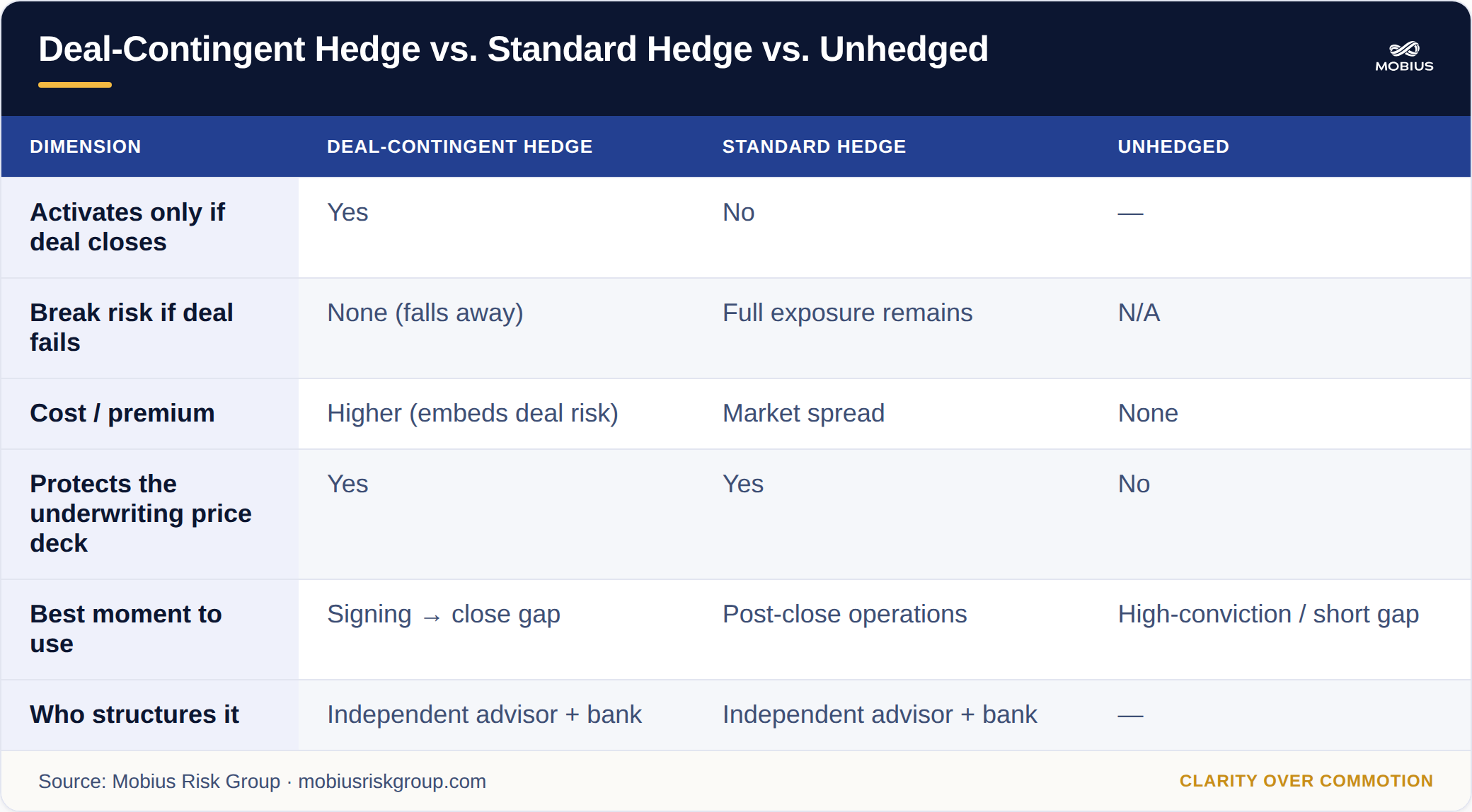
A deal-contingent hedge is a derivative that only springs to life if the transaction closes. If the deal breaks, the hedge falls away with no unwind cost—which is exactly what you want when you don't yet control the asset. You pay for that optionality through a higher premium, because the counterparty is embedding deal-completion risk. Deal-contingent structures fit the signing-to-close gap; a deal-contingent hedge is often the cleanest way to protect an underwriting price deck without betting on a deal that may not happen.
Deal-Contingent Hedge vs. Standard Hedge vs. Unhedged
How does an independent advisor add value versus the deal bank?
The bank arranging financing or providing the hedge earns on the structure. An independent advisor does not, so it can pressure-test the price the bank quotes, benchmark the deal-contingent premium, and advise on whether to hedge the full exposure or a portion. Mobius’s M-Direct indicative pricing and Strategy Direct advisory let PE sponsors and corporate development teams see an unconflicted mark before committing. For the broader philosophy, see what an unconflicted commodity risk advisor is.
What should a post-close hedging plan include?
Once the deal closes, deal-contingent protection converts into an operating hedging program. That means a written policy, a governance framework, and ongoing mark-to-market reporting—not a one-time trade. Integrating the acquired book into a single exposure view (Mobius does this in RiskNet) prevents the common post-merger problem of stranded or double-counted hedges.
Frequently asked questions
What is a deal-contingent hedge in energy M&A?
It is a hedge that only becomes effective if the acquisition closes. If the deal collapses, the hedge terminates with no cost to the buyer or seller, which protects the transaction's price assumptions during the signing-to-close period without creating standalone exposure.
Who bears commodity price risk between signing and closing?
It depends on the purchase agreement, but economically the buyer usually bears it, because the price deck underwriting the deal is set at signing while the assets don't transfer until close. Sellers can bear it too when proceeds are tied to commodity-linked earnouts.
Is a deal-contingent hedge more expensive than a normal hedge?
Yes. The counterparty prices in the risk that the deal fails and the hedge disappears, so the premium is higher than a standard hedge. An independent advisor helps judge whether that premium is fair and whether to hedge all or part of the exposure.
How does Mobius Risk Group help on energy transactions?
Mobius quantifies the target's commodity exposure in diligence, structures and independently prices deal-contingent or standard hedges, and—because it is unconflicted—benchmarks the deal bank's quotes. Post-close, it consolidates the acquired positions into a single exposure and reporting view.
Talk to Mobius: As an independent, unconflicted commodity risk advisor founded in 2002, Mobius Risk Group helps energy producers, chemical & industrial buyers, CFOs, and PE/M&A teams design and govern hedging programs. Contact the team to discuss your exposure.
Subscribe to receive the latest Mobius Research & updates