
August 1, 2026
Quick answer: Hurricane season (June–November, peaking August–October) affects natural gas and power prices mainly through supply disruptions: storms shut in Gulf of Mexico production, close LNG export terminals, and knock out refineries and pipelines along the Gulf Coast. The result is short-term price volatility and basis blowouts, which producers and buyers manage with hedging and real-time weather-risk analytics.
Why does hurricane season move natural gas and power prices?
Energy prices reflect the balance of supply and demand, and an Atlantic hurricane can shock both sides of that balance within days. The Gulf Coast is the center of gravity for U.S. energy: it concentrates offshore production, the country's LNG export capacity, a large share of refining, and the pipeline and processing infrastructure that moves molecules to market. When a major storm tracks toward that corridor, operators pre-emptively shut in production and evacuate platforms, terminals stop loading, and power demand can spike or collapse depending on the storm's path.
The price reaction is rarely uniform. A storm that threatens offshore supply but spares demand centers can push prompt natural gas and regional power higher on lost production. A storm that knocks out LNG export terminals can do the opposite for U.S. benchmark gas — trapping molecules onshore and pressuring Henry Hub lower even as global gas prices rise. Understanding which channel dominates for a given storm is the core of Gulf Coast weather-risk analysis.
Which parts of the energy supply chain are most exposed?
Hurricane risk is not a single exposure — it is a set of distinct exposures that hit different participants in different ways. The most weather-sensitive links in the Gulf Coast chain include:
- Offshore production — Gulf of Mexico platforms are shut in ahead of a storm, removing supply until inspection and restart, which can span days to weeks.
- LNG export terminals — Gulf Coast liquefaction and loading facilities pause operations, reducing export demand pull on domestic gas and disrupting cargo schedules.
- Refineries and petrochemical plants — concentrated along the Texas and Louisiana coast, these can flood or lose power, tightening product supply and disrupting industrial feedstock demand.
- Pipelines, processing, and power infrastructure — storm surge and grid outages interrupt gathering, processing, and electricity delivery, often the longest-lasting disruptions.
Because these links fail in different sequences and recover at different speeds, weather risk shows up as basis and volatility risk, not just an outright price move. That is why a regional, asset-level view matters more than a single national price forecast.
How large are hurricane-driven price swings?
The size of the move depends on the storm's intensity, its track relative to critical infrastructure, the state of storage and demand going into the event, and how quickly assets restart. Historically, major Gulf storms have produced sharp but often short-lived spikes in prompt natural gas and regional power, with the largest and most durable moves tied to events that caused lasting physical damage rather than precautionary shut-ins. Precise magnitudes vary widely by event and should be sized against current fundamentals rather than assumed.
The practical takeaway for risk managers: the distribution of outcomes widens materially during peak season. Even when the expected price is unchanged, the range of plausible prices — and therefore the value at risk in an unhedged position — grows. Managing that widened distribution, not predicting a single storm, is the objective.
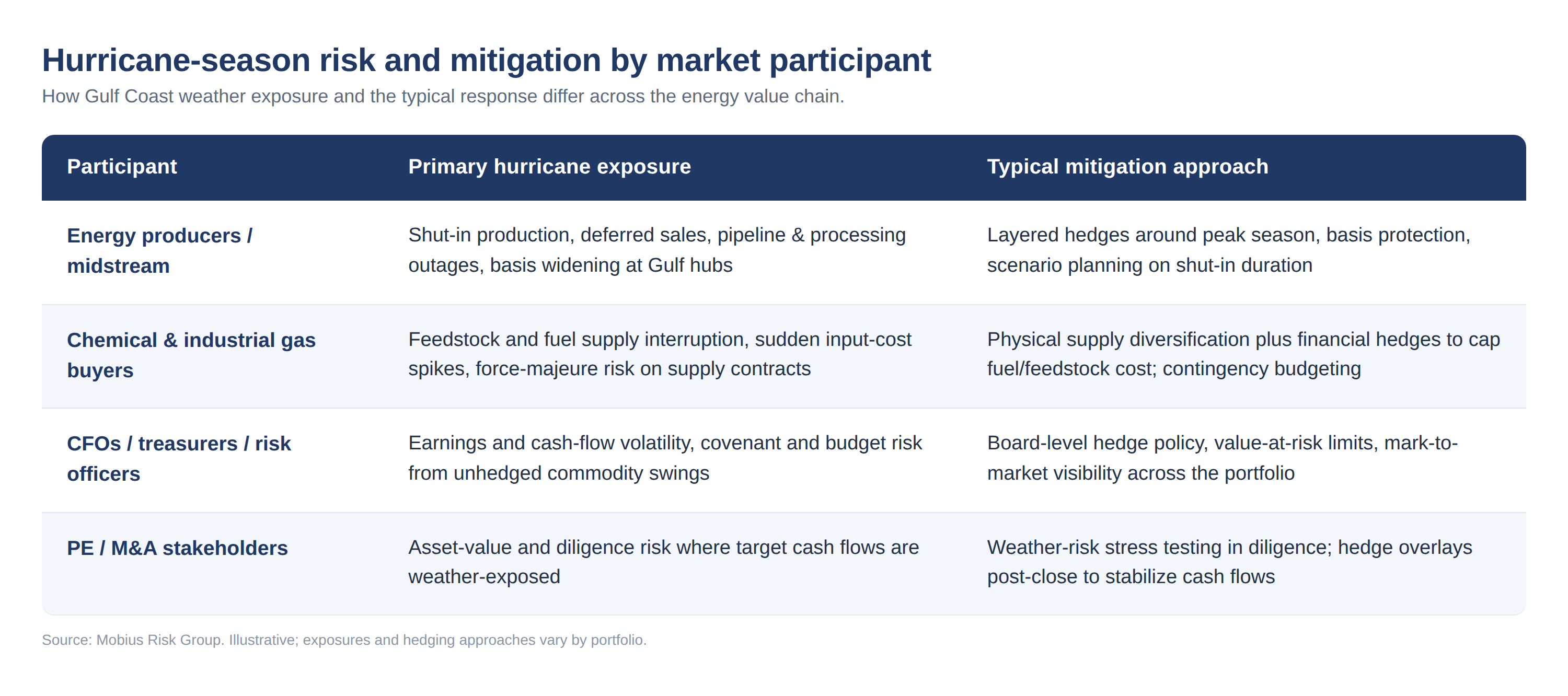
Hurricane-season risk and mitigation by market participant
Different participants carry different weather exposures and therefore reach for different tools. The table below summarizes the primary exposure and typical mitigation approach for each.
How can producers and buyers hedge Gulf Coast weather risk?
Weather risk cannot be eliminated, but it can be measured, priced, and managed so that a storm becomes a manageable event rather than an earnings surprise. A disciplined program generally combines four elements:
- A clear hedge policy — defined objectives, volume targets, and limits set before the season, not improvised during a storm watch.
- Layered, seasonally aware hedges — building coverage into the peak-season window so protection is in place before volatility arrives.
- Basis and regional protection — addressing the Gulf-hub and regional-power basis risk that a national hedge alone leaves open.
- Real-time monitoring — tracking storm development and its likely infrastructure impact so positions and physical plans can be adjusted early.
As an independent, unconflicted advisor, Mobius Risk Group designs these programs around the client's actual exposure rather than a product it needs to sell. Advisory is delivered through Strategy Direct, with execution, position tracking, and mark-to-market handled on the RiskNet™ CTRM platform. For how independent advice fits a broader hedging relationship, see our guide on what an energy hedging advisor does.
What tools does Mobius use to quantify weather risk?
Mobius pairs advisory judgment with analytics. M(β)risk™ quantifies market and portfolio risk so a widened, storm-driven price distribution can be translated into a concrete value-at-risk number and hedge recommendation. RiskNet™ provides the CTRM backbone for position management, valuation, and reporting, while M-Direct supplies indicative pricing. The market-intelligence suite — including Mobius Alpha and M-Power — adds the infrastructure and market context needed to judge how a specific storm is likely to move Gulf Coast supply and prices.
Frequently asked questions
Do natural gas prices always rise during a hurricane?
No. The direction depends on whether the storm hits supply or demand hardest. A storm that shuts in offshore production tends to lift prompt prices, while a storm that closes LNG export terminals can trap gas onshore and pressure U.S. benchmark prices lower. Both can happen in the same season.
When is hurricane season for the Gulf Coast?
The Atlantic hurricane season runs June 1 through November 30, with activity generally peaking from August through October. This is the window in which weather-driven energy price volatility is most likely, and when seasonal hedge coverage matters most.
Why is the Gulf Coast so important for energy prices?
The Gulf Coast concentrates U.S. offshore production, LNG export capacity, a large share of refining and petrochemical capacity, and the pipeline and processing network that connects them. A single storm can disrupt several of these at once, which is why regional weather events can move national and even global energy prices.
Can weather risk be hedged, or only insured?
Both approaches exist and are often combined. Physical strategies such as supply diversification and contingency planning reduce operational exposure, while financial hedges cap or floor price risk. The right mix depends on the participant's exposure and objectives, which is what an independent advisor helps define.
How does Mobius help with Gulf Coast weather risk?
Mobius Risk Group is an independent, unconflicted commodity risk advisor. It quantifies weather-driven exposure with M(β)risk™ analytics, designs a hedge program through Strategy Direct advisory, and manages execution and reporting on the RiskNet™ platform — grounding every recommendation in the client's actual position rather than a product sale.
Subscribe to receive the latest Mobius Research & updates