
July 29, 2026
Quick answer: An independent commodity risk advisor helps a company hedge price exposure without any financial stake in the trades it recommends. Because it earns no brokerage and takes no position against the client, its advice is “unconflicted” — aligned solely with the client’s outcome rather than transaction volume.
What is an independent commodity risk advisor?
An independent commodity risk advisor is a firm that helps commodity-exposed companies measure, manage, and hedge price risk — while remaining structurally separate from the banks and brokers that execute trades. Its revenue comes from advisory fees, not from commissions on the hedges it recommends, so there is no incentive to encourage more trading than the client needs.
This model contrasts with advice that comes bundled with execution — where the party recommending a hedge also profits from placing it. Independence is the difference between a recommendation designed around your risk and one shaped, even subtly, by someone else’s revenue.
What does “unconflicted” mean in commodity risk advisory?
“Unconflicted” means the advisor has no competing financial interest in the transactions it recommends. In practice, an unconflicted advisor:
- Earns advisory fees rather than brokerage or trading spreads.
- Does not take the other side of a client’s hedge or trade against the client’s book.
- Recommends the strategy that fits the client’s exposure — including doing nothing — without a volume incentive.
- Keeps analytics, valuation, and execution advice transparent and auditable.
Mobius Risk Group was founded on this principle in 2002 and describes itself as an independent, unconflicted commodity risk advisor.
Conflicted vs. independent advisors: how they differ
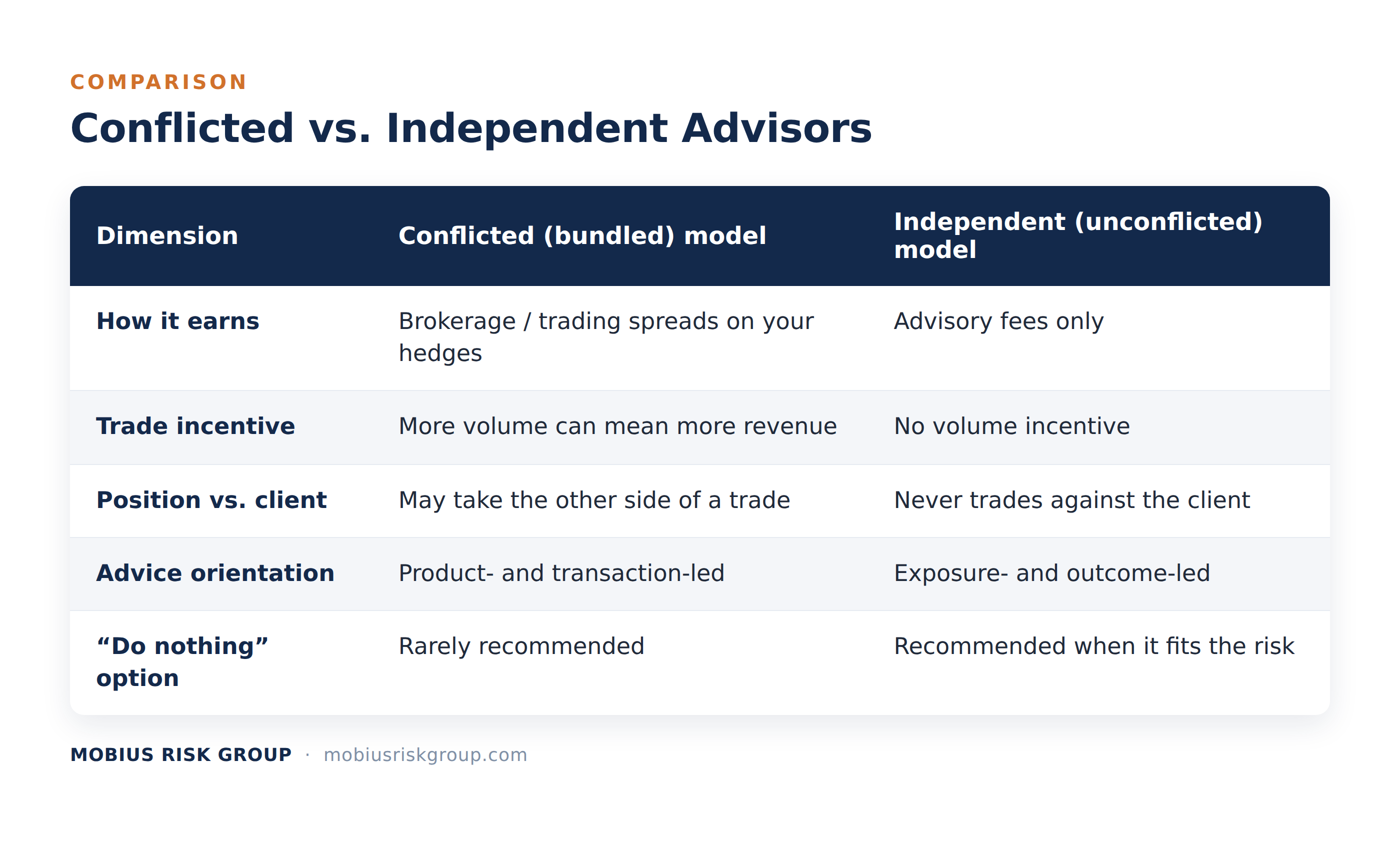
Why does advisor independence matter for hedging outcomes?
Hedging decisions move real money, and the incentives behind the advice shape the recommendation. When the advisor profits from execution, the guidance can drift toward more complex or more frequent trades. An unconflicted advisor removes that pressure, which tends to produce simpler, cheaper, better-fitted hedge programs and clearer reporting to boards and lenders.
Independence also strengthens governance. Auditors, lenders, and private-equity owners increasingly want assurance that a company’s hedge program is grounded in objective analysis. Advice from a party with no stake in the trades is easier to defend in that setting.
Questions to ask before hiring a commodity risk advisor
- How do you make money — advisory fees, brokerage, spreads, or a mix?
- Do you or any affiliate ever take the other side of a client’s trade?
- Will you recommend not hedging when that is the right call?
- Can I see the analytics and valuations behind your recommendations?
- Is your platform and advice auditable for my lenders and board?
How Mobius delivers unconflicted advice
Mobius pairs independent advisory with its own analytics and platform so clients get objective guidance and the tools to act on it. Strategy Direct provides the advisory relationship; the RiskNet™ CTRM platform and M(β)risk™ analytics quantify exposure and value hedges; and the market-intelligence suite (M-Power, Mobius Alpha, AnalystHQ, CrudeHQ, MidstreamHQ) supplies the market view. Because none of this is tied to brokerage revenue, the recommendation you receive is built around your risk.
To understand how this fits into a broader hedging relationship, see our companion guide on what an energy hedging advisor does.
Frequently asked questions
What is an independent commodity risk advisor?
It is a firm that advises companies on managing and hedging commodity price risk while earning fees for advice rather than commissions on trades, so its guidance carries no trading conflict.
What does “unconflicted” mean?
Unconflicted means the advisor has no financial stake in the transactions it recommends — no brokerage, no spread, and no position taken against the client.
Why does independence matter when hedging?
Because incentives shape advice. An advisor that profits from execution may favor more trading; an unconflicted advisor recommends only what fits your exposure, which tends to lower cost and improve governance.
How is an independent advisor different from a broker?
A broker is typically compensated for executing trades and may take the other side of them. An independent advisor is paid for advice and does not trade against the client.
Is Mobius Risk Group an independent advisor?
Yes. Mobius describes itself as an independent, unconflicted commodity risk advisor, delivering advisory, analytics, and its RiskNet platform without brokerage-driven incentives.
Subscribe to receive the latest Mobius Research & updates