
August 17, 2026
Quick answer: Basis risk in natural gas is the risk that the price at your local delivery point moves differently from the benchmark you hedged—usually Henry Hub. Even a fully hedged volume can lose money if regional basis blows out. It is managed with basis swaps, physical basis deals, and locational hedges that match the hedge index to where you actually buy or sell gas.
What is basis risk in natural gas?
Basis is the price difference between a national benchmark—Henry Hub in the U.S.—and a specific regional delivery point such as Waha, Algonquin Citygate, or Chicago. Basis risk is the chance that this differential widens or narrows against you. If you hedge with a Henry Hub swap but take or sell gas at a regional hub, your hedge only covers the benchmark component of the price. The locational spread is left open, and in constrained markets that spread can move more violently than the benchmark itself.
What causes natural gas basis to move?
Basis is driven by the physical reality of moving gas from where it is produced to where it is burned. Pipeline capacity constraints, local weather, storage levels, LNG export pull on the Gulf Coast, and maintenance outages all widen or compress regional differentials. In production basins with limited takeaway, basis can trade deeply negative; in demand pockets during a cold snap, it can spike far above Henry Hub. Because these drivers are regional and often sudden, basis frequently moves when you can least afford it.
Why does basis risk matter if I am fully hedged?
This is the trap that catches many hedging programs. A company can report a 100% hedge ratio and still take a loss because the hedge was placed at the wrong index. A benchmark hedge neutralizes national price moves but does nothing for a local blowout. During Winter Storm Uri, some hedged buyers discovered their Henry Hub protection was worth little against regional prices that traded at multiples of the benchmark. A hedge that ignores basis is only a partial hedge, which is why your true hedge ratio depends on matching the index, not just the volume.
How do you hedge natural gas basis risk?
The goal is to make the hedge index match the physical exposure. Three tools do most of the work: basis swaps that lock the differential between a regional hub and Henry Hub; physical basis deals that fix delivered price at your point; and index selection, simply hedging at the regional index from the start where liquidity allows. The right combination depends on where you transact, how liquid that point is, and how much residual spread you can tolerate.
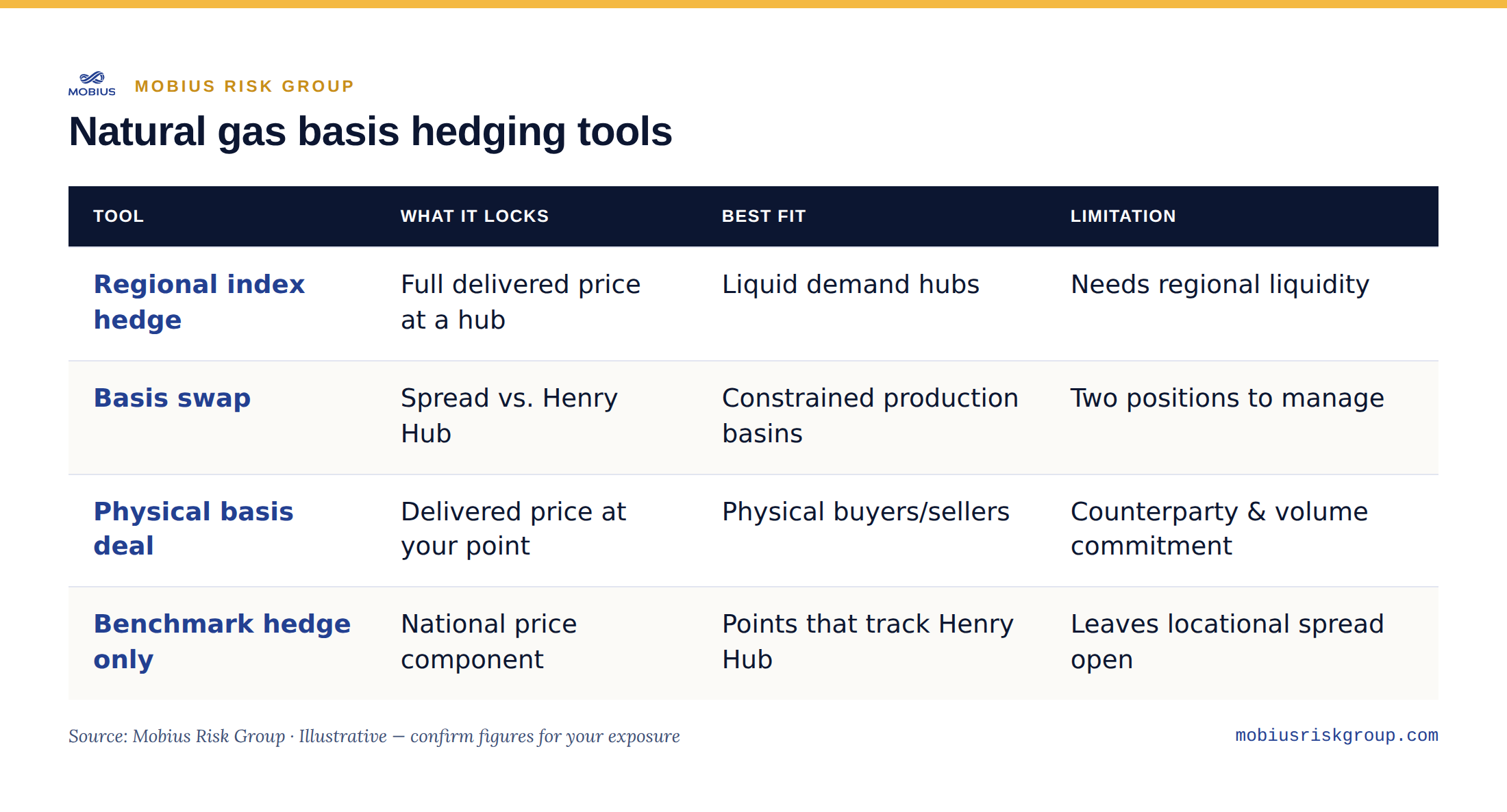
Which basis tools fit which exposure?
A buyer at a liquid demand hub can often hedge directly at that index and sidestep basis entirely. A producer in a takeaway-constrained basin usually needs an explicit basis swap layered on top of a benchmark hedge, because regional liquidity is thin. Seasonal exposure—like a Gulf Coast industrial user through hurricane season—may warrant wider basis protection precisely when pipelines are most likely to be disrupted. Matching the tool to the point and the season is the craft of basis management.
How Mobius manages basis for clients
Mobius Risk Group treats basis as a first-class exposure, not an afterthought to benchmark hedging. We map each client’s delivery points, model regional differentials with M(β)risk and our market-intelligence suite, and design hedges that align the index to the physical position. Because we are an unconflicted commodity risk advisor, we are not steering clients into whatever basis product a desk wants to sell—we recommend the structure that actually closes the locational gap, and monitor it on RiskNet.
Frequently asked questions
Is basis risk the same as price risk?
No. Price risk is exposure to the overall market level (e.g., Henry Hub). Basis risk is exposure to the difference between that benchmark and your local price. You can hedge one and still be exposed to the other.
Can basis ever work in my favor?
Yes. Basis is a differential that can move either way. A producer can benefit if regional prices strengthen relative to the benchmark; the risk is that it moves against your position when you are unhedged on the spread.
Why not just hedge everything at the regional index?
Many regional points lack the liquidity to hedge size efficiently, so pricing is wide or unavailable. That is why benchmark-plus-basis-swap structures are common: they combine deep benchmark liquidity with a targeted spread hedge.
How did basis risk show up during past winter events?
In events like Winter Storm Uri, regional prices in constrained markets spiked far above Henry Hub. Buyers hedged only at the benchmark still faced enormous locational costs, a textbook demonstration of unmanaged basis risk.
Subscribe to receive the latest Mobius Research & updates