
August 17, 2026
Quick answer: A hedge ratio is the percentage of your exposure covered by hedges—hedge 60% of expected natural gas volume and your hedge ratio is 60%. There is no universal “correct” ratio: the right level is set by your objective (budget certainty vs. upside participation), balance-sheet strength, and covenant requirements, then layered over time rather than placed in a single trade.
What is a hedge ratio?
A hedge ratio is the proportion of a known or expected commodity exposure that you have offset with hedges. If a manufacturer expects to burn 1,000,000 MMBtu of natural gas next winter and has hedged 600,000 MMBtu, its hedge ratio is 60%. The remaining 40% is left open to the market. The ratio is the single clearest expression of how much price certainty a company has chosen to buy—and how much upside or downside it has kept.
Hedge ratios apply on both sides of the market. A producer hedges expected production to protect revenue; a consumer or chemical and industrial buyer hedges expected demand to protect input costs. In both cases the ratio, the tenor, and the instrument together define the risk posture.
How do you calculate a hedge ratio?
At its simplest, the hedge ratio is hedged volume divided by total exposed volume for a given period. In practice, three refinements matter. First, use expected volume with a confidence band, not a single point estimate—over-hedging a volume you never produce or consume creates a new speculative position. Second, weight by tenor: a 70% ratio in the front year and 20% three years out is a very different posture than a flat 45%. Third, adjust for basis, because a hedge at Henry Hub does not fully cover exposure priced at a regional hub that can move independently.
How much of your energy exposure should you hedge?
The honest answer is that the right hedge ratio is the one that lets you sleep and still meet your budget. A company with thin margins, tight covenants, or a fixed-price sales book needs more certainty and typically runs a higher ratio. A company with pricing power, a strong balance sheet, or a mandate to participate in favorable moves can justify running more exposure open. The table below maps common objectives to the hedge ratios and structures that tend to fit them.
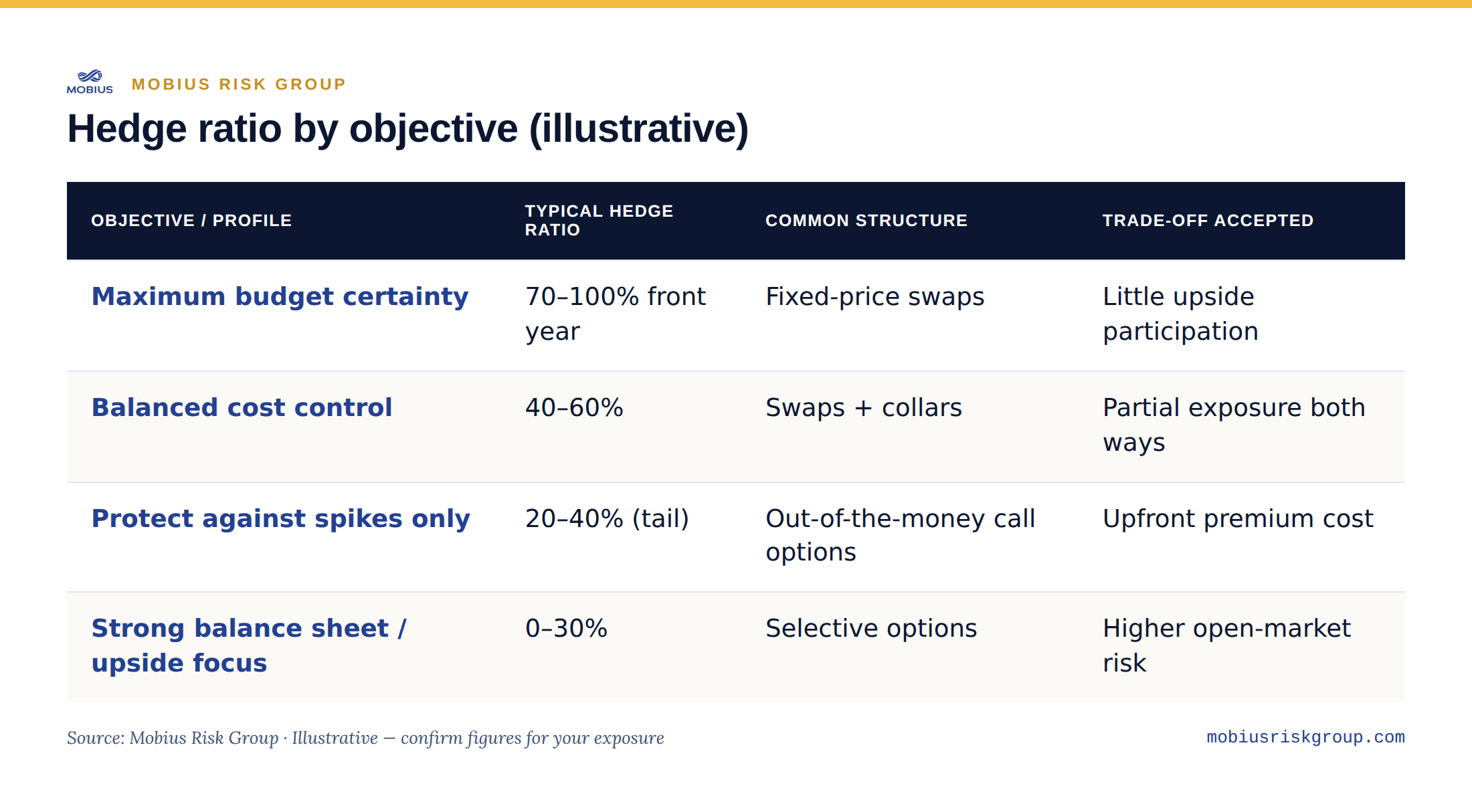
These are starting points, not prescriptions. The correct policy comes from stress-testing your own cash flows against a downside scenario and asking whether the open position is survivable.
What hedge ratio fits your objective?
Budget certainty favors higher ratios with simple swaps that fix a price. Cost-ceiling protection with retained upside favors call options or collars at a lower effective ratio, accepting premium cost or a capped floor in exchange for participation. A producer defending a drilling program leans toward higher near-term ratios; a buyer worried mainly about a price spike may hedge a tail with out-of-the-money calls rather than locking the whole book. The instrument choice is inseparable from the ratio.
Why layering beats a single hedge
Placing your entire hedge in one trade means betting the whole program on a single day’s price. Layering—adding hedges in tranches across time—averages entry levels, reduces timing regret, and lets policy respond to changing fundamentals such as weather and storage. A disciplined program defines target ratios per tenor and fills them methodically, which also removes emotion from the decision. Our guide to how hurricane season moves natural gas and power prices shows why a rules-based, layered approach matters in a seasonally volatile market.
How Mobius helps set hedging policy
Mobius Risk Group works with CFOs, treasurers, and risk committees to translate risk tolerance into a written hedging policy: target ratios by tenor, approved instruments, layering cadence, and reporting. As an unconflicted advisor we are not selling the derivatives we recommend, so the ratio is set by your objectives, not a desk’s trade target. We model the program with M(β)risk analytics and monitor executed hedges and remaining exposure on RiskNet, so the board always sees the live hedge ratio against policy.
Frequently asked questions
Is a 100% hedge ratio the safest?
Not necessarily. A 100% fixed-price hedge removes downside but also removes all upside and can create margining and opportunity costs. If actual volume comes in lower than hedged, part of the hedge becomes a speculative position.
What is the difference between hedge ratio and hedge tenor?
The ratio is how much of a period's volume you cover; the tenor is how far into the future you hedge. A complete policy specifies both—for example, 60% of year one and 25% of year two.
Can the hedge ratio change over time?
Yes, and it should. Most disciplined programs raise near-term ratios as certainty about volume increases and layer in longer-dated hedges gradually as the forward horizon comes into view.
Does basis risk affect my true hedge ratio?
Yes. If you hedge at a benchmark like Henry Hub but price at a regional hub, part of your exposure remains open even at a high nominal ratio. Basis hedges or locational products close that gap.
Subscribe to receive the latest Mobius Research & updates