
August 24, 2026
Quick Answer
Chemical and industrial manufacturers hedge natural gas and feedstock price risk by combining fixed-price physical contracts, financial swaps, and options to lock in a predictable cost of energy. A disciplined hedging policy — defining coverage ratios, tenors, and instruments — protects gross margin from volatile gas and NGL prices without betting on the market. Independent advisors such as Mobius Risk Group help buyers design and execute these programs.
Why do chemical and industrial manufacturers hedge natural gas?
For many chemical producers, natural gas is both a fuel and a feedstock — it heats processes and, as natural gas liquids (NGLs) like ethane, becomes a raw input. When gas prices spike, unhedged manufacturers see input costs jump and gross margins compress, often faster than they can raise product prices. Hedging converts a volatile cost into a predictable one, protecting margin and making budgets and customer pricing more reliable.
What price risks do manufacturers actually face?
Industrial buyers are exposed on several fronts: outright natural gas price (Henry Hub), basis risk between Henry Hub and their delivery location, NGL/feedstock spreads, and power prices driven by gas. A hedging program should be built around the specific exposures that move the company's margin — not a generic gas hedge.
Which hedging instruments do manufacturers use?
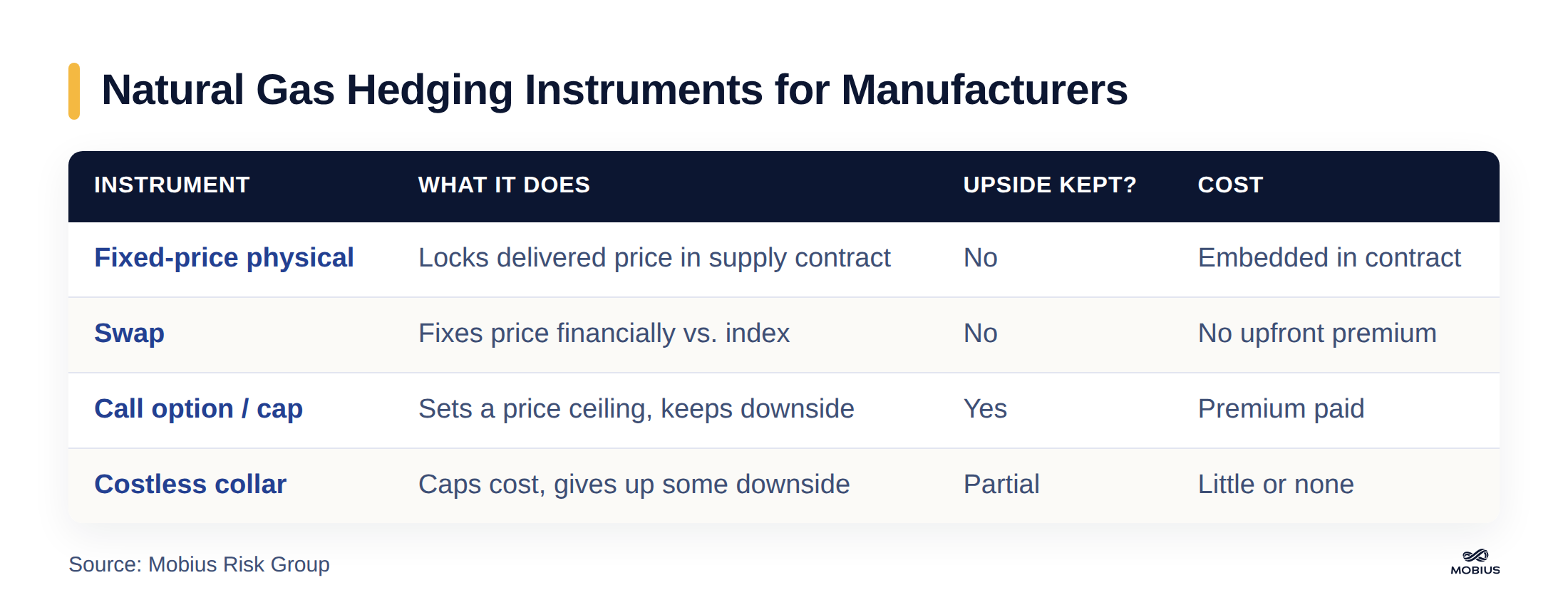
The core toolkit mirrors what energy producers use, applied from the buyer's side:
- Fixed-price physical supply — the simplest hedge, embedded in the procurement contract.
- Swaps — lock a fixed price financially while buying physical gas at index.
- Call options / caps — set a ceiling on price while keeping downside benefit.
- Costless collars — cap the upside cost by giving up some downside, at little or no premium.
The right mix depends on risk tolerance, budget certainty needs, and view on volatility. Learn how costless collars work.
What belongs in a manufacturer's hedging policy?
A written hedging policy keeps a program disciplined and defensible. It should define objectives (margin protection, not speculation), approved instruments, minimum and maximum coverage ratios by tenor, who has authority to execute, and how positions are reported and marked. Without a policy, hedging can drift toward speculation — the opposite of its purpose.
How does an independent advisor help industrial buyers?
Independent advisors like Mobius Risk Group help manufacturers quantify exposure, design a policy, select instruments, and — critically — stay unconflicted, since they don't profit from the derivatives they recommend. Paired with a CTRM platform such as RiskNet, buyers get both the strategy and the systems to track hedge coverage against policy.
Frequently asked questions
Should a manufacturer hedge 100% of its natural gas?
Rarely. Most programs hedge a portion — often a declining coverage ratio across future months — to balance budget certainty with flexibility. The right ratio is set in the hedging policy based on margin sensitivity.
What is basis risk for an industrial gas buyer?
Basis risk is the difference between the benchmark price (Henry Hub) and the price at the buyer's actual delivery point. A hedge tied only to Henry Hub can leave this local basis exposed.
Is hedging natural gas speculation?
No — when governed by a policy focused on margin protection, hedging reduces risk. Speculation means taking positions to profit from price moves, which a proper policy explicitly prohibits.
Can hedging get costless-collar or option treatment under ASC 815?
Many manufacturer hedges can qualify for hedge accounting under ASC 815 when properly documented, smoothing earnings impact. An advisor and CTRM platform help maintain that documentation.
Subscribe to receive the latest Mobius Research & updates