
August 30, 2026
Quick answer: Natural gas hedging strategies lock in or bound future prices using derivatives — swaps fix a price, collars set a floor and ceiling, and options cap downside while keeping upside. The right structure depends on whether you are a producer protecting revenue or a buyer protecting margin, and on how much premium you are willing to pay.
Why hedge natural gas at all?
Natural gas is one of the most volatile widely-traded commodities: weather, storage levels, LNG export demand, and production shifts can move Henry Hub sharply within a single season. A producer with unhedged output faces revenue swings that complicate capital budgeting; an industrial buyer or utility faces input-cost swings that squeeze margin. Hedging does not aim to beat the market — it narrows the range of outcomes so that budgets, covenants, and pricing hold up regardless of where gas settles.
Related: CTRM system.
What are the main natural gas hedging instruments?
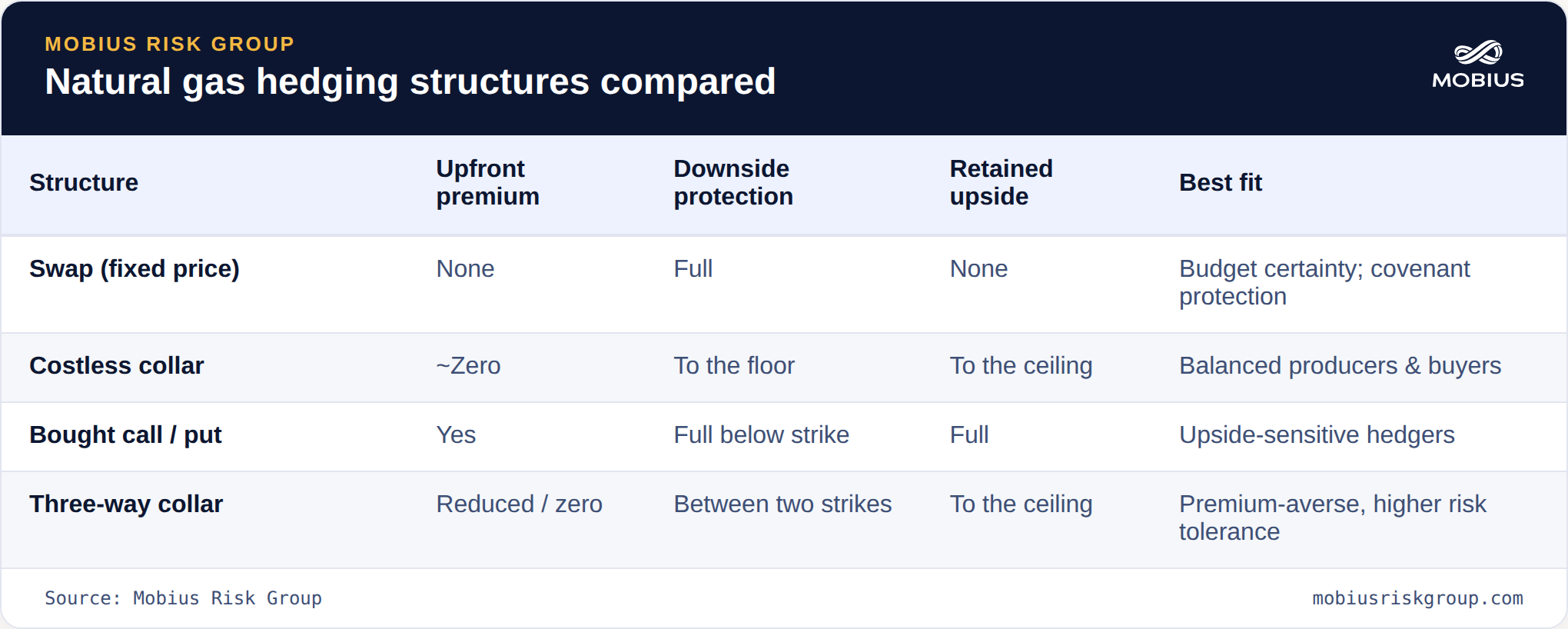
Four structures cover most programs. A swap fixes a single price for a volume and period — full certainty, no upside. A costless collar buys a floor and sells a ceiling so the net premium is near zero — protection with a capped range. A call option (for buyers) or put option (for producers) pays a premium to cap downside while keeping favorable moves. A three-way collar lowers or eliminates premium by adding a sold option, at the cost of re-exposing you beyond a second strike. Each trades certainty, cost, and retained upside differently.
How does a producer's hedge differ from a buyer's?
A producer is long physical gas and hedges to protect revenue against falling prices — buying puts or entering swaps that lock a floor. An industrial buyer or utility is short gas (needs to buy it) and hedges to protect margin against rising prices — buying calls or swaps that lock a ceiling. The instruments look symmetric, but the exposure being protected is opposite, which is why a one-size hedge template rarely fits both sides of the same molecule.
How much of your volume should you hedge?
There is no universal ratio. Most disciplined programs hedge a declining percentage across the forward curve — heavier coverage on near-term, budgeted volumes and lighter coverage further out where forecasts are softer. The coverage ratio should track the certainty of the underlying volume and the tightness of the margin or covenant being protected. Mobius builds these layered programs with M(β)risk analytics so coverage is set to a measured risk tolerance, not a round number.
See also: Gulf Coast weather risk.
Natural gas hedging structures compared
Frequently asked questions
What is a costless collar in natural gas?
A costless collar combines a bought floor and a sold ceiling whose premiums roughly offset, so the structure costs little or nothing upfront. It bounds your price between the two strikes.
Is hedging natural gas the same as speculating?
No. Hedging offsets an existing physical exposure to reduce outcome variance. Speculation takes on new exposure to profit from price moves. A disciplined hedge program is sized to real production or consumption.
What is the risk of a three-way collar?
A three-way collar reduces premium by selling an additional option below the floor, which re-exposes you to prices beyond that lower strike. It lowers cost but reintroduces tail risk.
How does Mobius advise on natural gas hedging?
Mobius is an independent advisor with no trading book opposite yours. It builds layered programs using M(β)risk analytics and M-Direct pricing, then executes and monitors them through RiskNet.
Subscribe to receive the latest Mobius Research & updates