
June 22, 2026
QUICK ANSWER
Manufacturers hedge natural gas costs using fixed-price swaps, call options, costless collars, or index-based physical contracts. Swaps lock a fixed price; options cap upside while keeping downside; collars bound both. The right mix depends on budget certainty, premium tolerance, and how predictable consumption is — most industrial buyers layer instruments across a rolling horizon.
For many manufacturers — in chemicals, food processing, glass, metals, and paper — natural gas is both a major operating cost and, through NGLs, a feedstock. When gas prices swing, unhedged buyers see margins compress unpredictably, budgets miss, and pricing decisions get harder. Hedging does not aim to beat the market; it aims to make energy cost predictable enough to plan, quote, and protect margin.
Why do manufacturers hedge natural gas?
The goal is usually one of three: lock a known cost to protect a budget, cap exposure to a price spike while keeping the benefit of a fall, or smooth volatility so procurement is not timing the market on every purchase. Because the exposure is structural rather than occasional, the question is not whether to manage it but how to do so with discipline.
What are the main natural gas hedging strategies?
Four instrument families cover most industrial hedging programs. Each trades cost certainty against flexibility and upfront premium differently. The graphic below maps how they compare.
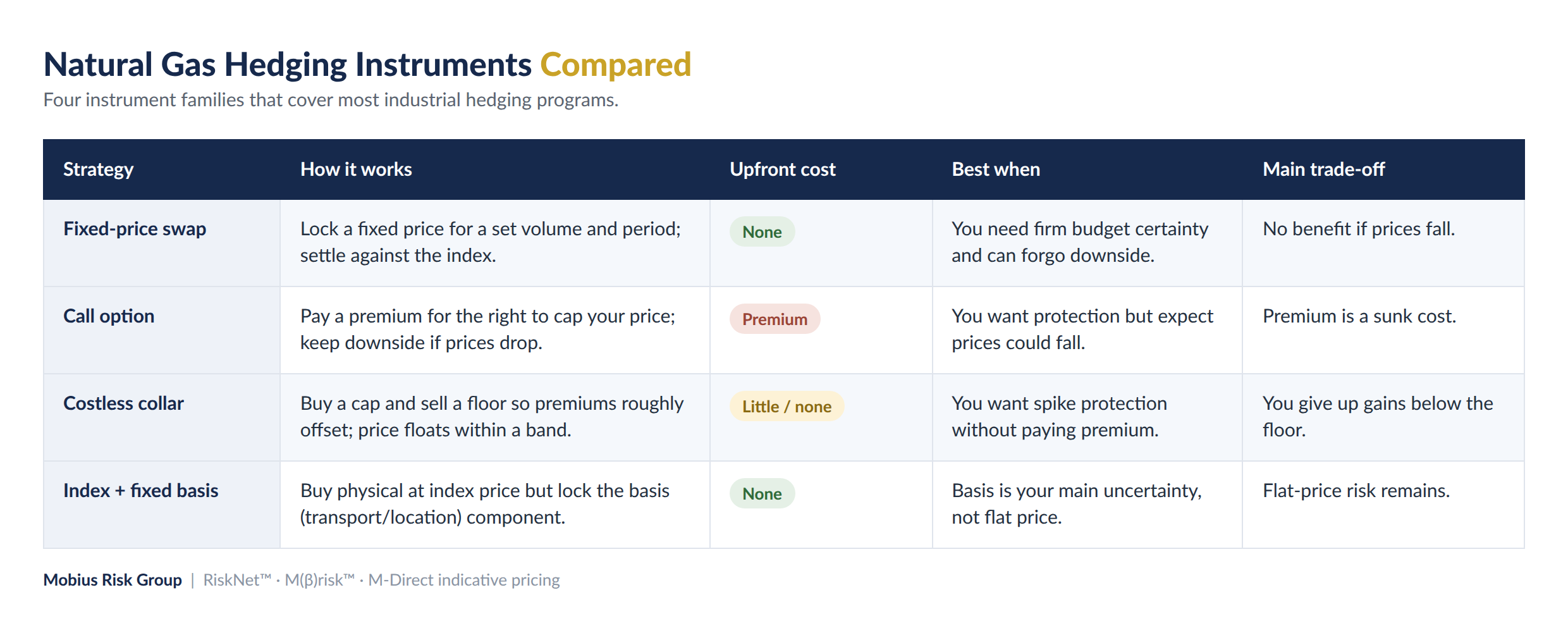
The takeaway: swaps buy certainty at the cost of upside; call options buy protection for a premium; costless collars protect margin at little or no cost by giving up some upside; and index-plus-basis structures address local delivery risk rather than outright price. A common mistake is defaulting to swaps for everything — that removes volatility but also removes the benefit of falling prices.
How much of your natural gas load should you hedge?
There is no universal ratio; the hedge percentage should track how confident you are in your consumption forecast and how much budget risk you can absorb. A common approach is to hedge a higher share of near-term, well-forecast load and taper coverage further out. Two guardrails matter more than any single number:
- Never hedge more than firm, must-run volume — over-hedging turns a hedge into a speculative position.
- Hedge in layers over time — so a single entry price does not define the whole program.
What is basis risk and why does it matter for industrial buyers?
Most financial gas hedges reference Henry Hub, but a plant buys gas at its local delivery point. The difference between the Henry Hub benchmark and the local price is “basis,” and it reflects transportation and regional supply-demand. A buyer can lock the Henry Hub flat price perfectly and still see costs move if basis widens. A complete program addresses both flat price and basis rather than assuming the benchmark hedge covers everything.
How do you build a natural gas hedging program?
A durable program is less about picking the perfect instrument and more about process:
- Measure the exposure — quantify forecast volume by month and delivery point, separating firm load from variable load.
- Set a hedging policy — define objectives, approved instruments, coverage bands, tenor limits, and who has authority to transact.
- Choose and layer instruments — match swaps, options, and collars to the policy and add coverage over time.
- Benchmark pricing — compare counterparty quotes against independent indicative levels before executing.
- Monitor and report — track mark-to-market, coverage ratios, and effectiveness, and adjust as the forecast changes.
This is where an independent advisor and the right systems help. Mobius Risk Group tracks exposure and positions in its RiskNet™ CTRM platform, sizes and stress-tests programs with M(β)risk™ analytics, and benchmarks counterparty quotes against M-Direct indicative pricing — as an unconflicted advisor that earns no spread or commission on the hedges it recommends.
Common mistakes manufacturers make when hedging natural gas
- Hedging to a market view instead of a budget — trying to time the bottom rather than protecting a plan.
- Ignoring basis — locking Henry Hub and assuming delivered cost is fixed.
- Over-hedging — covering more than firm load, which converts a hedge into speculation.
- No written policy — leaving coverage and authority to ad-hoc decisions.
- Not benchmarking prices — accepting counterparty quotes without an independent reference.
Frequently Asked Questions
What percentage of natural gas usage should a manufacturer hedge?
It depends on forecast confidence and budget tolerance. A common pattern is to hedge a larger share of near-term, well-forecast load and less further out, always staying within firm must-run volume. Coverage should be set by policy, not by a market call.
Are swaps or options better for hedging natural gas?
Neither is universally better. Swaps give firm price certainty with no premium but no downside benefit; options cap the price for a premium while preserving downside. Buyers with tight budgets often favor swaps; those expecting possible price declines favor options or collars.
What is the difference between Henry Hub and basis?
Henry Hub is the U.S. benchmark reference price for natural gas. Basis is the local price difference at your delivery point relative to Henry Hub, driven by transportation and regional supply-demand. A full hedge addresses both.
How far out should a manufacturer hedge natural gas?
Programs commonly cover a rolling 12–36 months, with heavier coverage near-term and lighter coverage further out. The right horizon depends on how far your budgeting and contracts extend.
Can we hedge without a trading desk in-house?
Yes. Many manufacturers run effective programs with a written policy, the right analytics, and an independent advisor to design, benchmark, and monitor hedges, while banks or suppliers act as execution counterparties.
Subscribe to receive the latest Mobius Research & updates