

August 13, 2026
Quick answer: Natural gas hedging strategies help industrial and chemical buyers lock in predictable fuel and feedstock costs using instruments such as fixed-price swaps, costless collars, and call options. The right mix depends on budget certainty needs, risk tolerance, and market structure—ideally guided by an unconflicted advisor.
Why do industrial and chemical buyers hedge natural gas?
For chemical producers, refiners, and heavy manufacturers, natural gas is both a fuel and a feedstock—often the single largest variable cost line. When Henry Hub prices swing, unhedged buyers see margins compress without warning, budgets miss, and procurement teams lose credibility with the CFO. Hedging converts an unpredictable cost into a planned one, protecting margin and giving finance a defensible number to build the annual plan around.
Mobius Risk Group works with industrial and chemical buyers to translate physical exposure into a structured hedging program—quantifying how much volume to cover, over what horizon, and with which instruments—so the hedge matches the business rather than a generic template.
What are the main natural gas hedging instruments?
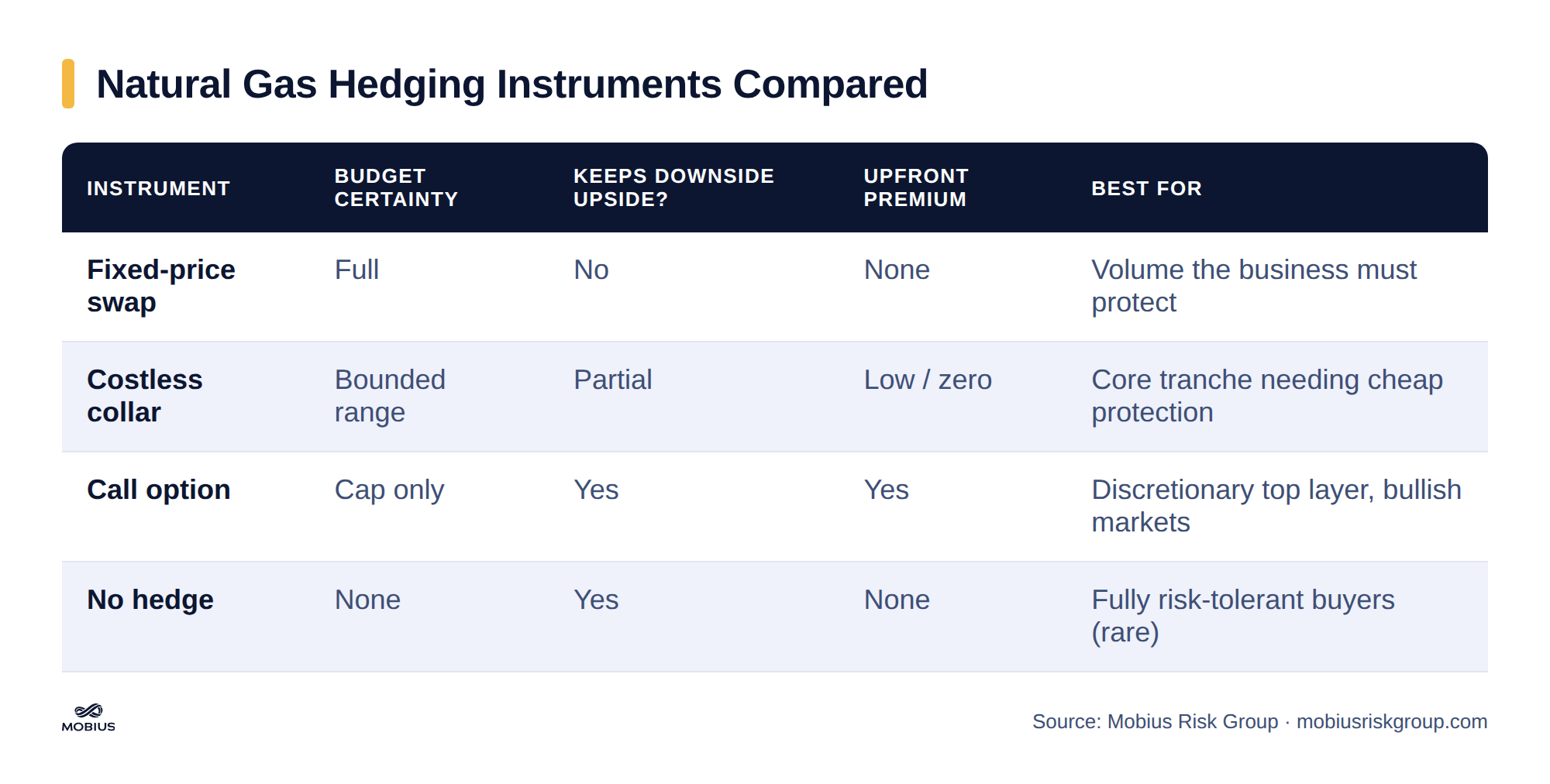
Three building blocks cover most industrial programs. A fixed-price swap exchanges a floating index price for a fixed one, delivering full budget certainty but no upside if prices fall. A costless collar buys a cap (call) and sells a floor (put) so protection is financed by giving up some downside—zero or low premium, but a bounded range. A call option caps the maximum price while preserving the full benefit of falling prices, in exchange for an upfront premium.
Most durable programs blend these: a base layer of swaps for the volume the business must protect, collars for the next tranche, and options for the discretionary top layer. The comparison table below summarizes the trade-offs.
How much natural gas volume should a buyer hedge?
There is no universal ratio. A sound program sizes the hedge to the volume that is genuinely price-sensitive to the P&L, then layers coverage over time—for example hedging a higher percentage of near-term months and tapering into later periods where forecasts are less certain. This laddered approach avoids the trap of hedging 100% at a single point and then watching the market move against that decision.
The analysis should be grounded in the buyer's own load profile, contract terms, and margin sensitivity—exactly the exposure modeling Mobius performs with its M(β)risk analytics before recommending any structure.
How does an unconflicted advisor change hedging outcomes?
Many hedging counterparties are also the banks or marketers selling the instruments, which creates an incentive to favor structures that generate transaction revenue. An unconflicted advisor—retained by fee, not compensated on trades—sits on the buyer's side of the table, benchmarks live dealer quotes, and evaluates whether a proposed structure actually fits the exposure. Mobius has operated on a 100% retainer-based, non-conflicted model since 2002, which means the advice on whether and how to hedge is separated from the incentive to transact.
Natural Gas Hedging Instruments Compared
Related from Mobius Risk Group: Hedge Strategy Solutions · What Is an Energy Hedging Advisor? · RiskNet CTRM Platform
Frequently asked questions
What is the difference between a swap and a collar for natural gas?
A swap fixes a single price and removes all price movement—up or down. A collar sets a ceiling and a floor, so the buyer is protected above the cap but still participates in price declines down to the floor. Collars are often structured at zero premium; swaps carry no premium but forfeit downside benefit.
Is natural gas hedging only for large buyers?
No. While the largest industrial buyers have the most notional exposure, mid-size chemical and manufacturing firms often have the greatest margin sensitivity to gas price swings. The key is sizing the program to the exposure, which an advisor can scale accordingly.
How far out should an industrial buyer hedge natural gas?
Programs commonly ladder coverage across 12 to 36 months, hedging a higher share of near-term volume and less of the uncertain outer months. The exact horizon depends on budget cycles, contract tenors, and how far forward the buyer has visibility into demand.
Why use an advisor instead of hedging directly with a bank?
A bank counterparty earns revenue on the trade, so its structuring advice is not independent. A retainer-based advisor benchmarks multiple dealer quotes, validates that the structure fits the exposure, and negotiates on the buyer's behalf—typically improving pricing and structure fit.
Mobius Risk Group is an independent, unconflicted commodity risk advisor. Talk to an advisor about building a program around your exposure.
Subscribe to receive the latest Mobius Research & updates