
August 16, 2026
Quick Answer
Renewable natural gas (RNG) is pipeline-quality biomethane captured from landfills, dairies, and wastewater. Its price stacks several layers: the underlying natural gas commodity plus environmental credits, chiefly federal RINs under the Renewable Fuel Standard and state LCFS credits, which often exceed the molecule's energy value.
What is renewable natural gas (RNG)?
Renewable natural gas is biogas captured from organic waste sources, such as landfills, dairy and livestock operations, and wastewater treatment, then cleaned to pipeline-quality specification. Once upgraded, RNG is chemically interchangeable with conventional (fossil) natural gas and moves through the same pipelines and equipment. What makes it valuable is not a different molecule but its lower lifecycle carbon intensity, which qualifies it for environmental incentive programs.
How is RNG priced?
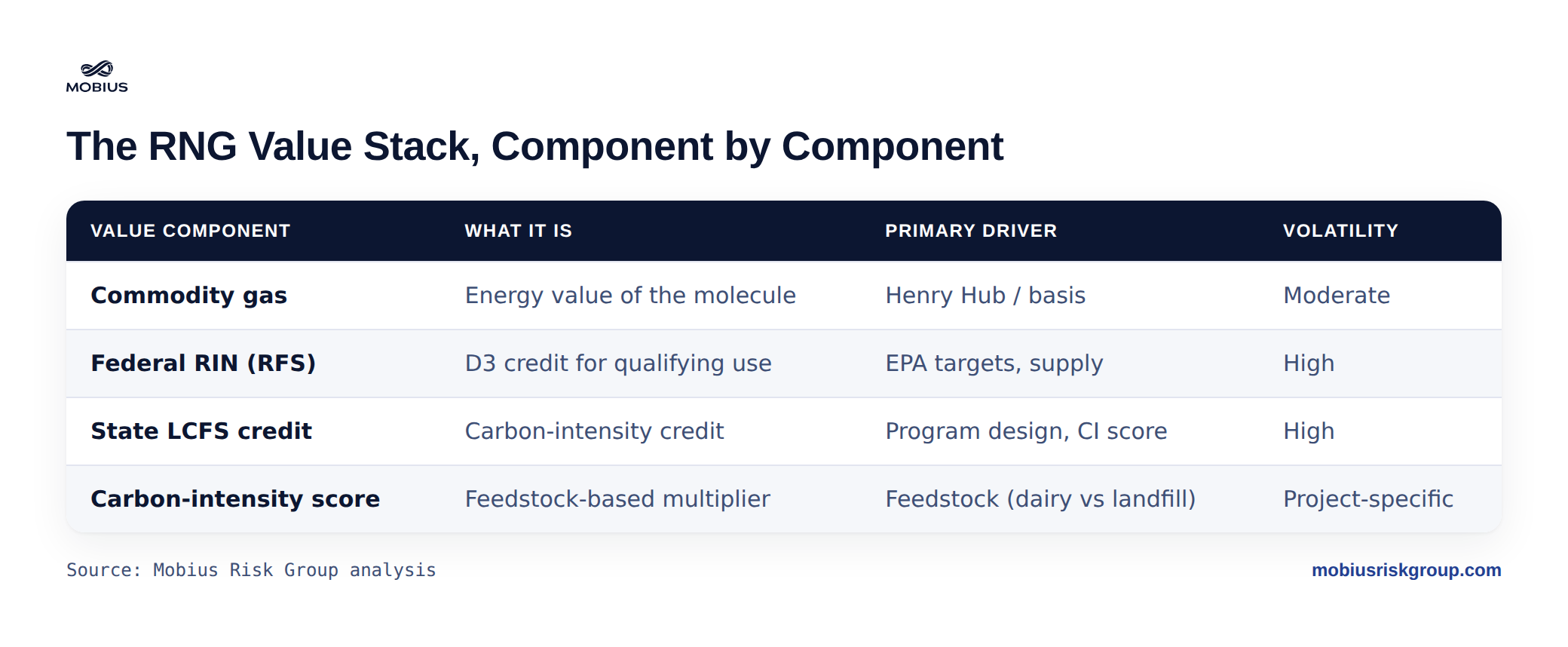
RNG is not priced as a single number. Its value is a stack: the commodity value of the gas itself (referenced to benchmarks such as Henry Hub) plus one or more environmental attributes the fuel generates when used in qualifying end uses, most often transportation. Those attributes are sold separately from the molecule, which means an RNG project's economics depend heavily on credit markets that trade independently of the gas price.
What are RINs and LCFS credits worth?
The two biggest attributes are federal RINs (Renewable Identification Numbers under the U.S. Renewable Fuel Standard, with RNG typically generating D3 cellulosic RINs) and state Low Carbon Fuel Standard (LCFS) credits, most notably in California. The combined value of these credits can be several times the commodity value of the gas, and it varies with a project's verified carbon-intensity score, which is why dairy RNG, with a very low or negative carbon intensity, has historically commanded a premium. Specific credit prices move constantly and should be confirmed against current market data.
Why is RNG pricing so volatile?
Because most of the value sits in policy-driven credit markets rather than the energy commodity. RIN and LCFS prices respond to regulatory decisions, program targets, credit-bank balances, and the pace of new supply. A change in a compliance obligation or a wave of new projects can reprice the credits sharply even when the underlying gas price is stable. For RNG producers and offtakers, that concentrates risk in exactly the components that are hardest to forecast.
How do buyers and producers manage RNG price risk?
Managing RNG risk means treating the stack as separate exposures. The commodity leg can be hedged with established natural gas instruments; the credit legs require a view on program mechanics and, where markets exist, forward sales or contracts to lock value. An independent advisor can help a project or buyer separate the molecule risk from the policy risk and avoid over-hedging one while ignoring the other. Mobius supports clients across physical and financial exposures through hedge strategy advisory and M(β)risk analytics.
The RNG value stack, component by component
Frequently asked questions
Is RNG chemically different from regular natural gas?
No. Once upgraded to pipeline quality, RNG is interchangeable with conventional natural gas. The difference is its origin from organic waste and its lower lifecycle carbon intensity, which unlocks environmental credit value.
Why can RNG sell for far more than conventional gas?
Because the buyer is really paying for the stacked environmental attributes (RINs and LCFS credits) on top of the energy. In many markets those credits are worth more than the gas itself.
What is the biggest risk in an RNG project's economics?
Policy and credit-market risk. Since most of the value comes from regulatory credit programs, changes to those programs or to credit prices can swing project returns more than the gas price does.
Make sense of RNG's value stack
Mobius Risk Group advises producers, buyers, and investors on commodity and energy-transition risk as an independent, unconflicted advisor. Schedule a conversation with our team →
Subscribe to receive the latest Mobius Research & updates