
April 13, 2026
QUICK ANSWER
An RNG hedging strategy manages the price risk in renewable natural gas revenue — which comes not just from the gas itself but from environmental credits such as RINs and LCFS credits. Because those credit markets are volatile and thinly hedged, an RNG program has to address commodity gas price, environmental-credit price, basis, and offtake risk together rather than treating RNG as ordinary natural gas.
Renewable natural gas looks like natural gas but prices like a stack of markets. A single MMBtu of RNG can earn a commodity gas price plus one or more environmental credits, and each of those revenue streams has its own price risk. Treating RNG revenue as if it were just Henry Hub gas leaves the largest and most volatile pieces — the credits — unmanaged.
What makes renewable natural gas price risk different?
Conventional gas has one price. RNG revenue is typically layered: the underlying (“brown”) gas value, plus environmental attributes like D3 RINs under the federal Renewable Fuel Standard and LCFS credits under state low-carbon fuel programs. Those credit markets are driven by policy and program balances rather than supply and demand for gas, so they move differently — and often more sharply — than the commodity itself. The result is a revenue profile that no single gas hedge can cover.
Where does RNG price risk come from?
It helps to break RNG revenue into its components and look at what drives each. The table below maps the main sources of price risk and the tools available for each.
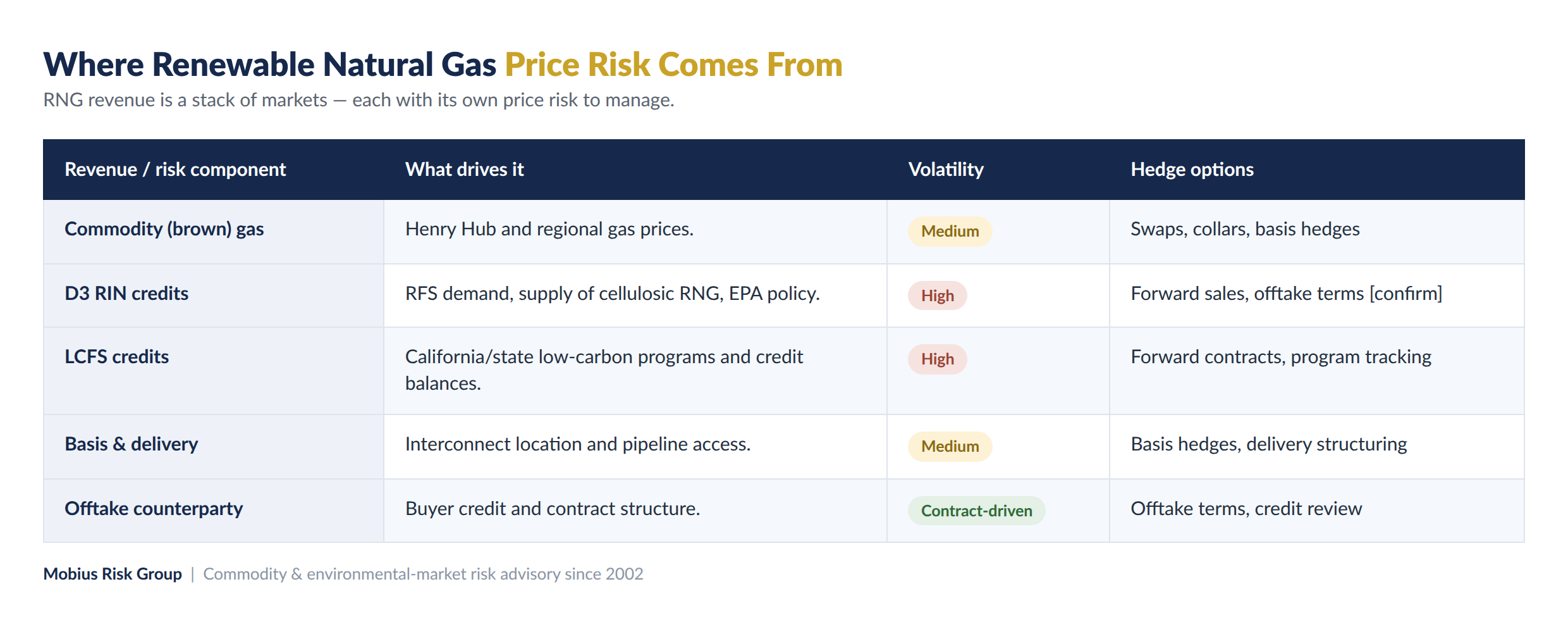
The takeaway is that the commodity gas leg is the most familiar and the most hedgeable, while the environmental-credit legs (D3 RINs, LCFS) are usually the most volatile and the hardest to hedge with standard instruments — which is exactly why they deserve the most attention in an RNG program.
How do you hedge RNG revenue?
- Hedge the commodity gas leg — use swaps, collars, and basis hedges on the underlying gas value, as you would for conventional gas.
- Manage credit exposure — lock value through forward sales or offtake terms where liquidity allows, and track program balances closely where it does not.
- Structure the offtake — the offtake agreement is itself a risk-allocation tool; who bears gas, credit, and volume risk is negotiated there.
- Address basis and delivery — interconnect location and pipeline access shape realized value.
- Measure it together — model the combined revenue stack so the program reflects total exposure, not just the gas piece.
What about RIN and LCFS credit price risk?
Environmental credits are where RNG economics are made or lost. D3 (cellulosic) RIN values respond to RFS volume obligations, cellulosic supply, and EPA rulemaking; LCFS credit values respond to state program stringency and credit-bank balances. Both can swing widely on policy news, and neither has the deep, standardized hedging market that exists for natural gas. A serious RNG strategy tracks these markets continuously and locks value opportunistically through contracts and offtake structure.
How do offtake agreements shift RNG risk?
Much of an RNG project’s risk is allocated in the offtake agreement rather than in a financial hedge. Terms define whether the producer or the buyer carries gas price, credit price, and volume risk, and how credits are shared or passed through. Because the offtake sets the baseline exposure, it should be negotiated with the full risk picture in view — the financial hedging program then manages what the contract leaves with the producer.
How Mobius Risk Group supports RNG and energy-transition risk
Mobius Risk Group brings commodity and environmental-market risk management to RNG and energy-transition projects: exposure and positions tracked in RiskNet™, scenario and value-based analysis via M(β)risk™, and coverage of compliance and environmental-credit markets alongside the commodity gas leg — all as an unconflicted advisor that earns no spread or commission on the hedges it recommends.
Frequently Asked Questions
What is an RNG hedging strategy?
A plan to manage the price risk in renewable natural gas revenue across its components — commodity gas, RIN and LCFS credits, basis, and offtake — rather than treating RNG as ordinary natural gas.
Why is renewable natural gas price risk higher than for conventional gas?
Because most RNG revenue comes from environmental credits (RINs, LCFS) whose prices are driven by policy and program balances and can move sharply, with far less liquid hedging markets than natural gas.
Can you hedge RIN and LCFS credit prices?
Not as easily as gas. Credit exposure is usually managed through forward sales, offtake terms, and close tracking of program balances rather than standardized derivatives.
How do offtake agreements affect RNG risk?
They allocate gas, credit, and volume risk between producer and buyer, setting the baseline exposure that the financial hedging program then manages.
Subscribe to receive the latest Mobius Research & updates