
March 2, 2026
QUICK ANSWER
A swap locks a fixed price with no upfront cost but no benefit if the market moves your way. An option pays a premium to buy protection while keeping the favorable move. Swaps suit hedgers who need firm budget or covenant certainty; options suit those who want protection but expect — or want to keep the option on — a favorable price move.
Almost every energy hedging decision comes down to one trade-off: certainty versus flexibility. Swaps and options sit at the two ends of it, and choosing well starts with knowing what you are actually trying to protect.
What is the difference between a swap and an option?
A swap exchanges a floating price for a fixed one, so both sides are locked — you are protected against adverse moves but give up favorable ones. An option gives the right, not the obligation, to transact at a strike, so it protects one direction while leaving the other open, in exchange for a premium.
Swap or option — which is right?
The comparison below lines them up on cost, certainty, and outcome.
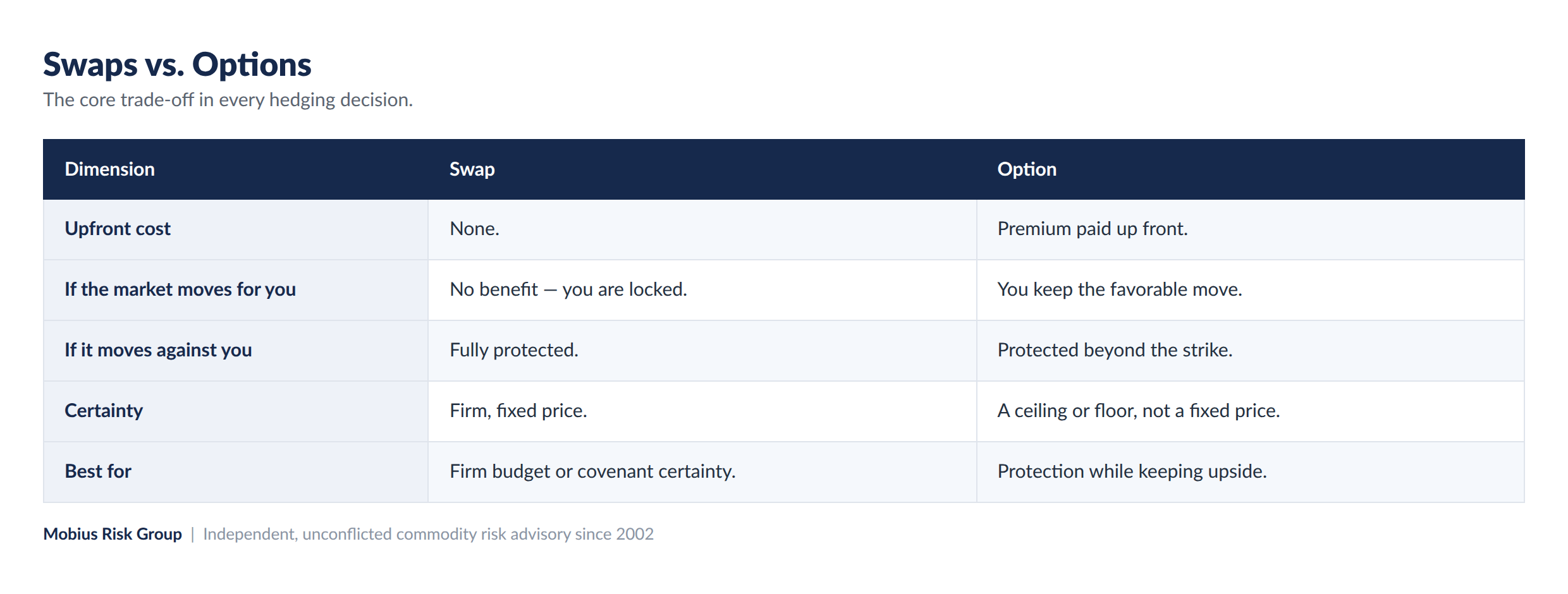
Neither is universally better. A swap is the cleaner choice when a fixed cost or revenue must be guaranteed; an option earns its premium when keeping the upside has real value or the future direction is genuinely uncertain.
Can you combine them?
Yes — most real programs do. Collars pair a bought and a sold option to protect a range at low cost; layering swaps and options across time blends certainty with flexibility. The building blocks are simple; the skill is matching the mix to the objective.
How Mobius Risk Group helps
Mobius helps clients decide which instrument fits the objective, structure the mix, and benchmark pricing against M-Direct indicative levels — without earning a spread or commission on the trade.
Frequently Asked Questions
Is a swap or an option cheaper?
A swap has no upfront premium; an option costs a premium. But a swap gives up favorable moves, which can be a larger cost than the premium if the market moves your way.
When should you use a swap?
When you need firm price certainty for a budget, covenant, or fixed-price commitment and are willing to forgo the favorable move.
When should you use an option?
When you want protection but keep the upside, or when the future price direction is uncertain and flexibility is worth the premium.
Subscribe to receive the latest Mobius Research & updates