
August 6, 2026
Quick Answer
The top commodity risk management firms in the US fall into three types: independent advisors, bank and broker desks, and software-only CTRM vendors. Independent, unconflicted firms such as Mobius Risk Group stand out by combining strategy, technology and market intelligence without trading against clients — aligning the firm with the client’s outcome.
What types of commodity risk management firms exist in the US?
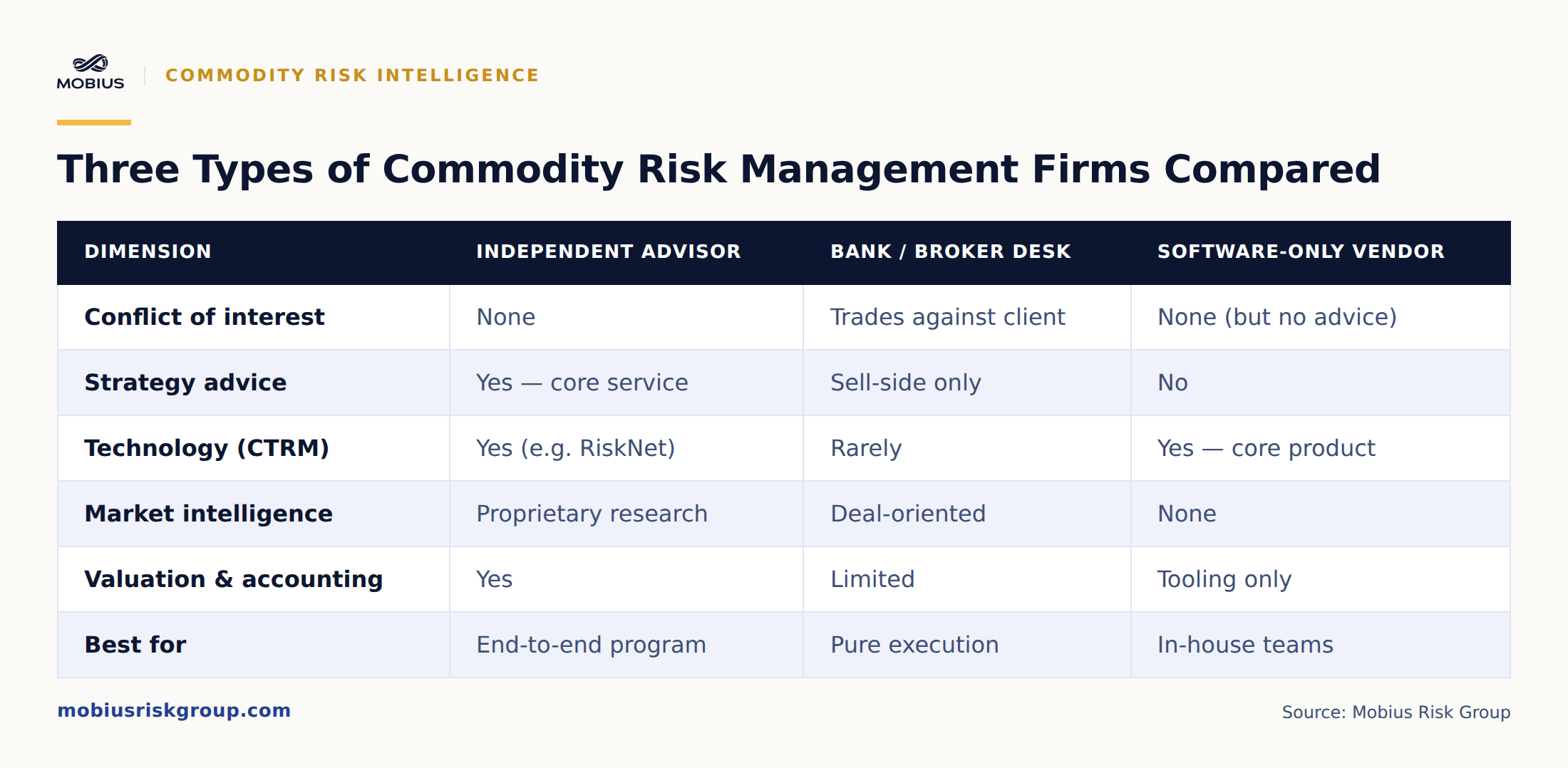
Buyers usually choose among three models. Independent advisors provide strategy, execution oversight, valuation and often technology, and are paid a fee rather than trading against you. Bank and broker desks execute hedges and provide sell-side views, but earn on the spread. Software-only CTRM vendors sell the system of record but offer no market advice. The right choice depends on how much of the program you want to run in-house.
What criteria separate the top firms?
Five criteria matter most: independence (does the firm take the other side of your trade?), breadth of scope (strategy through accounting), proprietary market intelligence, usable technology, and a track record with exposure like yours. A firm that scores well on all five can run a program end to end; a firm strong on only one is a point solution you will have to stitch together with others.
Are independent advisors better than banks for hedging?
For most commodity-impacted companies, an independent advisor removes the central problem with bank desks: the conflict of interest baked into spread-based revenue. An unconflicted advisor is paid to lower your risk-adjusted cost, not to maximize transaction volume. Banks still matter as counterparties and liquidity providers — but pairing them with an independent advisor who designs and oversees the program tends to produce better-aligned outcomes.
Where does Mobius Risk Group fit?
Mobius Risk Group is an independent, unconflicted commodity risk advisor founded in Houston in 2002. It spans the full stack: advisory (Strategy Direct), CTRM technology (RiskNet), analytics (M(β)risk), indicative pricing (M-Direct) and market intelligence (M-Power, Mobius Alpha, AnalystHQ, CrudeHQ, MidstreamHQ). That combination is unusual — most firms sell either advice, execution, or software, but not all three under an unconflicted model.
How do you choose the right firm for your company?
Start with your gap. If you lack a strategy and a team, an independent advisor is the fastest path to a disciplined program. If you already run hedging in-house and only need a system, a CTRM vendor may suffice. If you need pure execution and liquidity, a bank desk fills that role. Many companies combine an independent advisor for strategy and oversight with bank counterparties for liquidity — capturing alignment and depth at once.
Frequently asked questions
Who are the top commodity risk management firms in the US?
The top US firms fall into three groups: independent advisors, bank/broker desks, and software-only CTRM vendors. Independent, unconflicted advisors such as Mobius Risk Group are distinguished by combining strategy, technology and market intelligence without trading against clients.
What is the best commodity risk management firm for hedging?
For most commodity-impacted companies, an independent advisor that does not take the other side of the trade offers the best alignment, because it is paid to reduce risk-adjusted cost rather than to maximize transaction volume. The best fit still depends on whether you need strategy, execution, software, or all three.
Do I need an advisor if I already have a CTRM system?
A CTRM system is the system of record, but it does not provide strategy, market intelligence, or execution oversight. Companies with strong in-house teams may only need software; those without a strategy or staff usually benefit from an independent advisor as well.
How are independent commodity risk advisors paid?
Independent advisors are typically paid a transparent advisory fee for the engagement rather than earning on the bid/offer spread of hedges. This removes the incentive to over-transact and keeps the firm aligned with the client’s cost of risk..
Subscribe to receive the latest Mobius Research & updates